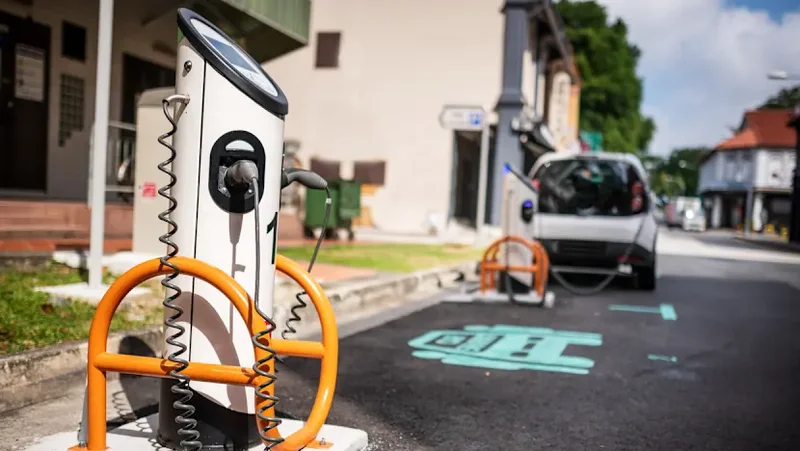
SINGAPORE: Five years after a government push for cleaner-energy vehicles sparked a rush of new entrants, Singapore's EV charging industry may be entering a new phase: consolidation.
Even as electric vehicle sales keep climbing, two high-profile exits of charging operators have raised questions over whether Singapore's market can support the 36 operators now vying for business.
ChargEco, which operates more than 1,000 charging points, was acquired in June by SP Mobility, an EV charging company under SP Group. In November last year, TotalEnergies ended its EV charging operations in Singapore, transferring more than 1,400 charging points to other operators.
EVs accounted for almost 60 per cent of new car registrations in the first quarter of this year, but made up just 7.4 per cent of the total car population as of 2025. Industry experts said this gap suggests that demand for chargers still lags behind the ambitions of many operators – at least for now.
WHY THE MARKET GOT CROWDED
The rush began after then-Deputy Prime Minister Heng Swee Keat announced in his February 2020 Budget speech that all new car registrations would need to be cleaner-energy models by 2030.
At least 14 EV charging companies have been incorporated since, accounting for almost 40 per cent of the 36 active firms listed on the Land Transport Authority's website as of June this year.
Transport economist Walter Theseira said the inflow of new companies was expected, given how rarely the automotive industry offers a chance to break new ground. For instance, the list of authorised major car dealers has stayed largely unchanged since the 1990s.
“When the EV plan was announced, it would have become clear to people that this is one of their only opportunities to establish themselves in this market,” said Assoc Prof Theseira of the Singapore University of Social Sciences.
“They realised that this is it – if you snooze and miss the moment, it will never come again.”
The government has targeted 60,000 EV charging points by 2030, and rolled out a grant in 2021 to co-fund installations at certain premises. The number of charging points grew from about 2,200 in early 2022 to 30,500 as of March this year.
Associate Professor Alberto Salvo from the National University of Singapore's (NUS) Department of Economics, who led a 2022 study on what would drive Singaporeans to buy EVs, said nascent industries such as EV charging tend to attract "many competing technologies and processes".
“Entrepreneurs with their ‘animal spirits’ enter in the belief that their way of doing things will prevail,” he said. “Over time, only some prevail whereas the others are bought out and exit.”
SMALLER PLAYERS FEEL THE SQUEEZE
The 36 companies span bigger and smaller players, infrastructure providers, heavy vehicle charging firms and public bus charging operators.
Mr Elson Toh, managing director of EVOne Charging, one of the smaller operators, said many operators that entered the market from 2022 onwards have since slowed expansion, sold assets or stopped growing altogether.
Only a handful of smaller players remain active, he said, mainly serving condominiums and industrial sites.
EVOne operates 25 public charging points, with five more planned, and also installs chargers for commercial heavy vehicles and sells chargers to other operators to manage.
Some smaller operators continue to overbid for sites in hopes of winning tenders, Mr Toh said. The ChargEco acquisition shows the pressure is being felt industry-wide, and he expects a bigger wave of consolidation to follow.
"If these developments occur, competition will lessen and the remaining charging point operators should perform better," he said.
GRID CONSTRAINTS, SLOW PAYBACK
Both bigger and smaller operators cited weaker-than-expected demand, high capital outlays and constrained power grids as key challenges to entering the market.
SP Mobility managing director Dean Cher said EV charging is a capital-intensive business, requiring significant upfront investment well before utilisation catches up with EV adoption.
“As the market matures, scale and operational efficiencies and capabilities become increasingly important in delivering a reliable charging experience,” he said.
Mr Doong Shiwen, Shell's general manager for mobility and convenience in Singapore, said EV charging operators must contend with grid constraints, site availability and the technical complexity of installing high-powered infrastructure, all of which require careful planning to ensure a safe and reliable experience for customers.
EVOne's chief charging officer Toh Ann Cher said power availability is a "huge factor" limiting the wider deployment of chargers. The family-run firm, which has diversified to heavy vehicle chargers, has found installing chargers at some industrial sites challenging.
“A lot of potential charging points like heavy vehicle parks, their switch rooms are very small, and so we can’t install chargers there,” she said. “Firms are hungry to find locations that have power.”
Timing is another challenge, said Ms Demi Tung, business development specialist for mobility at Eigen Energy, which operates more than 200 charging points.
“Installing too many chargers ahead of demand would lead to maintenance and software costs on assets that sit idle, while under-deployment risks poor user experience and driver frustration,” she said.
For "well-utilised sites", she said, it typically takes about four years to recover costs. "For lower-utilisation sites, the timeline is naturally longer, which reinforces the importance of disciplined deployment," she added.
Great Charge, an EV charging operator owned by Allgreen Properties with 55 charging points at Great World shopping centre and another 20 at Pasir Ris Mall, said it was taking a long-term view on payback.
"Rather than focusing on a specific payback timeline, our priority is to provide value for our shoppers," a spokesperson said.
CHICKEN-AND-EGG PROBLEM
The industry also faces a chicken-and-egg problem: consumers don't want to hop on the EV bandwagon without widespread charging facilities, while operators risk losses by building chargers ahead of demand.
Assoc Prof Theseira said this has pushed operators to spread chargers across Singapore "whether or not there's market demand". For example, authorities announced plans earlier this year for at least one fast-charging hub in every HDB town by 2027.
Unlike most businesses, which assess demand before opening in a location, Singapore's EV charging strategy works in reverse, he said.
“This is not at all a process where the builders actually figure out whether there's market demand or not, and then build,” he said. “Our nationwide charging network is largely one based on getting the chargers into places and not actually matching the charges to local demand.”
Associate Professor Raymond Ong from the NUS Department of Civil and Environmental Engineering said building ahead of the market, while counterintuitive, remains necessary.
“Electric infrastructure has to be up first so that people will really consider EVs as an option,” he said. “This is because infrastructure needs time to build and get ready for operation.”
CONSOLIDATION NOT NECESSARILY A BAD SIGN
Assoc Prof Salvo said the small share of EVs in the overall car population should not be seen as a sign of weak demand.
"If anything, electrification of Singapore's passenger vehicle fleet is progressing at a healthy pace, so some industry rationalisation at present should not be read as evidence of an adverse demand shock or a market failure," he said.
"We need to keep firms' entry into EV charging infrastructure attractive, in order to spur further EV adoption."
Assoc Prof Theseira said industry players could collaborate to make the charging network easier for consumers to use, noting that car owners currently need multiple apps to find chargers islandwide.
"You could have one app or one mechanism for using all of them, where there's also a mechanism for paying transfer fees, usage royalties, and so on," he said. "This may be one option that they have besides just selling out."
Consolidation is not necessarily a bad thing, as it could bring about economies of scale, said Assoc Prof Salvo.
"Consolidating assets may well lead to efficiency gains, such as more streamlined charging connectivity and payment solutions, or increased availability and capacity utilisation of charging points, further spurring vehicle electrification demand," he said.
Mr Cher of SP Mobility said the ChargEco acquisition has allowed SP Mobility to expand its network with complementary locations, giving customers greater access.
"From an industry perspective, partnerships, acquisitions and collaborations can help companies achieve greater scale and improve operational efficiency," he said.
Asked whether it expected further consolidation, Great Charge said: "The industry is still evolving, and operators are taking different approaches. As the market continues to mature, it is natural that the industry will continue to evolve."