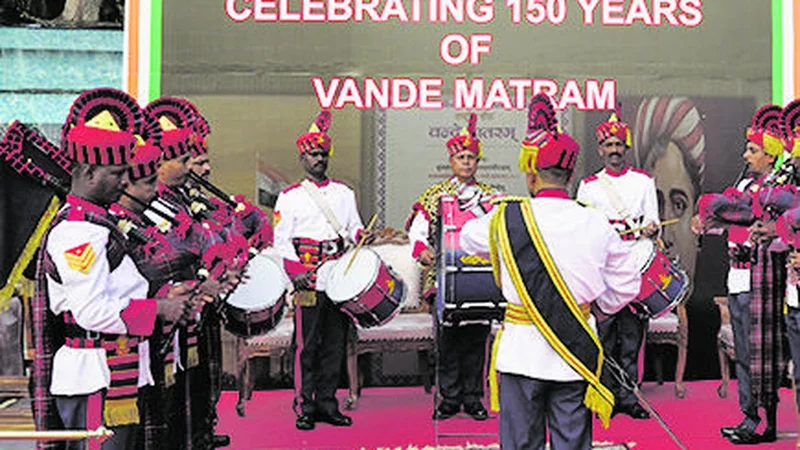
The story so far: The Rajya Sabha on July 24, 2026, introduced the Prevention of Insults to National Honour (Amendment) Bill, 2026, which seeks to extend statutory protection to Vande Mataram, the National Song, by amending the Prevention of Insults to National Honour Act, 1971. The Act currently criminalises insults to the National Flag, the Constitution and the National Anthem. This legislation is the culmination BJP government at centre’s year-long commemoration of the 150th anniversary of Vande Mataram and follows a series of government measures, including protocols for its rendition and directives to States regarding its observance.
What does the Bill say?
The Bill seeks to amend Section 3 of the Prevention of Insults to National Honour Act, 1971, which currently penalises anyone who intentionally prevents the singing of the National Anthem (Jana Gana Mana) or causes disturbance to an assembly engaged in its singing.
The amendment extends the same protection to Vande Mataram. If passed, intentionally preventing the singing of the National Song or disrupting a gathering engaged in its rendition would become a criminal offence punishable with up to three years’ imprisonment, a fine, or both. Repeat offenders would face a minimum prison term of one year, as is currently the case for offences relating to the National Anthem.
The government has justified the amendment by citing Constituent Assembly President Rajendra Prasad’s statement on January 24, 1950, in the statement of objects and reasons for bringing the bill, that Vande Mataram, which played a historic role in the freedom struggle, would enjoy a status equal to that of the National Anthem. It argues that while the National Song enjoys equal honour, there is currently no specific legal provision protecting it from disruption or insult.
What has been the historical stance on Vande Mataram?
Vande Mataram was written by the Bengali writer Bankimchandra Chattopadhyay in 1882. The song, particularly its first two stanzas, became a powerful symbol of anti-colonial nationalism, particularly during the Swadeshi movement following the partition of Bengal in 1905.
However the later stanzas of the song, even during the colonial era, were opposed by sections of Muslim community and several Congress leaders. The subsequent verses personify India directly as a Hindu goddesses specifically Durga and Lakshmi. And additionally, the stanzas feature militant battle imagery and temple references that many argued could alienate non-Hindu communities playing into the hands of the British policy of deepening the communal divide.
The debate culminated in a Congress Working Committee meeting in Calcutta in October 1937. Far from being a decision taken solely by Jawaharlal Nehru, the 1937 resolution was endorsed by many of the leading figures of the national movement. Rajendra Prasad moved the resolution and Vallabhbhai Patel seconded it. Gandhi attended as a special invitee. The meeting also involved consultation with Rabindranath Tagore, who advised that only the first two stanzas should be used for public and ceremonial purposes because they celebrated the country without invoking specific religious imagery.
The Congress Working Committee unanimously accepted that view and decided that only the first two stanzas should be used at national gatherings. This settlement subsequently shaped the approach of the Constituent Assembly. On January 24, 1950, Rajendra Prasad announced that Jana Gana Mana would be the National Anthem and that Vande Mataram would be honoured equally because of its role in the freedom struggle. However, the Assembly did not place the National Song on the same constitutional footing as the National Anthem. Critics of the current Bill note that the Assembly effectively adopted only the first two stanzas for official purposes and did not incorporate the later religious verses into the constitutional framework.
The distinction continued after Independence. Article 51A(a) of the Constitution requires citizens to respect the National Flag and National Anthem but does not mention the National Song. Similarly, the Prevention of Insults to National Honour Act, 1971, protects the National Flag, Constitution and National Anthem but does not extend penal protection to Vande Mataram.
Courts have also recognised this distinction. In Bijoe Emmanuel (1986), the Supreme Court protected the right of students to refrain from singing the National Anthem on grounds of conscience, provided they stood respectfully. In 2017, the Supreme Court observed that while the Constitution recognises the National Anthem, there is “no concept of a National Song” in law.
What are the Opposition’s objections?
Congress the principle opposition party sees this as another measure of the BJP government to further the “hindutva project” and another attempt to redefine Indian nationalism in explicitly Hindu majoritarian terms.
Congress leaders accused the BJP of misrepresenting the history of the 1937 decision to limit official use of Vande Mataram to the first two stanzas. During a Rajya Sabha debate on the song’s 150th anniversary, Congress’s general secretary (communication) and party Chief Whip in Rajya Sabha Jairam Ramesh argued that the decision was endorsed not only by Jawaharlal Nehru but also by Mahatma Gandhi, Sardar Vallabhbhai Patel, Rajendra Prasad, Maulana Azad, Subhas Chandra Bose, Govind Ballabh Pant and Acharya Kripalani. He cited correspondence between Rajendra Prasad, Patel, Bose and Rabindranath Tagore in 1937 and argued that portraying the decision as “appeasement” amounted to questioning the judgment of many leaders of the freedom movement. Ramesh also pointed to Tagore’s role in recommending that only the first two stanzas be used for national purposes.
CPI(M) Rajya Sabha MP John Brittas, who opposed the introduction of the Bill in Rajya Sabha argued that the Constitution and Parliament deliberately chose not to place the National Song and the National Anthem on the same legal footing. He contends that Rajendra Prasad’s January 24, 1950 statement that Vande Mataram would be “honoured equally” with the National Anthem did not have constitutional force because the Constituent Assembly adopted no formal resolution conferring identical legal status on the two.
Mr. Brittas has further argued that Article 51A(a), which lists Fundamental Duties, requires citizens to respect the Constitution, the National Flag and the National Anthem, but does not mention the National Song. Parliament reflected this distinction in the Prevention of Insults to National Honour Act, 1971, by granting penal protection only to the National Anthem. Criminalising conduct relating to Vande Mataram, he argues, would infringe freedoms protected under Articles 14, 19(1)(a), 21 and 25 of the Constitution, including freedom of speech, conscience and religion.
The legal activists criticised the Centre’s January 28, 2026 protocol order, which directed that all six stanzas of Vande Mataram be played at certain official functions and that attendees stand at attention. They argue that the order overturns the 1937 political settlement limiting official use to the first two stanzas and runs contrary to the Supreme Court’s judgment in Bijoe Emmanuel vs State of Kerala (1986), which held that citizens cannot be compelled to participate in patriotic observances against their conscience. In that case, the Court ruled that students who stood respectfully during the National Anthem but declined to sing it were protected by their rights to free speech and freedom of religion. Critics argue that if citizens cannot be compelled to sing even the National Anthem, which has constitutional and statutory protection, they cannot be compelled to participate in the singing of the National Song, which has neither.
Muslim organisations such as the All India Muslim Personal Law Board, Jamiat Ulama-i-Hind and Jamaat-e-Islami have expressed concerns that attempts to make the song effectively compulsory could violate constitutional guarantees of freedom of conscience and religion, particularly because later stanzas invoke Hindu deities.
Published - July 28, 2026 10:58 am IST