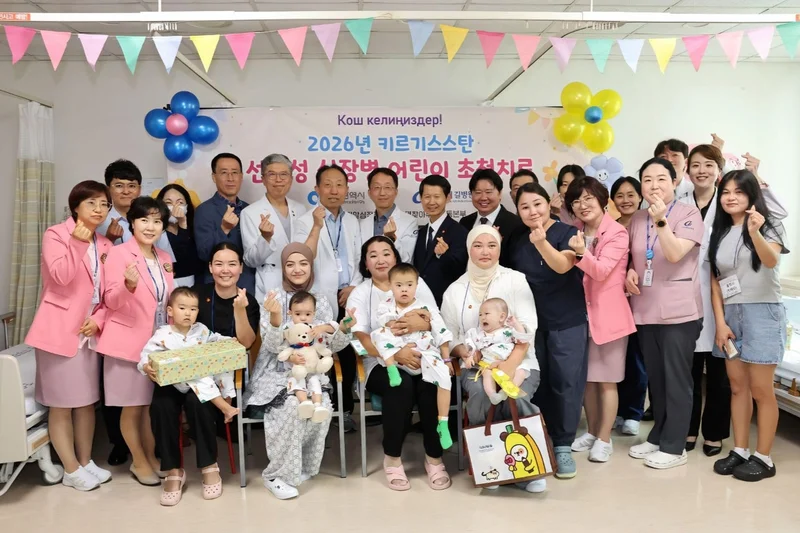
When 6-year-old Akzhol was born in Bishkek, Kyrgyzstan, doctors immediately detected a ventricular septal defect alongside a complex pulmonary condition. But in a household of six children with modest means, the lifesaving heart surgery he desperately needed felt impossibly out of reach.
When news reached his mother, Zheenkul, 44, that a city in Korea was offering to cover everything — from international airfare to specialized surgery and hospital stays — she hesitated.
“I couldn’t believe it was completely free at first,” Zheenkul recalled. “It was only after speaking multiple times with the family of a child who had undergone surgery through the same program last year that I finally gained the confidence to travel to Korea.”
Akzhol’s successful procedure in July was made possible through the city of Incheon’s Asian Exchange Cities Medical Support Program. Celebrating its 20th year, the initiative represents a distinct brand of human-centered local diplomacy. Rather than focusing solely on trade pacts or cultural exchanges, municipal authorities team up with local hospitals and civil organizations to deliver lifesaving care to impoverished children in partner cities across Asia.
The program relies on a collaborative medical framework.
Incheon City funds round-trip travel, local transportation and logistical expenses. Partner medical centers, led by Gachon University Gil Medical Center, contribute expert surgical teams and cover hospital care costs. Nongovernmental organizations, including the Milal Heart Foundation, assist on the ground from patient identification to international travel logistics.
The pipeline begins abroad: medical teams travel directly to partner regions to screen young patients, bringing those facing critical congenital conditions to Korea for advanced care. Over the past two decades, doctors have examined 6,792 patients locally and brought 175 children — from nations including Vietnam, Cambodia, Uzbekistan, Mongolia and Kyrgyzstan — to Incheon for life-changing operations.
In May, medical personnel visited Bishkek to evaluate 55 children, ultimately selecting four for surgery in Korea based on medical urgency and long-term recovery prospects. Among them was 2-year-old Rinat, whose severe heart condition caused cyanosis — turning his fingers and lips blue. Following his operation in Incheon, the blue tint faded, replaced by a healthy, rosy complexion.
“It felt like God chose our child,” Zheenkul said as Akzhol rested comfortably in the ward, eating and sleeping well for the first time. “I hope he grows up healthy enough to become a swimmer.”
For the surgical team, watching a child’s health transform offers the deepest reward.
“We feel immensely fulfilled working together with the city and civic groups to help these children reclaim healthy lives,” said Dr. Choi Chang-hyu, a professor of cardiovascular and thoracic surgery at Gil Hospital who performed the procedures. “The most touching moments are seeing children we operated on years ago grow up to become confident, thriving members of society.”
As the four young Kyrgyz patients prepared to fly home, municipal leaders emphasized that the medical initiative remains a cornerstone of the city’s international vision.
“Saving a child’s life means saving a nation’s future and planting deep roots of solidarity,” said Incheon Mayor Park Chan-dae. “We will continue to expand our support to fulfill our responsibility as an international city practicing compassion beyond borders.”
This article was published with the assistance of generative AI and edited by The Korea Times.