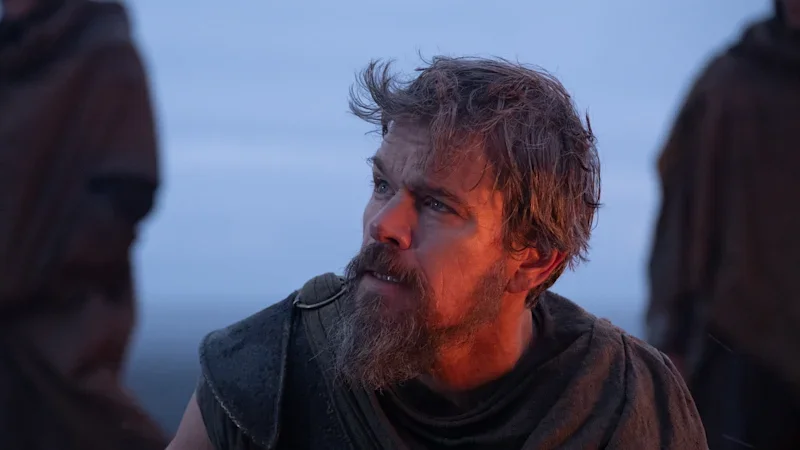
Is the movie as good as the book? The question always arises when a filmmaker adapts one of our favourite texts. Not many book-based movies turn out better than the works that inspired them. Jaws and The Godfather spring to mind as rare examples. But most of the time we find ourselves lamenting the movie’s failure to reproduce all the marvellous mental pictures we imagined when reading the book.
Christopher Nolan’s adaptation of Homer’s Odyssey is a remarkable piece of old-school epic filmmaking – vast, visceral, and visually breathtaking. But does it do justice to the book?
To answer that question, we’d first better establish exactly which “book” we’re talking about. Few of us are equipped to read Homer’s Odyssey in the original Greek. Unless we are, the book we measure Nolan’s film against will have to be a translation. And whichever translation we read, it too will be a kind of adaptation, marred by its own compromises and trade-offs and deviations from the original text.
In Homer’s case, the “original text” is a slippery concept anyway. Homer’s two-verse epics, The Iliad and The Odyssey, were products of a pre-literate culture. They weren’t written for publication on paper, or even papyrus. They were composed to be memorised and sung by travelling bards, whose role in Greek culture was analogous to the role that touring entertainers play in ours.
The earliest surviving written fragments of The Odyssey date from around 300 BCE — that is, about five centuries after the poem began circulating orally. Today’s standard Greek text, reconstructed from the various ancient fragments and medieval manuscripts that have come down to us, represents the scholars’ best stab at what the original work might have looked like.
But since those sources date from so long after the poem’s inception, it’s fanciful to believe that they constitute an exact record of Homer’s original words. In the course of being orally transmitted from one generation to the next, his poem inevitably would have been reshaped – even, perhaps, improved.
Indeed, some scholars doubt that Homer existed at all. Ancient Greek tradition had it that he was a blind bard from Ionia, possibly descended from one of the Muses. Modern scholars tend to believe he was a mythical figure, invented in retrospect to serve as the lone author of works that were, in truth, communal creations.
Even if Homer existed, he didn’t invent the stories told in his poems. He recycled tales that were already staples of Greek tradition. The Iliad tells the story of the Trojan War, which may or may not have been a real historical conflict. The Odyssey recounts the long journey home from that war of the Greek warrior Odysseus.
Whoever wrote them, the genius of Homer’s epics lay in the language they used to tell those stories – a language so powerful that the poems became the foundation stones of Western literature, and are still reverberating through our culture three millennia later.
Ninety-odd years ago, Jorge Luis Borges wrote an essay about the trickiness of reading The Odyssey called “The Homeric Versions.” Because he couldn’t read it in the original Greek, Borges found that The Odyssey was, for him, less “a uniform monument” than “an international bookstore of works in prose and verse.”
Homer’s influence on Western culture runs so deep that we often allude to him without even knowing it.
The bookstore evoked by Borges didn’t just contain a multitude of translations, “all of them sincere, genuine, and divergent.” It also contained an endless array of other books and poems and plays inspired by Homer’s work. Other artists have been freely adapting and tinkering with Homer’s stuff for centuries: not out of disrespect for it, but because its simple human power makes it eternally relevant.
When the ancient Romans reworked Homer’s tales, they gave Odysseus a new name, Ulysses. They also renamed most of the gods who feature in Homer. Zeus became Jupiter, Poseidon became Neptune. The only Greek god whose name the Romans didn’t change was Apollo.
A few decades before the birth of Christ, the Roman poet Virgil retooled Homer’s works for Latin readers in his Aeneid. He compressed the stories of Troy and the Odyssey into a single epic poem, and invented new characters to bridge the gap between Homer’s narratives.
Nolan takes similar liberties in his movie. The character of Sinon, played by Elliot Page, has a small but vital role in Nolan’s story, but Sinon doesn’t appear in Homer at all. He’s an invention of Virgil’s, whom Nolan appropriates and puts to eloquent use of his own.
Homer’s influence on Western culture runs so deep that we often allude to him without even knowing it. When we use the word “siren,” or worry about Trojan-horse malware, we’re borrowing from Homer.
We do the same when we refer to any arduous journey as an “odyssey.” This word didn’t predate Homer; Odysseus wasn’t called that because he went on an odyssey. His name comes from the Greek word for pain or vexation. The English word “odyssey” was coined centuries later, in conscious homage to Homer.
Indeed, Homer’s poem isn’t called The Odyssey in Greek. Its Greek title is Odysseia – meaning the story or song of Odysseus. Early English translations echoed this usage. George Chapman’s 1614 translation was called Homer’s Odysses. Thomas Hobbes used the same title for his 1673 translation.
Related Article
Alexander Pope, who rendered the poem into heroic couplets in 1725, was the first English translator to call it The Odyssey of Homer. But Pope still didn’t mean “odyssey” in our modern sense. He meant it as an English equivalent for “story of Odysseus.” It wasn’t until the next century that “odyssey” was first used as a generic word for journey.
English poets have been riffing on Homer for centuries. I first encountered Homer when my Year 7 English class studied John Keats’s sonnet On First Looking Into Chapman’s Homer — that staple of the high school syllabus, in which Keats describes having his mind blown by Chapman’s translation.
William Shakespeare was inspired by Chapman’s Homer too. After Chapman published a partial translation of The Iliad in 1598, Shakespeare wrote his strange and rarely performed play Troilus and Cressida. Shakespeare’s take on the Homeric material was subversive — his scurrilous clown Thersites dismisses the entire Trojan War as a falling-out between “a cuckold and a whore.”
James Joyce made similarly ironic use of Homer in his Ulysses. That novel’s hero, Leopold Bloom, spends a day wandering the streets of Dublin. To give Bloom’s journey shape and resonance, Joyce turned it into a modern parody of the Odyssey. In Homer, Odysseus must defeat Polyphemus, the fearsome one-eyed giant. In Ulysses, Bloom tangles with a metaphorically one-eyed Irish bigot called The Citizen. In Homer, Odysseus is tempted by the song of the sirens. Joyce’s Bloom is tempted by a couple of barmaids in a pub.
Compared with Shakespeare and Joyce, Christopher Nolan plays the Homeric material straight. Is his movie as good as the book? The question has two meanings, when you think about it. It doesn’t just mean, “Does the movie measure up to the book?” It can also mean, “Is the movie as good a movie as the book is a book?”
Editor's pick
If you can arrange to see Nolan’s film on as big a screen as possible — preferably an IMAX one — you may feel that the answer is yes. Like Homer, Nolan catches the sweaty and brutal spirit of the Greek myths by pushing the resources of his art to strenuous extremes. Homer immortalised those myths by using the most potent medium available to him — language, pushed to its lyrical and heroic limit.
Nolan, to make his Odyssey, has hauled massive IMAX cameras to some of the most forbidding locations on earth, and captured some of the most stunning landscape shots in cinema’s history. Watching his tiny and fragile human characters move across wind-pummelled cliffs and beaches, and contend with roiling oceans, you viscerally understand why the ancients thought the elements were controlled by angry gods.
Would Homer have liked Nolan’s film? If he existed, and could see, I think he would have.
What else is happening in the book world?
- A split-second mistake sent author Jaclyn Moriarty on a two-decade literary odyssey.
- The legendary cinematographer for Blade Runner 2049,FargoandSkyfalltakes us behind the lenses in his new memoir.
- Here’s why you should keep re-reading your favourite book (without feeling guilty).
- And there’s a new word for when a media empire targets you
The Booklist is a weekly newsletter for book lovers from Jason Steger. Get it delivered every Friday.
Continue this series
The Odyssey##### Up next
Can’t tell your Zeus from your Zelus? Or think Scylla is some kind of hip-hop fusion band? Don’t worry, we’ve got you.
The British director has released 13 widely acclaimed films, collectively winning 18 Academy Awards along the way. But one is the greatest of them all.
Previously
- ★★★★
With a build-up filled with controversy and nit-picking, does Christopher Nolan’s big-budget epic rise above the discourse?