Unpacking the ‘I’ in MICE: Why global firms are choosing Singapore for incentive trips
SINGAPORE – In June, a delegation of around 150 global policymakers, chemical industry consultants and corporate executives boarded a convoy of coaches in the lobby of the Hilton Singapore Orchard – destination unknown.
Armed with only the brief to “ditch the business casual, wear comfortable footwear”, the group, in town for the biennial ChemCon Asia conference, was driven straight to the lush, green heart of the island: the Mandai Wildlife Reserve.
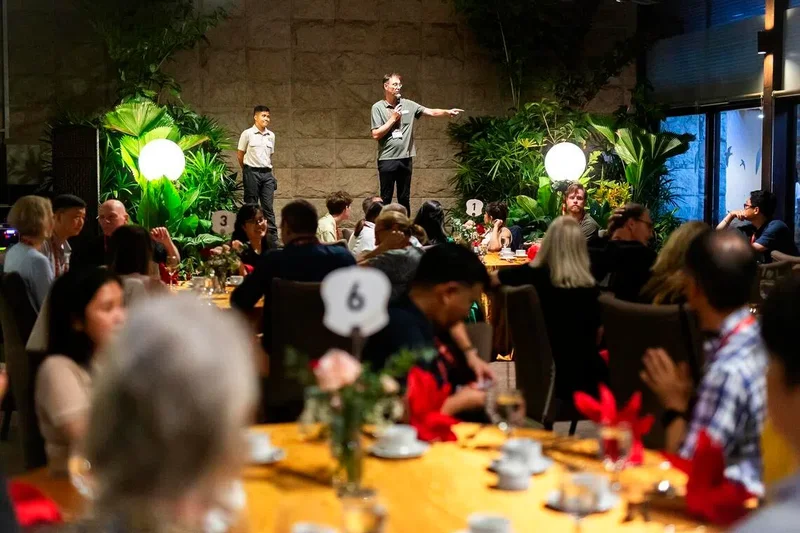
What followed was a private, after-hours journey through the precinct. Delegates had River Wonders to themselves, attended a cocktail reception against the backdrop of the Amazon Flooded Forest, dined at the Singapore Zoo’s Forest Lodge, and capped the night aboard dedicated trams through the Night Safari.
This exclusive, “money-can’t-buy” evening was not a random field trip but a carefully orchestrated play in one of Singapore’s most lucrative, yet little understood, business sectors: incentive travel.
Incentive events are corporate travel programmes designed to recognise and reward a company’s top-performing employees or business partners.
They fall under the MICE umbrella (meetings, incentives, conventions and exhibitions), which recorded a 35 per cent jump in tourism receipts to $2.3 billion in 2025.
Corporate business events account for roughly a quarter of Singapore’s MICE sector, with incentive trips making up about half of this, according to the Singapore Tourism Board (STB).
These events range from intimate retreats for 20 people to mega-incentives like Amway China’s 10,000-strong gathering in 2024 and Indian pharmaceutical giant Sun Pharma’s 6,100-delegate event in 2025.
Mexican nutritional supplements company OmniLife will bring another 2,000 attendees from its Latin American division in November 2026.
While absolute figures were not disclosed, Singapore’s volume of incentive business has remained steady, said Carrie Kwik, executive director of conventions, meetings and incentive travel at STB.
Because corporate groups typically rotate destinations to keep rewards fresh, it can take several years for organisers to return.
“Unlike some international association meetings, there is a stronger possibility of corporate meetings and incentives returning to a destination,” said Kwik. “Rather than signalling a decline in interest, this dynamic rotation creates a steady pipeline of new groups.”
Large-scale, months-long events
While some corporations rotate cities every few years, others opt for long-tail events that unfold over months.
Japan’s Katsumata Group selected Singapore for its 100th-anniversary incentive programme, bringing about 2,200 employees over nearly a year, from June 2025 to May 2026. To avoid disrupting daily operations across the automotive and logistics group’s retail and service branches in Japan, the company rolled out the trip in 14 distinct “waves”.
This meant sending 150 to 170 delegates each week on four Singapore Airlines flights from Haneda and Narita airports for a five-day, three-night itinerary. The campaign generated roughly 3,400 hotel room nights at Conrad Singapore Marina Bay.
“The 100th anniversary presented an opportunity for us to express our gratitude to our employees,” said Kazuyuki Narawa, spokesman for Katsumata Group.
“We prioritised a destination where every employee could feel they were part of a truly special occasion… alongside (a destination that provided) the operational reliability required for a large-scale trip.”
The itinerary mixed local experiences – like visits to hawker centres during the day – with exclusive events like a private dinner party at the Night Safari. Behind the scenes, dedicated airport check-in counters, custom in-flight headrest covers and tailored hotel welcome arrangements made staff feel valued, said Narawa.
‘Money-can’t-buy’ moments
Delivering these moments for hundreds or thousands of delegates simultaneously requires months of back-of-house orchestration.
“Today’s high-net-worth corporate groups are looking far beyond traditional sightseeing and gala dinners,” said Jezz Wu, executive director for events and experience design at destination experience agency REALM.
“They want experiences that feel exclusive, immersive and genuinely connected to the destination... Clients are constantly seeking fresh venues and unique settings.”
To deliver that exclusivity, planners pull off structural and culinary feats, including constructing custom, all-weather pop-up structures over three weeks, only to dismantle them two days post-event, or collaborating with acclaimed local chefs to curate one-off menus.
Behind the scenes, planners act as shock absorbers for constant operational shifts and disruptions, from fluctuating flight manifests to sudden weather changes.
“One seemingly simple change can create a ripple effect across multiple suppliers, venues, transport providers and operational teams,” said Wu. “The true value lies in anticipating challenges, adapting quickly and ensuring the delegate experience remains flawless.”
Easing cost pressures
To help organisers manage logistics without compromising quality, STB funds three key support schemes.
Through INSPIRE Global 3.0, international corporate groups of 20 to 250 delegates receive complimentary curated experiences at more than 30 venues across attractions, dining, team building and thematic tours.
For broader cost savings, SMAP 5.0 brings together 14 partners, including Klook, Expedia and ION Orchard, to offer organisers and delegates complimentary gifts and discounts across retail, accommodation and sustainability initiatives.
Meanwhile, the SHINE hotel programme partners with 22 MICE-focused properties, representing roughly 25 per cent of Singapore’s room inventory, to offer preferential room rates.
Icons double as event spaces
Major tourist attractions here have also evolved from standard sightseeing stops into fully integrated MICE destinations.
“We’re seeing increasing interest from corporate planners in experiential incentive travel,” said Jean Choi, chief sales officer at Mandai Wildlife Group. “Guests can enjoy dining alongside wildlife encounters or gain behind-the-scenes access to animal care work – all experiences unique to our precinct.”
She added that Mandai is positioning itself for multi-day corporate stays through new infrastructure like the Mandai Rainforest Resort by Banyan Tree, glamping options and the forest-themed Green Canvas event space.
To accommodate large groups while maintaining public access, venues like River Wonders and multimedia attraction Exploria are available for private, after-hours buyouts.
A similar trend is unfolding at Gardens by the Bay, where corporate organisers are increasingly seeking “eminently shareable” programmes.
“Hosting an event here means anchoring their programme at a globally recognised icon, not merely a venue,” said Linda Tay, Gardens by the Bay’s senior director of programming.
Travellers attending MICE events typically spend around twice as much as leisure visitors, according to STB.
Tay highlighted how companies are combining multiple attractions, such as pairing gala dinners at the Flower Dome with private, after-hours light shows at Supertree Grove, complete with customised music segments, to create bespoke journeys for their delegates.
From corporate boot camp to the forest
Such curated experiences are particularly vital for demanding corporate programmes, where delegates risk burnout.
When ChemCon Asia 2026, hosted around 150 C-suite executives and policymakers at the Hilton Singapore Orchard in June, attendees went through an intense daily “boot camp” of meetings and presentations from 8am to 7pm. To weave Singapore into the delegate experience, conference director Tjeerd Bokhout looked beyond the traditional set-up.
The centrepiece was a surprise mid-week excursion to Mandai, complemented by a daily in-house television programme featuring snippets of the day’s events and insights into Singapore, broadcast straight to delegates’ hotel rooms.
“We have content throughout the week, but connecting people is essential,” said Bokhout. “Instead of sitting in a conference room, you walk through River Wonders, you sit next to someone on a tram ride through the Night Safari, and you have an experience to talk about.”
He noted that the strategy paid dividends. Despite the packed agenda, many delegates chose to extend their stays over the weekend to explore Singapore on their own.
Currency of trust
Ultimately, while regional rivals can compete aggressively on price and the availability of natural attractions, industry players agree Singapore’s edge rests on a foundation that is harder to replicate: trust, safety and operational predictability.
“For planners managing large groups, cost is just one consideration among many,” said STB’s Kwik. “Risk mitigation, access to medical services and overall safety infrastructure become increasingly important at scale.”
That operational certainty is backed by a mature ecosystem of local suppliers.
“Service providers here operate to exceptionally high standards,” said REALM’s Wu. “They place a strong emphasis on risk management and contingency planning. When managing events of scale, that level of operational maturity makes a significant difference.”
For corporate clients like Katsumata Group, that reliability ensures an event delivers on its promise.
“Its air connectivity, high-quality hotels and venues created a stable environment, allowing employees of all ages to participate with peace of mind,” Narawa said.
Kwik said: “If there’s one thing that sets Singapore apart, it is the ability to deliver an extraordinary range of experiences within a couple of hours, without the logistical friction.
“But perhaps the most important X factor is one that is harder to quantify: trust. Planners who bring their delegates to Singapore know what they are getting... That consistency, and the confidence it inspires, is what keeps Singapore on the shortlist.”