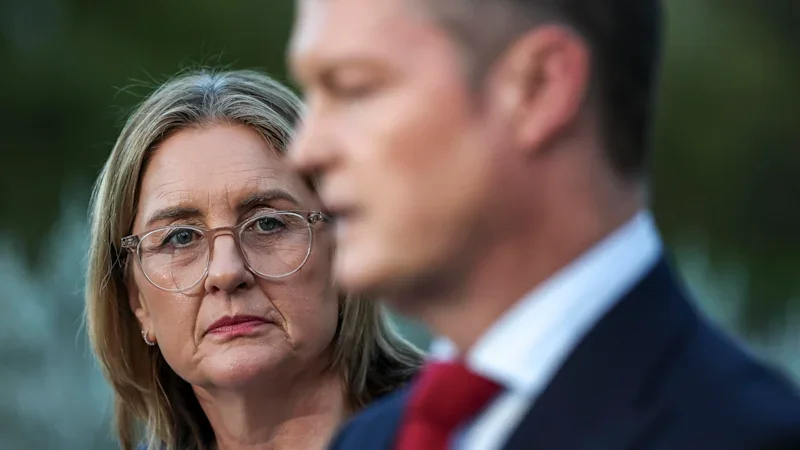
Of course Jacinta Allan resigned at the last moment. She had been around long enough to know the score.
Ever since Shakespeare placed the words “Et tu, Brute?” in the mouth of Julius Caesar at the moment of his assassination, a theatrical formula is followed at forced political departures.
Denial meets all suggestions there is a plot, usually for weeks.
And so it was six weeks ago that Ben Carroll declared to Allan, in her presence and the glare of television cameras, that he could look his premier in the eye and tell her he was not going to ask her to step aside. “I want to serve Jacinta Allan,” he said.
Today, he is the premier.
The script requires generic utterances of loyalty to the end.
Last Friday, Government Services Minister Ingrid Stitt said publicly she supported Allan, that no one had raised the spectre of a leadership challenge with her, and that Victorians didn’t want to be focused on idle gossip.
All the while, like rising mist, the play commands that meetings are known to be occurring “behind closed doors”.
Finally, the thrust of the dagger, amid feigned surprise that friendship and allegiance were not quite what they were cracked up to be. “Et tu, Ben?”
Allan’s last-minute resignation, making way for an “orderly transition”, is simply part of the theatre.
The factional arm-twisters and the would-be leg-breakers traditionally visit at the last minute, barely needing to describe to the soon-to-be victim the ugliness that would accompany the unfortunate requirement to actually apply the knife. Such was the case for Allan, who was paid a visit not once but twice on Monday, to be informed of the fate they told her was already sealed.
Though the 49th premier of Victoria talked about being a fighter up to Tuesday morning, her own political instincts surely meant she didn’t need the leg-breakers to go into much detail at all.
The victors, when the messy business is done, tend to rear with self-righteousness if called out.
In 1983, Bob Hawke, fresh from replacing Bill Hayden as leader of the federal opposition after months of plots and destabilisation, turned like a maddened cockatoo on Richard Carleton when the late ABC journalist dared to open his interview with the deathless words: “Mr Hawke, can I ask you if you are embarrassed at the blood that’s on your hands?”
“It’s a ridiculous question, and you know it’s ridiculous,” Hawke spat, declaring Carleton was a “damned impertinence”.
Almost a decade later, Hawke himself became the first Labor prime minister to be removed from office by his colleagues after Paul Keating took him on and marshalled a small army of intriguers.
Hawke was in ostentatious denial until the very end, inviting journalists to Christmas drinks at The Lodge and merrily mouthing plans for the new year over a foaming tankard of non-alcoholic beer (“cat’s piss”, he called it) while his senior ministers met secretly only a few blocks away to nail down his political demise.
The following day, Hawke was gone.
We remain transfixed all these years later by the manner of Hawke’s coming and going because the killing floor was so exotic and on unusual full display at the time, at least for the Labor Party.
The Liberals had gotten into the swing of things after Bob Menzies chose his own time to leave and his successor, Harold Holt, went for a fateful swim.
But even then, something approaching niceties applied. John Gorton used his own casting vote to end his prime ministership in 1971 when his party room was locked on a no-confidence motion against him.
The Liberal knives got a big workout during their long years of opposition, when Andrew Peacock and John Howard set about destroying each other – once, memorably, when the transcript surfaced of a most colourful mobile phone conversation between Peacock and Victoria’s then premier Jeff Kennett. Peacock declared he had told Howard: “You’re a c---. You haven’t got my support, you never will have.”
Later, with Peacock and Howard offstage, exhausted and resting in the wings, Malcolm Turnbull displayed his combative streak when Brendan Nelson defeated him in their first opposition leadership ballot. Furious, the former merchant banker burst into Nelson’s office and delivered a character assessment that included the words “wimp” and “toughen up”.
Turnbull, of course, went on to bring down Tony Abbott, only to be brought down himself by Scott Morrison, who knew the Julius Caesar script by instinct.
Who could forget the former member for Cook’s fawning over Turnbull, declaring he had only ambition for Turnbull’s prime ministership, only to manoeuvre himself into the job within hours. Et tu, Scott? Of course.
Meanwhile, the Labor Party in Canberra spent the 1990s and the first decade-and-a-half of the 21st century perfecting the art of the political knife. Beazley, Crean, Latham, Beazley, Rudd, Gillard, Rudd.
By the end of it all, the script was so worn and heavily spattered with blood that Anthony Albanese replaced it with a user’s manual packed full of caution warnings.
Back in Victoria, there was only the memory of the quick political liquidations of Ted Baillieu and Denis Napthine to compare, and neither did, really.
It took Daniel Andrews’ legacy, a line-up of thugs and standover merchants intent on milking dry Labor’s Big Build, the investigative energy of The Age’s incomparable journalist Nick McKenzie, a swivel from the spectre of a seriously embarrassing royal commission, a looming state election and a confusion of voter revolts to bring Jacinta Allan to her nadir, and a political destiny dramatised 427 years ago by Shakespeare concerning the sudden expiration of a Roman ruler more than 2000 years ago, to bring this sorry story to its fateful end.
More: