The Galaxy Z Fold 8 won me over with 3 upgrades no one's talking about
Jul 28, 2026 — 5:30 AM ET
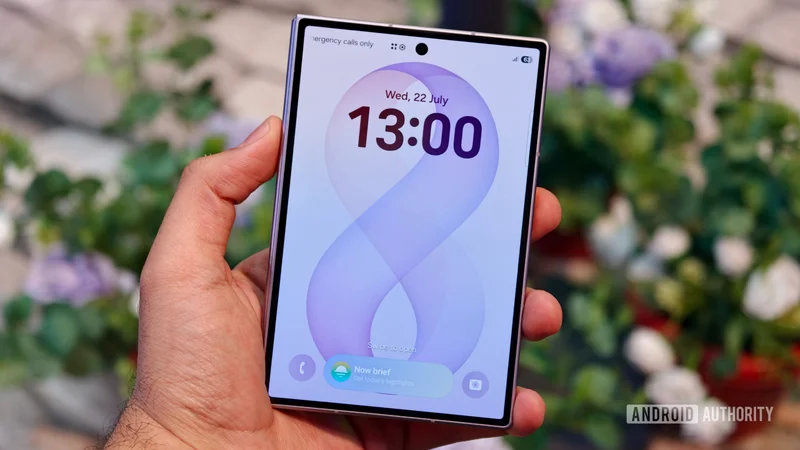
It finally happened. The ‘wide’ Samsung Galaxy Z Fold 8 is officially here, marking the company’s first foldable in a passport-style form factor. It’s shorter than the standard Galaxy Z Fold phones we’ve seen over the years and noticeably wider, which means it truly opens into a tablet-like form factor when unfolded.
Initially, I assumed Samsung was doing this purely to get ahead of Apple’s foldable iPhone Ultra arriving later this year. And on the surface, it’s easy to look at the new aspect ratio, call it the whole story, and write the Galaxy Z Fold 8 off as a lazy attempt at beating Apple to the punch. But that’s not actually the case.
I’ve now had some hands-on time with the Galaxy Z Fold 8, and while the new aspect ratio has definitely won me over, there are three other upgrades on this foldable that no one is really talking about. In fact, those are the changes that impressed me the most during my short time with the device.
Which Galaxy Z Fold 8 upgrade matters most to you?
The crease finally fades into the background
If you’ve ever picked up or used a Samsung foldable before, you’ll know just how noticeable the crease on Galaxy foldables has been. Even some of Samsung’s older Chinese competitors, like the OPPO Find N5, had a much less visible crease than the Galaxy Z Fold 7.
Sure, it’s something you gradually stop noticing as you use the phone, but hand a Galaxy Z Fold to someone who’s never used a foldable before, and the crease is almost always the first thing they’ll point out. Thankfully, Samsung has finally addressed that with the Galaxy Z Fold 8 series.
The company says it has re-engineered the internal display, calling the new panel Flex Titanium. Thanks to the titanium design, it’s more durable and slimmer than before, and it also allows for a significantly reduced crease.
And that reduced crease, in my opinion, is a big upgrade this year. I spent a few hours with the Galaxy Z Fold 8, and it’s noticeably less visible than before. It’s still not perfectly flat, of course. Anything that folds fully shut is bound to have a crease. But it’s so minute this time around that it’s barely noticeable, and it essentially disappears once the screen is on and you’re watching videos or reading.
To me, this is one of the biggest quality-of-life improvements Samsung has made this year. The crease is one of those things everyone notices the moment they pick up a foldable, whether they care about it or not. Reducing it makes the entire device feel more polished.
Interestingly, there are also reports suggesting that Samsung’s new display may feature a self-repairing crease that helps it maintain its appearance over time. We haven’t been able to independently confirm that with Samsung yet, but we’ll update this article if and when we learn more.
The anti-reflective display deserves more attention
The second upgrade that stood out to me almost immediately after unfolding the Galaxy Z Fold 8 was also related to the inner display: the new anti-reflective coating.
Samsung quickly brushed over this during its presentation, but both the Galaxy Z Fold 8 and the Galaxy Z Fold 8 Ultra now have an anti-reflective coating on the inner display. And in my opinion, that is a game-changer.
Samsung’s foldable displays are made using Ultra Thin Glass (UTG), but because that glass needs to bend, it doesn’t behave like the rigid glass on a regular smartphone. Instead, it has a glossy, almost plastic-like finish that reflects light much more aggressively.
If you’ve ever used a foldable outdoors or under bright ceiling lights, you’ll know exactly what I’m talking about. There’s almost always a bright patch of reflected light somewhere on the display, making it harder to see the content underneath.
The anti-reflective coating might be my favorite upgrade on the entire phone.
That’s changing with the Galaxy Z Fold 8 series, thanks to the new anti-reflective coating on top. Light doesn’t bounce off nearly as much, making content far easier to see compared to older foldable phones.
Not to forget, the screens now hit a much higher peak brightness of up to 3,000 nits, making things easier to see than on previous Galaxy Fold devices.
Samsung finally fixed my biggest Fold annoyance
Finally, there’s a small upgrade that’s been pending on Samsung’s foldables for a long time. It sounds minor, but it’s something Samsung hadn’t fixed for years, and that’s simply the act of unfolding the foldable.
Samsung has been making Fold devices for a long time, and while the Galaxy Z Fold 7 made huge strides in becoming thinner and lighter, it wasn’t always the easiest phone to unfold. If you’ve ever used one, you probably know what I mean.
The two halves sat so tightly together that it could sometimes be difficult to find enough grip to pull them apart. It often felt like there should be a little more space for your thumb to get in.
That’s exactly what Samsung has changed with the Galaxy Z Fold 8. The edges where the two halves meet are now slightly curved, creating a small gap that gives your thumb somewhere to grip. Combined with the redesigned hinge, the phone is noticeably easier to unfold than previous Galaxy Fold models.
It’s a tiny tweak that Samsung barely mentioned during the launch, but it’s one of those changes you’ll appreciate every time you unfold the phone.
On the whole, I haven’t had the Galaxy Z Fold 8 for very long. My hands-on session lasted only about an hour, so these are very much first impressions. But from what I’ve seen so far, Samsung’s new Fold is shaping up to be a very promising foldable.
We’ll be spending much more time with it over the coming weeks, so stay tuned for our full review.