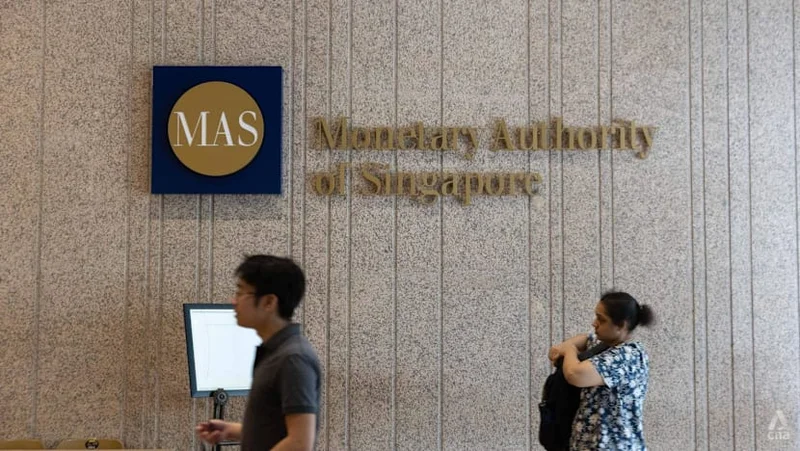
MAS reports net profit of S$20 billion driven by strong investment gains
The central bank's managing director said global financial conditions have been benign so far, but a "major uncertainty" is the sustainability of the artificial intelligence investment boom.
SINGAPORE: The Monetary Authority of Singapore (MAS) reported a net profit of S$20 billion (US$15 billion) in the financial year that ended on Mar 31 on the back of strong investment gains, it said in its annual report released on Tuesday (Jul 28).
Taking into account the S$1 billion contribution to the government's consolidated fund, the figure is the central bank's third highest net profit on record.
Attributing the latest results to a global economy that remained resilient to repeated shocks and to financial markets that performed well, the central bank's managing director Chia Der Jiun said global financial conditions have been benign so far and equity market valuations are high despite recent pullbacks.
During the financial year, all asset classes across bonds and equities, developed and emerging markets, posted good returns, said Mr Chia in a press conference.
For the latest financial year, MAS recorded investment gains of S$39.8 billion, partially offset by negative currency translation effects of S$16.4 billion from the Singapore dollar strengthening against the US dollar and Japanese yen, and net expenses of S$2.4 billion.
The expenses were partially incurred from MAS’ money market operations to manage banking system liquidity.
"While investment gains vary from year to year, this year's upturn was similar to last year's and above our 10-year historical average of S$18.3 billion," said Mr Chia.
The central bank's board approved a return of S$2.5 billion to the Singapore government. "The amount to be paid to the government reflects the offsetting of losses accumulated from previous years," he said.
Before this year, the last time MAS contributed to the consolidated fund was in the financial year 2020/2021. Last year, MAS reported a net profit of S$19.7 billion and did not make a contribution to the consolidated fund.
UNCERTAINTY OF THE AI INVESTMENT BOOM
Despite this, Mr Chia characterised the ongoing artificial intelligence investment boom as a "major uncertainty to the benign picture thus far".
While these AI investments continue to boost economic growth in the near term, the situation is less certain in the medium term, since large equity and debt financing will be needed in the years ahead, he said.
"In the race for model advantage and to scale adoption, projected investments by hyperscalers and model builders have expanded beyond cashflows and commercial revenues," said the MAS managing director.
Global growth, investment and financial market performance have become highly dependent on projections of data centre and semiconductor investments continuing well into the future, said Mr Chia.
"The sustainability of AI investments is thus highly consequential for global growth and financial stability," he said.
He then described two possible scenarios in the medium term which can have a sizeable impact on the global economy.
If revenue growth accelerates and productivity gains broaden, the investment boom could be an extended one, but there are also risks on the path of AI investment monetisation, he said.
Mr Chia highlighted the escalating costs of energy and chips, supply bottlenecks of raw materials, regulatory uncertainty and intense competition, including from lower-cost open-weight models as risks to monetisation.
On the other hand, if the payoff of AI investments fall short of expectations, hyperscalers will moderate the pace of investment and markets will reassess asset valuations, he said.
"The implications are significant if either outcome comes to pass."
In a long AI investment boom, stronger and broader spillovers to income, demand and inflation could ensue. On the other hand, if there is a major retrenchment in AI investment, global growth could be sharply weaker.
The growth of AI investments could be sustainable or unsustainable, Mr Chia told reporters at a media briefing. The expectations of future revenue streams arising from AI needs to be aligned with the path of projected and committed investments into capacity.
If they are misaligned and untethered for a long period of time, the potential slowdown could be more impactful. But if there are adjustments so that there is a closer nexus between the two, then a sustainable path will be visible, he said, noting that there is underlying interest and demand for AI.
"The question is finding that sustainable path forward, and the markets will have to find that alignment," he said.
If that path can be found, then this could be a long investment boom that broadens out because it helps corporate profitability, but if it cannot be found, there could be damage to growth and financial markets.
"There's a lot of uncertainty in this. It's something I think we have to watch for. It is potentially highly transformative and can have good outcomes, but I think we have to guard against outcomes that will be destabilising," he said.
MAS' base case for the near term is that AI continues to provide support and a boost to economic growth, but beyond that, "it's something we're all watching".