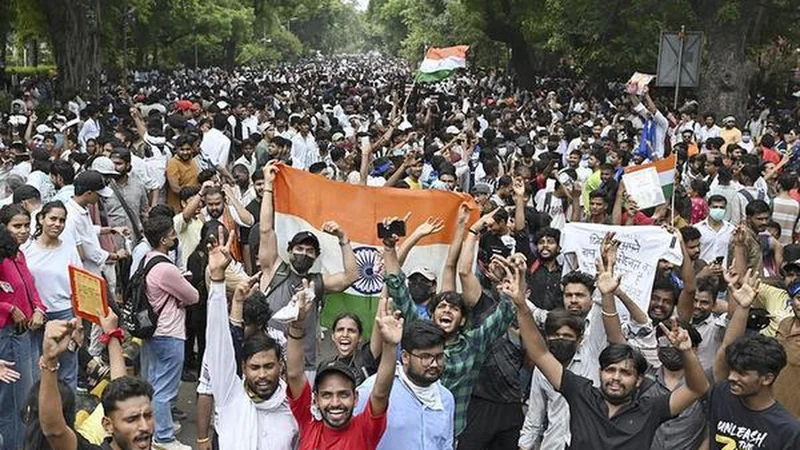
Rajya Sabha Member of Parliament A.A. Rahim moved the Supreme Court on Tuesday (July 28, 2026) against the deployment of facial recognition technology and allied mass surveillance measures by the Delhi Police against students and persons who participated in the Cockroach Janta Party-linked protests over the National Eligibility-cum-Entrance Test-Undergraduate (NEET-UG) exam paper leaks.
The petition sought a judicial declaration that such surveillance was unconstitutional. Mr. Rahim, represented by advocate Subhash Chandran, sought directions from the court to forthwith cease and desist from using facial recognition technology and other surveillance measures on peaceful protestors without a valid law.
“The gravamen of the challenge is the automated, algorithmic extraction and matching of the biometric identifiers of thousands of peaceful protesters, and the interlinking of such data with permanent national criminal databases. Since the commencement of the sit-in on July 20, the Delhi Police have subjected thousands of protesters, journalists and ordinary citizens to continuous and pervasive biometric surveillance,” the petition said.
Also Read | Protest venue under a web of cameras and facial recognition systems
The plea said the surveillance was done with the acquisition of videos and photographs through CCTV cameras, drones, a mobile command and control vehicle, and hand-held devices.
“The real-time processing of such footage through automated facial recognition technology using the ‘Ikshana’ vehicle and ‘AjnaLens’ smart spectacles and the collection and matching of fingerprints through the National Crime Records Bureau’s ‘Abhigyan’ mobile application against the National Automated Fingerprint Identification System. This surveillance is carried out in a complete legal vacuum,” the petition said.
The plea said neither the Delhi Police’s own standing orders governing the protests nor the Criminal Procedure (Identification) Act, 2022 authorise the biometric surveillance of persons attending a lawful assembly.
Also Read | Delhi Police likely to withdraw FIRs as agitation ends, says DCP
“The Delhi Police’s own Right to Information (RTI) responses confirm that no privacy impact assessment was ever conducted, that an unvalidated 80% similarity score is treated as a positive match, and that facial recognition technology use is internally meant to be confined to tracing missing persons and identifying the dead. These objects are wholly unconnected with the policing of a peaceful protest,” the petition said.
The scale and manner of surveillance seen at the protest site offended the right to privacy under Article 21 (right to life and dignity) of the Constitution, Mr. Rahim said.
Published - July 28, 2026 04:44 pm IST