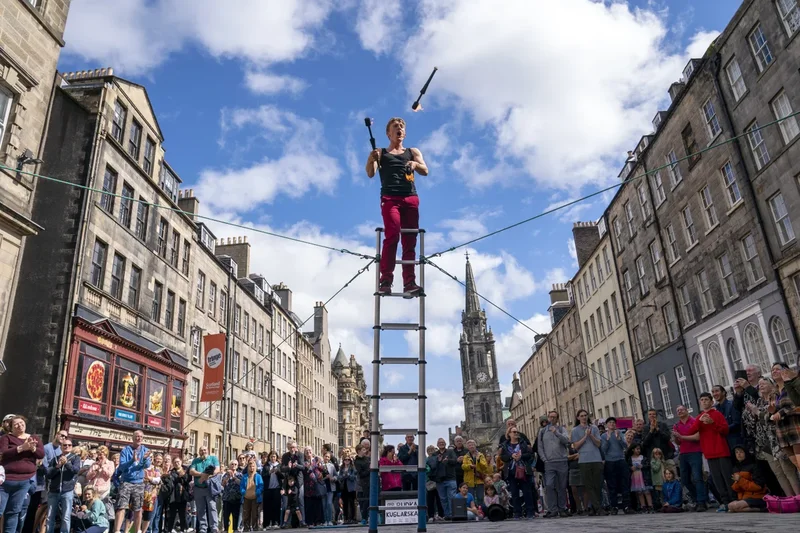
Edinburgh’s new tourist tax has proved to be divisive ahead of the city’s Fringe Festival, with visitors set to pay more when booking hotels and accommodation going forward. However, many of those performing at the annual event are championing the levy – and they actually don’t think it goes far enough.
The Scottish city became the first in the country to introduce a tourist tax last week, with those staying in hotels, bed and breakfasts and self-catering accommodation being charged an extra five per cent on top of their booking cost. Edinburgh’s council is hoping that the levy, which is capped at five nights, will raise £50m annually to invest back into the city for cultural initiatives, new housing and the police.
While the Fringe just days away, not everyone is happy; Scottish Ballet – which pays over £200m annually to accommodate its artists in Edinburgh – recently revealed that it would be cancelling some of its shows in December. The company’s executive director, Steven Roth, said that the “economics of touring to Edinburgh are fast becoming unsustainable” with the tax.
However, for many of the acts performing at the Fringe this year, the tax doesn’t make much of a difference to the already astronomical cost of accommodation in the city.
“An added-on five per cent isn’t the make-or-break,” says Zoe Wohlfeld, who’s performing her show DOG FUNERAL at the festival this year. “The make-or-break happened long ago. The people attending thee Fringe are people who can already afford to do it.”
Her partner and director Jack Grossman adds that the issues around Fringe accommodation are “much more complicated” than implementing a tax. “There’s definitely price gouging that goes on but also tonnes of demand and not enough housing so that’s not going to affect that.”
Edinburgh is famously an expensive city to stay in during the month of August, when the Fringe is on, with the Post Office’s City Costs Barometer reporting in May that visitors pay an average of £462 for just two nights in three-star accommodation. While last year, hotel rooms were listed for up to £4,000 a night the same month when the Fringe festival happened to clash with Oasis performing in the city.
“People have been priced out of Edinburgh for a long time,” says Deborah Pearson, an Edinburgh resident and a founding co-director of UK artist collective Forest Fringe, which is performing at the festival this year. “I’ve lived here for 20 years and I’ve never known it to be something that doesn’t come with its expenses.”
For most performers at the Fringe, the scale of their productions are much smaller than that of the Scottish Ballet – and so a five per cent tax, which is capped at just five nights, won’t make much of a difference to their overall costs, especially as it’s usually make-do-and-mend where sleeping arrangements are concerned.
“We’re staying in student accommodation this year and we paid for it months ago,” New York-based Wohlfeld says. “In our first year at the Fringe, we stayed in a four-bedroom Airbnb and we had 15 to 20 people there at all times because people were looking for places to stay for a couple of days of the week. We had people sleeping in the hallway.”
“The cost of living right now is insane and being an artist is really hard at the moment for so many different reasons,” Pearson says. “The rising costs always feel like a negative but I think we also have to keep in mind that Edinburgh is a city and if those taxes are going to actually benefit the city, then hopefully that’s a good thing.”
Instead, many are keen to see the tax fund improvements to Edinburgh city, which faces the strain every year when almost one million people – double its usual population – descend on the festival.
“The festival does some stuff for the city but it also does a lot of damage too,” Wohlfeld says. “The sheer number of people you have to interact with every day for a whole month is very overwhelming in a way that the city is not necessarily used to.”
“It’s a huge burden for sanitation and police. I was there a few years ago when there was the trash strike and that was crazy,” Grossman says, referring to the 2022 bin collection strikes in the city, which coincided with the festival.
If anything, the tax should apply to more than just those staying in hotels, he argues. “A lot of people who come to the festivals are coming from nearby in Scotland or around the UK for day trips so they’re not going to be paying anything,” he says.
“There are a lot of people who just trash the place – if you go on The Cowgate past 10pm, it can be kind of a rough environment. We’ve met a lot of hen dos from Glasgow that are pretty destructive and they’re not going to have to pay the tax.”
“It’s really about improving the situation for the people who live in Edinburgh year,” Deborah adds. “I think it’s quite important that those who come to the Edinburgh Festival remember that it’s a city.
“Our organisation never could have existed without the generosity and help of the city’s full-time residents.”
Zoe Wohlfeld: Dog Funeral is showing at the Jelly Belly at Underbelly from 5 - 30 August. Forest Fringe is performing at Shedinburgh from 25 to 26 August.