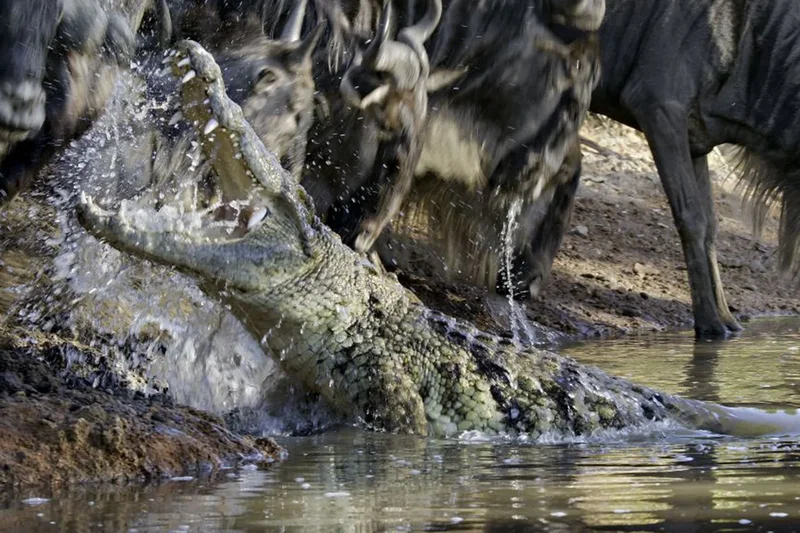
Human rights groups have condemned Israel’s plans to build a crocodile-filled moat around a prison holding Palestinian detainees as “vicious” and “nonsensical”.
Far-right national security minister Itamar Ben-Gvir is seeking to introduce the reptiles at Ketziot Prison in southern Israel in a move directly inspired by Alligator Alcatraz, the US immigration detention facility which closed in June.
Last week, a source in Ben-Gvir’s office confirmed that digging was already underway at the maximum-security prison after the Israeli government reclassified the Nile crocodile as a “tended wild animal”, allowing them to be kept on the site.
The 170 metre-long moat, which will cost $6.3 million, will surround the prison.
Ketziot currently holds an undisclosed number of Palestinian prisoners who are accused of being members of Hamas’ elite Nukhba force, who were involved in the Nova Festival massacre on October 7, 2023.
Ben-Gvir’s project has faced significant domestic and international backlash, despite his claim it will reduce the burden on prison staff.
Moazzam Begg, director of human rights group CAGE international, told The Independent: “Modelling a prison on Alcatraz is nonsensical.
“The fact that that we’re even trying to rationalise using crocodiles as a legitimate security apparatus in the 21st century feels outright satirical.”
Former Homeland Security Secretary Kristi Noem’s flagship detention centre, Alligator Alcatraz, was scrapped in the face of several lawsuits alleging inhumane and unconstitutional conditions and threats to a sprawling protected nature preserve in June this year.
A report published by Amnesty International found that the conditions in Alcatraz were tantamount to torture, including the routine and prolonged use of shackles and the use of the “box” - a 2x2 foot cage-like structure that prisoners were put in as punishment.
Mr Begg expressed concerns that the attempt to emulate Alcatraz could lead to similar human rights violations, saying: “Israel regularly acts with impunity under the pretext of national security.
“Adding crocodiles is just another vicious decision in the consistent mistreatment of Palestinians.”
More than 50 harrowing testimonies of prisoner abuse at Ketziot were published by B’Tselem, an Israeli human rights organisation, following the October 7 attacks.
However, the Israeli government has maintained that the proposed crocodile moat addresses a “real need” for security due to the penitentiary system’s acute overcrowding crisis.
Israel’s environmental protection minister, Idit Silman, said: “Yes, it serves as a deterrent. They have a very great fear of crocodiles. We are speaking in a language our enemies understand.
“Everyone can laugh if they want, but the number of terrorists has increased by thousands, while the number of prison guards has not.”
In a bid to accelerate the project, Ms Silman has signed an administrative order that reclassified the previously “protected” Nile crocodiles, as "managed wild animals."
The decision means that government bodies — including the Israel Prison Service (IPS) — can hold them under specific security conditions.
Ben-Gvir celebrated the decision on Facebook on Thursday, posting an AI-generated image of himself holding a crocodile on a lead.
"Damn terrorist, thinking of trying to escape? Think again," the minister wrote.
Silman's decision has drawn major opposition from the Israel Nature and Parks Authority (INPA) and environmental groups, which argued the move is unlawful and puts both crocodiles and the public at risk.
In a statement to The Times of Israel, the INPA said there was "no sufficient professional basis" to permit crocodiles to be kept at security facilities.
The statement concluded that “security should be achieved through real means, not through animals."
Ben-Gvir said that the choice to proceed with the plans was part of a “unique mission against terrorists.”
During his tenure, the treatment of Palestinian prisoners has deteriorated dramatically, according to a report authored by the United Nations.
In a now-deleted post on X in July 2024, the national security minister said: “One of the ultimate goals I set for myself [as minister] is worsening the [incarceration] conditions for terrorists in prisons, and to reducing their rights to the minimum required by law.”