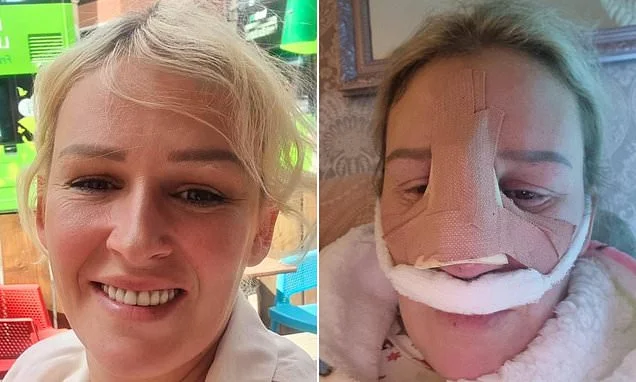
In 2022, 35-year-old Mel Frisby was on holiday in Turkey with her eldest son (then 13) and a friend when she was dared – then double-dared – to jump into the sea from their boat. Despite a lifelong fear of the ocean, the holiday spirit took over, and she decided to throw caution to the wind.
Upon resurfacing, Mel developed a nasty nosebleed. Thinking little of it, she carried on enjoying the rest of the trip. She had no idea this moment would mark the beginning of a tortuous four-year ordeal fighting for her life.
Later that evening, Mel noticed a small dent at the top of her nose. Assuming she had broken it from the impact of the water, she put it out of her mind since it didn't hurt. A couple of days later, the busy mum of three returned home to the UK and got on with life.
However, as time went by, her nose appeared increasingly misshapen. The turning point came during a family day trip when her husband glanced across the car at her and begged her to go to A\&E.
While the hospital confirmed her nose was not broken, Mel was referred to the ear, nose and throat (ENT) team for further investigation. Consultants discovered a serious infection in her nostrils, resulting in an immediate overnight admission despite Mel feeling otherwise well.
Further CT scans and blood tests revealed that the left side of her nasal bridge was crumbling. She was diagnosed with osteomyelitis (a severe bone infection) and rushed into surgery that afternoon to drain the area and start strong intravenous (IV) antibiotics.
Mother-of-three Mel Frisby, 35, pictured before the diagnosis that changed her life forever
Mel assumed that once the infection cleared, she would simply need reconstructive surgery. Although her nose continued to swell, doctors presumed it was standard post-surgery inflammation. A week later, during a FaceTime call, a friend pointed out that the lump had grown noticeably larger. Now, it was painful, hard, and had the texture of a knuckle. Her husband immediately took her back to A\&E.
After a gruelling 18-hour wait, Mel was admitted again. Following another CT scan, a young doctor came to her bedside to escort her to the consultant. Mel recalls that she ‘thought it was strange as an in-patient, but with the lack of sleep I just got on with it’.
However, alarm bells rang as the consultant’s demeanour had completely changed. Gently holding Mel's hand, she took a biopsy and ordered an urgent MRI. Walking down the empty hospital corridor, reality began to set in. Mel remembers slowing down before ‘closing my eyes and saying out loud “There’s cancer in the middle of my face”’.
Breaking down, she called her husband and asked to go home. Within 72 hours, she had the MRI. Following a painful three-week wait, she received her official diagnosis: Stage 3/4 sinonasal squamous cell carcinoma.
Having lost her mother to cervical cancer at age 19 and her father to oesophageal cancer seven years later, Mel says she felt naive for not recognising the signs. However, head and neck cancers (while the sixth most common cancer group) often present with symptoms that are easily dismissed.
In hindsight, Mel's symptoms included waking up with a sore nose (which she assumed was from her husband accidentally bumping her in her sleep) and extreme fatigue, which caused her to drift off as early as 7pm on holiday. Because Mel’s cancer grew outwards, it was caught; had it grown backwards toward her brain, it would have been completely silent.
Before Mel's diagnosis, her nose appeared increasingly misshapen. Later it emerged that this was a sign of sinonasal squamous cell carcinoma - a type of nasal cancer
Telling her children was the hardest hurdle. She approached them separately, tailoring the conversations to their ages. She began by telling her 13-year-old, ‘You know I’ve not been well recently.’ His response broke her heart: ‘Mum do you have cancer?’ When he asked if she was going to die, Mel promised she was going to do her very best not to.
With her eight- and nine-year-olds, she asked if they had ever heard of cancer. Since they hadn't, she explained that she had an illness that required operations and medicine, which would make her feel poorly for a little while before she got better.
Next came the terrifying wait for a rhinectomy: a surgery to remove all or part of the nose. Mel would only learn the extent of the removal upon waking up. A partial removal meant she could undergo nasal reconstruction; a full removal meant magnetic implants and a prosthetic.
Before entering the operating theatre, Mel and her husband said goodbye, knowing it was the last time they would see her face as it was. Upon waking up, Mel immediately reached for her nose. Though the entire nasal bone was gone, the tip and nostrils remained intact. She was a candidate for reconstruction.
‘I hadn’t let myself think about it’, Mel shares regarding her appearance. ‘I was just worried about my children and my husband.’
Mel’s gruelling treatment plan included four reconstructive surgeries, six procedures to manage infections and 30 intensive sessions of radiotherapy. Doctors even harvested cartilage from her ribs to rebuild her nose.
With sensitive skin and a completely altered face, navigating her new identity was incredibly difficult, and Mel struggled to look in the mirror.
Mel after one of her surgeries. She endured four reconstructive operations, six procedures to manage infections, and 30 intensive sessions of radiotherapy
Mel pictured recently with her reconstructed nose... she shared her story on social media. It soon gained millions of views and inspired other survivors to reach out
Two years ago, in an effort to process her feelings, she posted her story on TikTok. By the next morning, her son revealed it had hit seven million views, eventually climbing to 16.5million. But feeling that the experience was still too fresh, she stepped back from social media.
This year, encouraged by her family to combat the loneliness of isolation, she returned.
‘I’m sharing my story to spread awareness,’ she says. ‘With this kind of cancer people don’t know what to look out for, and early diagnosis and treatment can make all the difference’.
Four years out from her initial holiday, Mel refuses to waste a single moment.
‘I went through hell to survive, so I’m making sure I live my life. Yes, it can be difficult, it’s not always perfect, but life can be hard for everyone – you just have to find a way,’ she says.
When she first fell ill, her daughter worried about who would do her hair for school. Mel promised she would always be there to do it. She has kept that promise every day, finding strength in routine. ‘Small achievements in the morning led me to days where I didn’t feel sorry for myself,’ she says.
Her return to social media recently brought an unexpected miracle. Mel connected with a woman who received the exact same diagnosis at age 35, 19 years ago. This survivor recently found a specialised surgeon capable of rebuilding lost nasal bone who was willing to help. Just this week, Mel got in touch with the very same surgeon. For the first time in years, she is filled with hope. ‘And all because of social media!’ she says. ‘It turns out the world is actually full of really lovely people. I’m excited for the next step.’
Follow Mel's journey at @melfrisbyofficial