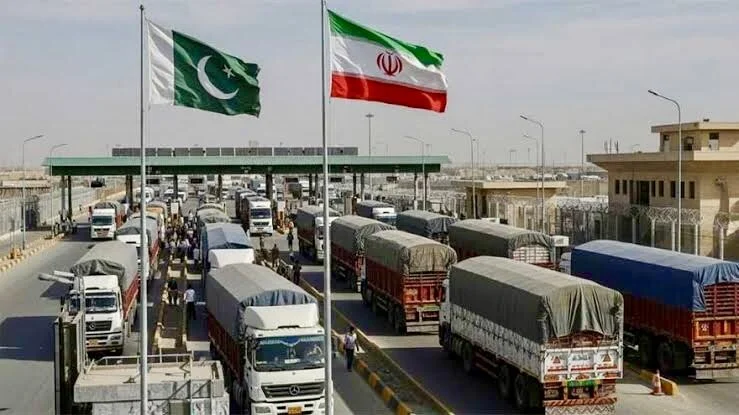
Iran-Pakistan border development: New horizons for trade, regional connectivity
TEHRAN- Recent agreements between Iran and Pakistan represent a significant turning point in bilateral economic relations, with the shared border regions—particularly Iran's Sistan-Baluchestan province—emerging as the primary focal point for enhanced cooperation. With approximately 930 kilometers of shared border, Sistan-Baluchestan stands as Iran's only province with a land border with Pakistan, making it an indispensable gateway for bilateral exchanges.
The comprehensive agreements, formalized during a high-ranking Iranian delegation's visit to Islamabad led by the Interior Minister, have set ambitious targets including increasing bilateral trade value from approximately $3 billion to $10 billion annually, establishing new official border crossings, expanding border markets, and completing critical transport infrastructure. These developments signal that Iran's eastern borders are receiving unprecedented development-oriented attention, with the potential to transform the economic landscape of the border regions and establish Sistan-Baluchestan as a pivotal hub for Iran's trade with Pakistan and broader South Asian markets.
Strategic border crossings: Cornerstone of economic integration
The development of official border crossings represents the cornerstone of the Iran-Pakistan economic initiative, with several strategic gateways identified for activation and expansion. The official Kuhak border crossing in Saravan county has emerged as a particularly significant addition to the existing border infrastructure. This crossing has been a long-standing demand of local communities and development planners in Sistan-Baluchestan, and the Pakistani side's agreement to accelerate its activation promises to unlock substantial economic potential for the region. The Kuhak crossing will complement existing official borders at Mirjaveh, Rimdan, and Pishin, creating a more balanced distribution of commercial traffic and reducing congestion at current crossings. The need for this expansion is underscored by the ambitious target of achieving $10 billion in annual trade, which requires approximately 2,000 trucks to cross shared borders daily—a capacity that existing crossings cannot accommodate alone.
The Rimdan border in Dashtyari county holds particular strategic importance due to its unique position adjacent to the Chabahar Free Zone. This proximity offers exceptional potential for integrating land and maritime trade, transforming Rimdan from a simple border crossing into a vital link in the regional trade network. The advantages of Rimdan extend beyond its geographical location; the simultaneous presence of an official border crossing, a free trade zone, local marketplaces, and access to transport routes positions this area as one of the most promising sites for economic development and investment attraction. The agreements encompass investment in slaughterhouse facilities, expansion of live animal exports, commodity bartering, and enhanced financial exchanges—all aimed at activating the economic potential of the border strip. Furthermore, the revival of the ECO corridor and the connection through Rimdan to the China-Pakistan Economic Corridor (CPEC) represent transformative opportunities that could, with the necessary infrastructure development, open new horizons for regional trade and position Sistan-Baluchestan as a critical transit hub connecting Central Asia to South Asia.
**Overcoming operational barriers: Private sector challenges and solutions **
Despite the promising political agreements and infrastructure development plans, significant operational barriers continue to hamper the full realization of Iran-Pakistan trade potential. Samad Hassanzadeh, the Head of the Iran Chamber of Commerce, Industries, Mines and Agriculture (ICCIMA), has highlighted several critical obstacles during discussions with Pakistani Ambassador Imran Ahmed Siddiqui in Tehran. Among the primary challenges are the lack of efficient financial mechanisms, standards and quarantine issues, and the prolonged detention of containers at Karachi Port. These logistical bottlenecks have resulted in substantial financial losses for Iranian economic activists and created uncertainty that has discouraged trade expansion. The absence of a specific authority in Pakistan to handle disputes arising during trade, coupled with changes to customs regulations without prior notification, has further complicated the business environment for Iranian traders.
Hassanzadeh has proposed several practical solutions to address these challenges, most notably the establishment of a green border corridor that would support the electronic transfer of documents and streamline customs procedures. The Iran Chamber of Commerce has designated a representative for communication with the Pakistani Embassy to pursue issues and resolve trade barriers, with quarterly meetings proposed to review the implementation progress of agreements.
The Pakistani side has responded positively to these concerns, with Ambassador Siddiqui suggesting that border operating hours could be extended to 24 hours a day, seven days a week, to provide greater opportunities for private sector cooperation. Pakistan has also placed coordination and standardization in customs affairs on its agenda and has submitted a proposal to the Iranian side regarding customs documentation. In addressing the container accumulation problem at Karachi Port, Pakistan has indicated that a green channel and joint customs mechanism are under consideration. The ambassador also highlighted cooperation in the pharmaceutical industry, agriculture, and food sectors as serious areas of mutual interest, suggesting that a specialized exhibition in the food industries sector scheduled for Karachi Port in November 2026 could serve as an opportunity for enhanced private sector engagement.
Institutional framework and regional connectivity
The success of the Iran-Pakistan border development initiative depends significantly on establishing robust institutional mechanisms that translate political agreements into tangible economic outcomes. A joint committee mechanism between Sistan-Baluchestan province and Pakistan's Balochistan province has been established, with expert meetings scheduled to be held regularly at the Taftan border. This framework is designed to address implementation issues, remove trade obstacles, and ensure that agreements move from the level of political negotiation to practical execution. The agreements also include provisions for increasing border operating hours and facilitating customs procedures, with the goal of creating a more efficient and predictable trading environment. The expansion of cooperation between the Iran Chamber of Commerce and the economic section of the Pakistani Embassy in Tehran is seen as essential for addressing remaining issues, including banking relations and transit arrangements that require time and specific actions beyond the purview of embassies or even governments. In this regard, barter trade mechanisms are under consideration as an alternative approach to overcome financial transaction limitations.
The geographic positioning of the Kuhak, Pishin, Rimdan, and Mirjaveh borders along east-west corridors and their connection to north-south routes represents a strategic asset that can facilitate access to regional markets. The revival of the ECO corridor and the potential connection through Rimdan to CPEC offer transformative possibilities for regional connectivity. Sistan-Baluchestan's role in this regional architecture is further enhanced by its proximity to the Chabahar Free Zone and its capacity to serve as a bridge between Central Asian markets and South Asian destinations. The agreements also encompass maritime and air transshipment, natural gas pipeline transfer, railway development, and facilitated truck movement—all components of a comprehensive approach to regional connectivity. The development of a 10,000-hectare zone around the Rimdan border is under consideration, with the aim of leveraging the capacities of the official border, the Chabahar Free Zone, and retail marketplaces to create a major economic hub.
A vision for sustainable border development
The recent Iran-Pakistan agreements represent more than a series of trade facilitation measures; they constitute a comprehensive vision for transforming the border region into a dynamic economic zone that benefits both nations. The success of these initiatives ultimately depends on the speed of border infrastructure implementation, transportation network development, trade procedure facilitation, and sustained joint cooperation. The recognition by both sides that economic development and sustainable security in border regions are complementary objectives provides a solid foundation for long-term commitment. The emphasis on improving livelihoods for border communities through expanded trade opportunities serves both economic and security objectives, demonstrating a holistic approach to border development. If realized, these agreements could significantly increase Sistan-Baluchestan's share in Iran's foreign trade and firmly establish the province's position as the gateway for Iran's exchanges with Pakistan and South Asia. The integration of private sector perspectives, as articulated by the Iran Chamber of Commerce, alongside government-to-government agreements, ensures that the development process remains grounded in practical realities and responsive to the needs of economic actors. As both nations continue to work through implementation details, the vision of a vibrant, interconnected border region that serves as a model for regional economic cooperation appears increasingly within reach.