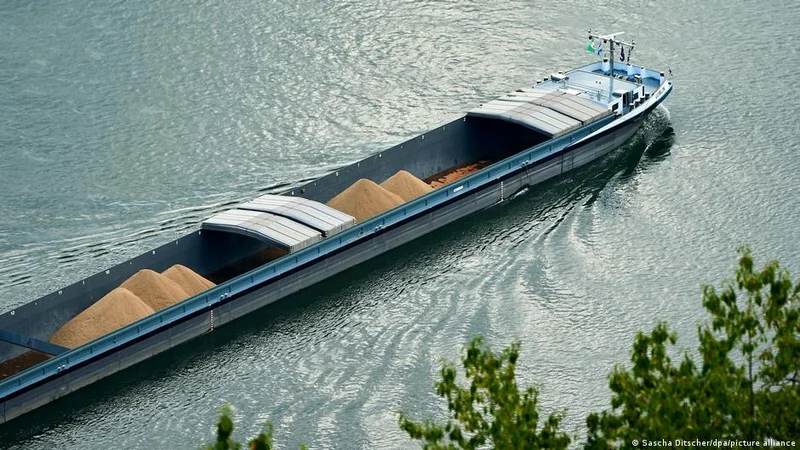
Persistently low water levels on the Rhine River could shave as much as 0.2% off Germany's economic output in the third quarter, the Kiel Institute for the World Economy said on Tuesday.
Prolonged dry weather has continued to lower levels on the busiest inland trade waterway on Europe, connecting the vast port of Rotterdam in the Netherlands with much of western Germany.
Less rain fell than forecast this past weekend, and the national weather service now forecasts another incoming period of high temperatures, particularly further south along the river.
How can a low Rhine affect the economy?
The Rhine carries key commodities including grain, minerals, ores, coal and petroleum products such as petrol.
When the river is low, cargo vessels can no longer travel fully loaded and must spread shipments across several ships.
Traders have said some inland vessels are operating at only 15% to 20% of their maximum load. That raises transport costs and places further pressure on an economy that had recently begun to show signs of a modest recovery.
Many economists expect growth of no more than 0.2% during the summer months, meaning the disruption could push Europe's largest economy toward stagnation.
"The effects could be strong enough to reduce gross domestic product in the third quarter by 0.1% to 0.2%," Stefan Kooths, director of the institute's business cycle and growth research group, told the Reuters news agency.
At Kaub, a crucial bottleneck between the cities of Koblenz and Mainz, a benchmark measurement gauge fell to 30 centimeters (12 inches) on Tuesday. Germany's waterways authority expects it to drop to around 25 centimeters by Friday, matching a record low reached in October 2018.
"As water levels are unlikely to rise suddenly above the critical threshold at the beginning of August, transport capacity is likely to remain impaired for some time next month," Kooths said.
Poor economy could lessen impact
Under normal economic conditions, the prolonged disruption would reduce industrial activity by around 0.8% in July and cut overall monthly economic output by about 0.2%, Kooths said.
However, the current weakness of German industry could make the overall impact somewhat smaller.
Deutsche Bank Research analysts warned that the problem was being compounded by the months-long closure of an important rail alternative.
The railway line on the eastern bank of the Rhine is closed to freight traffic for renovation work until December 12. Even under normal circumstances, rail can replace only a limited share of inland shipping capacity.
Edited by: Jenipher Camino Gonzalez
Don't let the algorithm hide the news. If you rely on our team for trusted reporting, please take a moment to select us as your Preferred Source on Google, so you'll always see our verified news first.