About 2,000 years ago, a woman named Julia Felix decided to rent out sections of her large estate. Historians know about these seemingly mundane business dealings because her property happened to be located in ancient Pompeii, which was devastated by Mount Vesuvius’ eruption in 79 C.E. The disaster froze the city in time, preserving a rental notice painted on Felix’s wall. It reads:
To let, for the term of five years, from the 13th day of next August to the 13th day of the sixth August thereafter, the Venus bath, fitted up for the best people, shops, rooms over shops and second-story apartments in the property owned by Julia Felix, daughter of Spurius.
Elsewhere in the city, a teenager named Avianius Felicio was coming of age. Ancient inscriptions suggest that his family, the Avianii, had once been among Pompeii’s elite, but their fortunes later reversed. Shortly before the eruption, a family member appeared among the witnesses listed on a loan tablet. “The nine witnesses to loans generally signed in order of their social rank,” classicist Steven L. Tuck writes in Escape From Pompeii. The family name “is just above the signatures of the enslaved.”
Now, Felix and Felicio are central characters in the semi-fictionalized documentary series “Pompeii: Out of Time With Tom Hiddleston.” The British actor has been fascinated with Pompeii since he first visited the ancient city in 1998, when he was 17. The trip inspired him to major in classics at the University of Cambridge.
“We all know the story of Pompeii, right?” Hiddleston says in the series. “The story of Pompeii is a story of death—but that isn’t exactly true.” He explains that the city wasn’t buried instantly. Instead, the eruption was a process that intensified over the course of one day. For some lucky survivors, a day might have been enough time to escape.
The National Geographic documentary is anchored in that slim chance. Across three episodes, Hiddleston follows three victims who experienced the eruption—Felix, Felicio and an unnamed Roman soldier—and tries to piece together whether any of them could have made it out alive.
This framing is based on Tuck’s research. For years, he’s been tracking Romans living near Vesuvius whose names appear in inscriptions from before 79 C.E. Do those same names ever show up in inscriptions created after the eruption? As the researcher explains in the series, “We find that same person later in another community—then, bingo, we’ve found a survivor.”
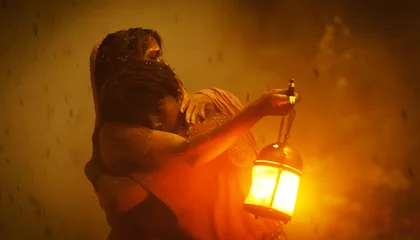
The documentary begins with Felicio, imagined as a headstrong teenager who works as an apprentice to the Masuri, a local blacksmith family. One scene shows him arguing with his employer, who is angry that the boy fumbled a delicate task during one of the minor earthquakes that preceded the disaster. Just as they reconcile, Vesuvius erupts in the distance.
These dramatizations are interspersed with traditional interviews. In addition to classicists, archaeologists and scientists, Hiddleston speaks with Sarita Robinson, a disaster psychologist who studies patterns of human behavior in life-or-death situations. After Felicio witnesses the eruption, Hiddleston asks whether the boy would have evacuated immediately. “Well,” Robinson replies, “maybe.” In emergencies, she explains, people tend to make sure their loved ones are safe before getting themselves to safety. The series shows Felicio running deeper into Pompeii to find his mother.
Hiddleston also wonders why Pompeii’s residents didn’t evacuate even earlier in the day, when earthquakes rocked the city. Robinson offers a modern-day example: When a fire alarm goes off, few respond with urgency. “People have learned that there’s no danger, so they don’t respond,” she explains. Earthquakes are common in Italy, and Pompeii’s residents likely learned “to just ignore tremors, just like we ignore fire alarms.”
The third subject, the Roman soldier, was based in the nearby town of Herculaneum, located even closer to the eruption than Pompeii. The documentary imagines him as a cynical man whose military service left him with a jaded view of humanity. He ultimately finds redemption by using his training to organize an evacuation by boat.
Hiddleston doesn’t reveal this soldier’s fate until the end of the series, but (spoilers ahead) researchers have known it since the 1980s, when they excavated his skeleton from a beach in Herculaneum. A few years ago, researchers re-examined the artifacts found near the nameless soldier: a belt, a sword and a bag of coins. The decorations on the belt and sword suggest that he may have belonged to the elite Praetorian Guard. The coins he carried add up to the monthly salary such soldiers were paid. Some researchers hypothesized that he was part of Pliny the Elder’s rescue mission, though others have expressed skepticism.
Quick facts: Pliny the Younger’s account
- The Roman author Pliny the Younger famously wrote two letters describing the eruption of Mount Vesuvius.
- His uncle, Pliny the Elder, who was commanding a fleet of ships at Misenum, sailed toward the eruption to attempt a rescue. “He hurried to a place from which others were fleeing and held his course directly into danger,” his nephew wrote.
- Pliny the Elder landed at Stabiae, a town southwest of Pompeii, where he likely died after inhaling volcanic gases.
Julia Felix, meanwhile, is a curious case. Her lavishly decorated property, excavated in 1755, was one of the largest estates in Pompeii. Based on the available evidence, she appears to have been a shrewd businesswoman who opened her bathhouse to customers. A major earthquake had hit the city in 62 or 63 C.E., damaging the public baths, which may have made her establishment a “popular haunt,” Sophie Hay, an archaeologist who has conducted excavations in Pompeii, explained in a 2021 interview.
“It would have been, as far as we know, really unusual for an independent woman to run an operation like this,” archaeologist Caitie Barrett tells Hiddleston in the documentary. The series imagines Felix making clever quips as she manages the whims of particularly demanding guests. Surely, Hiddleston presses, such a shrewd Pompeian would have evacuated? “Well, here we are bumping up against the limits of the archaeological record,” Barrett says. “We just don’t know. Archaeology can’t get us inside people’s heads.”
At this point, Hiddleston explains his decision to combine documentary and fiction. At Cambridge, he learned that the Latin word historia can be translated as either “history” or “story.” “That means evidence and imagination intermingled,” he says. “They’re the same thing.” The documentary reviews the evidence and then provides what Hiddleston calls a “fuller truth,” presenting fictional scenarios that could have plausibly happened on that fateful day.
Hiddleston is best known for playing the trickster god Loki in the Avengers franchise. The documentary’s executive producer, Kevin Wright, was also a producer on “Loki,” the actor’s Disney+ series. Although “Pompeii” had a much smaller budget, both men pulled from their experience in big-budget spectacle.
“Sometimes you need that big VFX shot, you need the big drone to sell the story, because that’s the only way you can do it justice,” Wright tells Ars Technica. “That was where the worlds really merged.” In the series, Hiddleston grows increasingly anxious as the minutes tick down, drilling the experts about the characters’ chances of survival at each stage of the eruption.
The series reveals each subject’s fate through a combination of evidence and invention. In the 1950s, archaeologists excavated a body from Felix’s estate, though they don’t know whether it was the owner herself. Adorned in expensive jewelry, the skeleton was positioned near a shrine to the goddess Isis. The series shows Felix deftly organizing an evacuation but then deciding to stay behind. By praying at the shrine, Hiddleston says, “she believes that she can provide her household and the people she loves with safe passage.” Barrett replies, “That’s certainly a story that we can imagine.”
As for Felicio, his story concludes with evidence from Tuck’s research, which reveals that his gravestone is located in the ancient town of Nuceria. The inscription reads: “To the Spirits of the Dead. The Masuri made [this] for Avianius Felicio, dearest foster son.” Tuck thinks that Felicio’s family died in the eruption, leading the Masuri to take him in. The documentary imagines the boy running into his employers’ arms when they find him after the eruption.
“Felicio might have been a foundling, but that does not mean that he was not cared for or cared about, despite his vulnerable legal position,” Tuck writes in Escape From Pompeii. “He may provide the only explicit evidence of the fate of surviving minors without parents in the post-eruption world.”
Even if Felicio survived the eruption, Tuck suggests that it’s “very likely that he was still a minor when he died.” The documentary, however, glosses over this fact, with the researcher explaining only that the gravestone dates to “long after the eruption.” When Hiddleston reads the inscription, he says, “The Masuri, the bronzesmith family—they adopt Avianius?” Tuck smiles and replies, “That’s how I read it.”