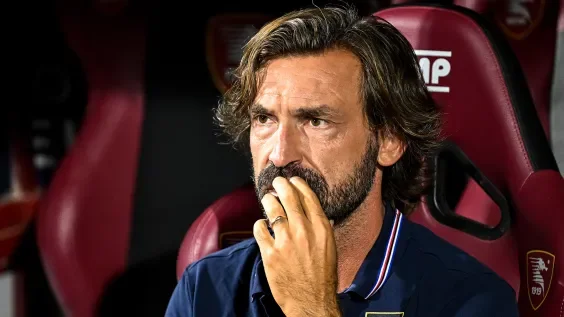
Andrea Pirlo is one of the greatest Italian soccer players of all time. His résumé as a player is impeccable. He won six Serie A titles, two Champions Leagues, and most crucially, the 2006 World Cup. His evolution from a classic trequartista, attacking-style player into one of the defining deep-lying playmakers of his era spoke to both his talent and his tactical intelligence. In every sense of the word, he is an Italian legend. But not even Pirlo is immune from the humiliation vortex that has encircled Italian soccer over the last decade.
On Friday, it was reported that Pirlo was on the brink of being named manager of the Italian national team, signaling a new era for a country that failed to qualify for three straight World Cups. On Monday, Pirlo's appointment was called off due, in part, to his ties to a Russian betting company. That reversal also led to the resignation of Italy's new technical director and fellow Italian legend Paolo Maldini (and I mean new; Maldini was at the job for 16 days before leaving his post on Monday). On Tuesday, Roberto Mancini was officially appointed for his second stint with the Azzurri, after his first ended in disgrace following the failure to qualify to the 2022 World Cup.
What the hell happened?
Let's start with Pirlo, as he is the catalyst for this latest embarrassment. After scoopster/shill Fabrizio Romano hit the news that Pirlo would join the national team as manager with a "here we go," here we did not go. Swiftly, Pirlo's impending appointment came under fire. Pirlo's managerial stint at Juventus in 2020-21, his first real job as a manager, ended after one mildly acceptable season (he won the Supercoppa Italiana and presided over the first non-Serie A-winning season for the club in nine years), and since then, he hasn't exactly covered himself in glory, with middling tenures in Turkey, in Italy's second division, and in the UAE.
It was his time in the UAE with Dubai United that torpedoed the Italian job. While at that club, Pirlo signed a sponsorship deal with Fonbet, a betting company based out of Moscow and founded by Sergey Lomakin, a Russian billionaire ally of Vladimir Putin who has been sanctioned by Ukraine, and who is also the owner of Dubai United. Pirlo's Fonbet deal started in Oct. 2025, and he has appeared in ads and at events for the company as a global ambassador. This raised red flags, as Russia continues its war in Ukraine amidst, most relevantly, a ban from FIFA for international competitions. Journalist Andrea Papaccio raised these links in relation to the national team appointment on July 24, and by the evening of July 27, the noise around Pirlo's ties to Fonbet had grown too loud to ignore. Pirlo defended himself on Instagram by saying his ties to Fonbet began and ended while he was at Dubai United, and that his relationship was, in his eyes, only "commercial and sporting," not political: "Attributing a political significance to that collaboration means attributing beliefs to me that I have never expressed and don't belong to me."
That's a load of rubbish, of course. Pirlo's value to Fonbet was obviously largely political. By tying itself to one of the biggest names of the last generation of players, the company could use the sponsorship as a bit of sportswashing, showing the world that Russia remains a viable commercial partner for major players in soccer. Pirlo isn't alone here in terms of Italian World Cup champions; Francesco Totti was at an awards event in Russia in 2025, and Marco Materazzi apologized after he linked up Fonbet.
Sketchy sponsorships with betting companies is not a new or particularly Italian phenomenon; who can forget Giannis Antetokoumpo's Kalshi saga? But it's the Russian angle that was a bridge too far for the Italian public and the country's politicians. As reported by the BBC, Pina Picierno of the European Parliament said that the national team "desperately needed a cultural, ethical and managerial revolution," and that Pirlo could not be considered one thanks in part to his ties. Italian senator Carlo Calenda was more explicit, saying that "anyone who is or has been promoting Russia after 2022 should not hold national office."
With that, on Monday, Pirlo announced via a now-expired Instagram story that he was out of the running for the job, having been told late on Sunday that his Fonbet deal had disqualified him. The whole mess spiraled from there. Maldini and his adviser, Brazilian soccer exec Leonardo, resigned from their respective roles at the Italian FA, just about two weeks into the job. Maldini had been given the job with the responsibility of finding the new national team manager. After a failed flirtation with Pep Guardiola, who turned Italy down to take a break from the sport following his departure from Manchester City, Maldini landed on his former AC Milan teammate, Pirlo. It's reported that this went against the wishes of Italian soccer president Giovanni Malagò, who wanted Mancini, an experienced hand and a personal friend, to take over. Having their authority undermined like that is what convinced Maldini and Leonardo they couldn't stay in the job.
In the end, Mancini has wound up with the manager position, and former Premier League-winning manager Claudio Ranieri has been named Maldini's replacement as national team technical director. Mancini isn't the most exciting choice, but Italy didn't have many options. Once Guardiola said no, and with Carlo Ancelotti locked in with Brazil, Italy's options dwindled to the point that Pirlo, a candidate only because of his legend and not his actual managerial experience, became the front-runner. Once that became untenable, Italy did what it does almost better than any country and recycled a manager, picking Mancini over the other rumored ex-Azzurri coach in the running, Antonio Conte. And though Mancini's Italy failed to qualify for the 2022 World Cup, he did oversee the last great Italian tournament showing when they won Euro 2021. So there is some reason for optimism there.
Surely no one but his old teammates feels bad for Pirlo today. He only has himself to blame for signing deals with shady organizations and seeing it backfire. Still, it's hard to fully buy that Pirlo's snub was first and foremost about geopolitics rather than soccer politics. Fans hated the idea of entrusting such an important sporting project to an unproven manager like Pirlo, and Malagò didn't want his own tenure in charge of Italian soccer to be tainted right from the outset by an unpopular hire, especially when his old buddy Mancini was right there. The most convincing proof for the Russia stuff being more pretext than cause comes from Mancini's own history. Italy was all set to continue with Mancini even after the national team didn't qualify for the 2022 World Cup, only to see him ditch them in controversial fashion for an incredibly lucrative offer to go coach the Saudi Arabia national team in 2023. Dirty money is everywhere in soccer, and all that matters is whether or not the powers that be choose to go looking under your fingernails.