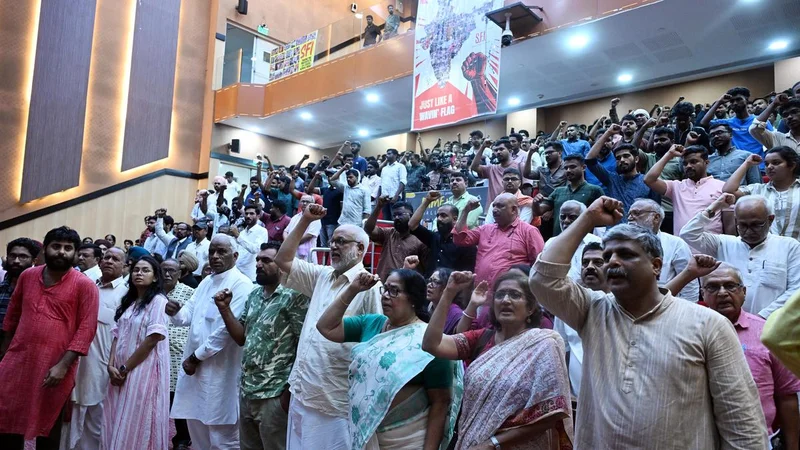
Students won. Education Minister Dharmendra Pradhan resigned. The Prime Minister announced fast-track courts to deal with paper leaks and a task force to reform how examinations are conducted. He agreed to withdraw all FIRs against protesters, compensate the families of students who died by suicide, and engage with the Cockroach Janta Party (CJP) on its proposals for examination reform.
This is indeed a victory for democracy and people power over an arrogant and increasingly authoritarian state. But I am afraid that this win, while symbolic and important, will not resolve the structural problems that led to this showdown between the government and the people.
The manner in which the government responded to the protesters when they marched toward Parliament — unleashing violence upon them — and the rhetoric coming from many in authority, demonising them and trying to discredit them, signal that the government neither cares about their future nor respects them.
It is critical that the Modi government recognise that some of its national policies are fundamentally responsible for the economic and educational crisis that led to the Jantar Mantar protests. Surrendering to the minimalist demands of the CJP to prevent the spread of political damage ends the protests for now. But unless profound reforms are instituted in the education system, the philosophy of development, and the country’s economic policies, the causes of the unrest and protests will remain.
World-beating talent
India’s greatest advantage is its enormously talented young population. The entire world, until recently, sought their talent. Why, then, are India’s youth in despair in the world’s fastest-growing economy, experiencing its Amrit Kaal? This is the question that everyone who cares about India’s present and its future must ponder.
In the post-COVID years, the Indian economy made a remarkable recovery. But its recovery has a dark underbelly that has been hidden by the government’s overly triumphal narrative of the so-called India growth story, aided and assisted by an uncritical echo in the mainstream media. To an outsider, it appears that the country, intoxicated by nationalist fervour, has become blind to the huge gap in its economy.
Between 2014 and 2024, the number of student suicides rose from 8,068 a year to 14,488 — a nearly 80% increase. That is not a small number. The trend over the decade has been unmistakably upward. Even as the government and the media have been bragging about India’s growth story, students have been dying by suicide in greater numbers.
In 2022, 18.4% of young people with a secondary education or higher were unemployed, and among graduates, the rate was 29.1%. In 2025, the unemployment rate among urban youth aged 15 to 29 stood at 13.6%. Around 90% of India’s workers are informally employed, which means that most do not enjoy the protections and benefits associated with formal employment. Indian women have never been as educated and accomplished as they are today; yet only about one-quarter of urban women participate in the labour force.
The two jewels of India’s growth story are its globally coveted tech talent and its excelling diaspora — a community created by talented workers and young scholars who studied abroad, stayed back, and rose to prominence worldwide. Yet active tech job openings in India fell by 24% year-on-year at the start of 2026, fresher hiring in the IT sector fell by about 80% from its financial year 2021-22 peak to financial year 2024-25, and H-1B approvals for new employment at the top seven India-based IT companies dropped by 70% from 2014-15 to 2024-25.
On the visa front, U.S. F-1 student visa issuances to Indians fell from 1,30,839 in 2023 and 1,24,562 in 2024 to about 71,500 in the latest 12-month count. Indian study visas to the U.K. fell by 11% in the year ending June 2025, while U.K. work visas overall fell by 48%. Canada cut its cap on new study permits by 35% from 2023 levels in 2024 and by a further 10% in 2025. As tightening visa policies, rising rejection rates, and shifting job markets took hold, the number of Indians going abroad in pursuit of higher education dropped by nearly 31%, from 9,08,000 in 2023 to 6,26,000 in 2025. Prospects are bleak both at home and abroad.
The message that Indian youth are sending is loud and clear. They are telling us that they have done their part. They have studied, they have worked hard, and they have done everything that was asked of them. But the system has betrayed them and failed them. This feeling resonates loudly in the speeches, songs, and poetry that one hears from the protesters at Jantar Mantar. I have heard these songs, these speeches before, many times, in the capitals and public squares of Arab countries, during the Arab Spring.
No respect for dignity
During the Arab Spring protests, from 2011 to 2013, I travelled extensively through West Asia — to Istanbul, Tunis, Cairo, Rabat in Morocco, and Amman. I spoke with many protesters and activists, and they all told me the same thing. They had worked hard and done their part, but there was no reward for their hard work. The young felt that their countries and societies had failed them and that their governments neither cared about their future nor respected their basic human dignity.
The Koranic verse, “Karramna Bani Adam (We have endowed the children of Adam with dignity”) was often repeated. They would say, “God gave us dignity. Who are Mubarak or Ben Ali to take it away?” The Arab Spring was not just a cry for reform; it was also a cry to restore human dignity. They, too, in spectacular fashion, captured the imagination of the world and won the resignations of brutal dictators such as Hosni Mubarak of Egypt and Ben Ali of Tunisia. But look at these countries today. They are more authoritarian than they were before. There is no hope, economic revival or democracy in these countries.
I fear for the victorious children who were so brave during the Jantar Mantar protests. Will the government respond by actually instituting reforms? Did the farmers’ protests result in beneficial reforms for farmers? Or will the Government of India become more authoritarian and more capable of suppressing protests like those at Jantar Mantar, rather than addressing the plethora of challenges that our youth face at home and globally today?
Dr. Muqtedar Khan is Professor of International Relations at the University of Delaware and a Senior Non-Resident Fellow of the Middle East Policy Council. He hosts a YouTube show on World Affairs called Khanversations.
Published - July 28, 2026 12:01 am IST