There is a lazy consensus about India’s Gen Z, repeated so often in drawing rooms and Op-Ed pages that it has calcified into fact: that they are distracted, entitled, allergic to hardship, more fluent in memes than in civics, and raised on instant gratification, and they could never organise, let alone sustain, anything requiring discipline.
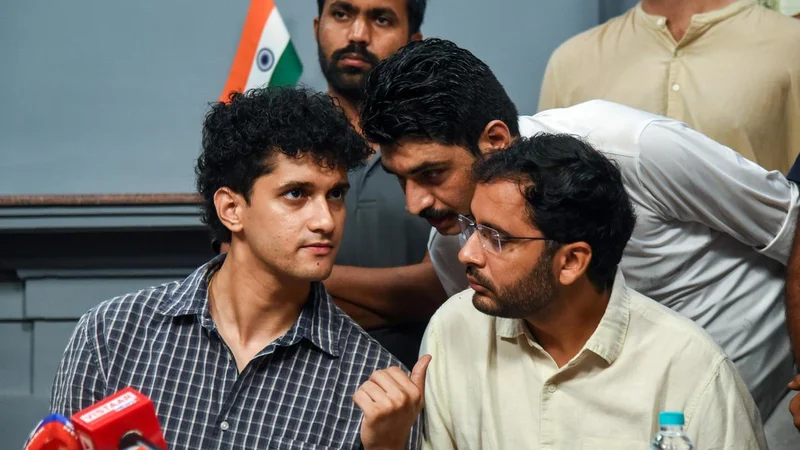
However, Union Education Minister Dharmendra Pradhan’s resignation on July 25 is the empirical refutation of that theory, delivered not by argument but by five weeks of evidence on the ground at Jantar Mantar. A demographic dismissed as apolitical assembled, sustained a peaceful sit-in through summer heat and police batons, absorbed nearly hundreds of injuries without abandoning non-violence, and extracted a Minister’s resignation from a government that has otherwise shown remarkable imperviousness to public pressure. If this is apathy, democracy should wish for more of it.
What distinguished this movement was not merely its scale but its idiom. These were protesters who came bearing copies of the Constitution rather than only slogans, who offered roses to policemen even as they were being dispersed, who turned steel thalis and spoons, props borrowed knowingly from the state’s own pandemic-era theatre, into instruments of satire aimed back at it. This is not the vocabulary of nihilism. It is the vocabulary of a generation fluent in irony as a mode of serious politics, one that understands, perhaps better than its elders, that humour can travel past censorship in ways that solemn protest cannot. To read this only as spectacle is to miss its argument: that mockery, deployed with discipline, is itself a legitimate register of democratic dissent, one with a lineage running from Czechoslovakia’s Velvet Revolution to Hong Kong’s umbrella movement.
Specific indictment
Nor were the demands inchoate. Behind the theatre lay a specific, documented indictment: a decade of examination failures, leaked papers (152 paper leaks across the country in the past 12 years), and administrative opacity at the agency entrusted with the country’s entrance tests, each episode individually forgettable, their accumulation devastating to an entire cohort’s sense that merit and effort still mean anything in India. When a system built to sort talent instead rewards proximity to leaked material, it does not merely inconvenience students; it corrodes the implicit contract between citizen and state that examinations, however imperfect, are meant to honour. What the protesters were defending was not one flawed test but the idea that the state’s mechanisms of opportunity remain trustworthy, arguably the most foundational promise a modern republic makes to its young.
This is where the episode earns its place in a longer argument about democratic theory rather than merely electoral news. Accountability in a democracy is rarely a single mechanism; political scientists distinguish between “vertical accountability”, exercised through elections at fixed intervals, and “horizontal accountability”, exercised continuously by courts, auditors, and legislative committees. What Jantar Mantar demonstrated was a third, less theorised form — accountability exercised directly by an unelected, unaffiliated public between elections, compressing what might otherwise have taken years of parliamentary questions and CAG reports into five weeks of sustained, visible pressure. Whether one welcomes this as a healthy supplement to sluggish institutional channels or worries about the precedent of street pressure substituting for procedure is a live and legitimate debate. But it cannot be dismissed as mob rule when the demand itself, competent, honest examination administration, is one no democratic government should need street pressure to deliver in the first place.
A quieter accountability story unfolded alongside the street protests, and it deserves to be named rather than assumed. For much of the five weeks, large sections of mainstream audiovisual media, the prime-time ecosystem that most Indians still consume as their primary window onto public events, either underplayed the scale of the demonstrations, framed the students as disruptive rather than aggrieved, or simply changed the subject when the visuals grew inconvenient for the government. It was print journalism, less dependent on advertiser sentiment for daily survival, that persisted with ground reportage, documented the injuries, and kept every record in public view long enough for it to matter politically. This divergence is not a stylistic footnote; it is a live demonstration of why a free press is called democracy’s fourth pillar rather than its fourth entertainment channel. A citizenry that receives its news primarily through a medium disciplined by ratings rather than verification is structurally disadvantaged in holding power accountable, and the lesson of these five weeks is one every consumer of news owes it to themselves to absorb: which outlets stayed on the ground, and which decided not to look.
Regional echo
The regional echo deserves sober attention rather than romanticism. Sri Lanka’s Aragalaya in 2022, Bangladesh’s student-led uprising in 2024, and Nepal’s Gen Z mobilisation in 2025 have each, in different registers, demonstrated that South Asia’s youngest cohorts are willing to convert economic and institutional grievance into direct political consequence with a speed their party systems were not built to anticipate. India’s variant is, so far, the most restrained of the four — channelled through peaceful assembly rather than regime rupture, resolved through a resignation rather than a collapse of government. That restraint should be read as a credit to India’s constitutional architecture holding under strain, not as evidence that nothing serious occurred. A young population increasingly indifferent to inherited party loyalties, organised through platforms no single institution controls, is now a standing feature of the subcontinent’s politics, and every incumbent from Colombo to Kathmandu to New Delhi would be unwise to treat it as an aberration.
The deeper reason education carries this much civic voltage is worth naming plainly. In a country where public employment has grown scarcer relative to the number of qualified aspirants, and where a private-coaching economy worth thousands of crores has arisen precisely to exploit anxiety about examinations, the testing system is not a peripheral bureaucratic function — it is the primary gate through which social mobility must pass. A leak or an administrative failure at that gate does not merely cost a student a year; it reallocates opportunity by proximity to malpractice rather than by merit, an injustice more corrosive to a young republic’s legitimacy than most economic grievances, because it strikes at the fairness of the one institution young citizens are told to trust unconditionally.
None of this is honoured by a resignation letter alone, however cathartic the moment. What the country actually requires is unglamorous and structural: a testing agency with genuine parliamentary oversight rather than executive-only accountability, transparent third-party audits of every examination cycle rather than post-facto damage control, statutory timelines for redress when leaks occur, and a public education budget restored to a trajectory of growth rather than retreat, so that families are not driven into a shadow coaching economy to compensate for the state’s underinvestment. A single ministerial exit changes personnel; it does not yet touch policy architecture, procurement contracts, or the perverse incentives that make leaks profitable in the first place.
What this generation has demonstrated, and what its critics would do well to absorb, is that indifference was never the diagnosis. The correct one is a democracy that had grown complacent about its own accountability mechanisms, rescued, however briefly, by citizens young enough to still expect it to work as advertised. Whether India’s institutions meet that expectation with reform, or merely with relief that the pressure has lifted, will determine whether this week is remembered as a turning point or a postponement. In the end, it turns out the “lazy generation” was just busy doing democracy’s homework.
Barkha Dwivedi and Kartikey Singh are lawyers based in New Delhi
Published - July 28, 2026 12:02 am IST