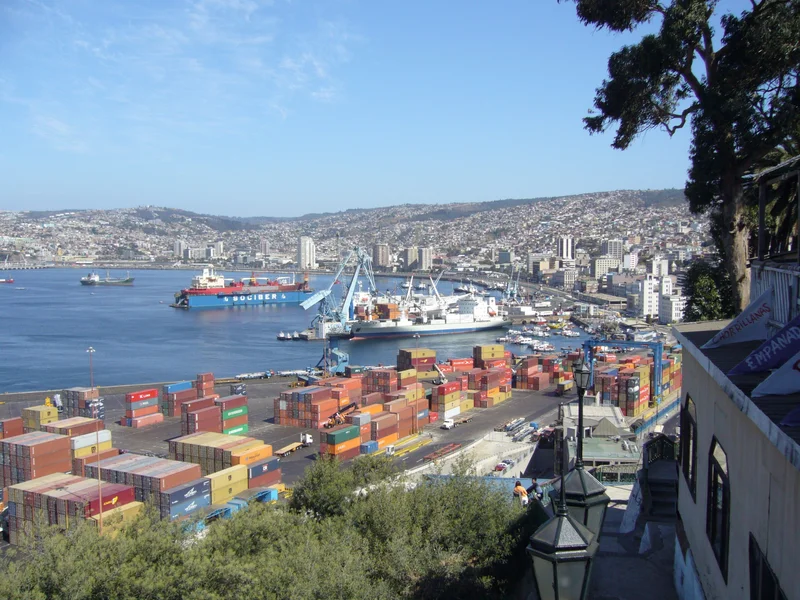
Valparaiso Port Expansion Gets Green Light After 12 Years
Chile · Business
Chile’s Committee of Ministers has confirmed the environmental permit for the Valparaiso port Terminal Cerros de Valparaiso (TCVAL) expansion, a decision that clears the main regulatory obstacle for a US$380 million project after more than 12 years of environmental evaluation.
What the Committee of Ministers Confirmed for the Valparaiso Port
The regional environmental commission (COEVA) had already unanimously approved the project earlier, in March 2026. The Committee of Ministers’ confirmation removes the last major administrative barrier, validating the environmental impact assessment for a new container terminal that will add berths and cargo-transfer capacity at Chile’s second-busiest port.
Who Holds the TCVAL Project
The TCVAL expansion is held by the Puerto de Valparaiso Company (Empresa Portuaria Valparaíso, or EPV), Chile’s state-owned port authority. EPV has held the project since 2019 and is responsible for overseeing the development of port infrastructure in Valparaíso, a historic coastal city about 110 kilometers northwest of Santiago, the capital.
Under Chile’s landlord port model, the state owns the infrastructure and awards long-term concessions to private operators. The environmental permit confirmation now clears the way for EPV to advance the project toward implementation, with an estimated investment of about US$380 million.
Why the Valparaiso Port Expansion Matters for Foreign Investors
Chile’s economy is deeply dependent on maritime trade. The country is the world’s top copper producer and a major exporter of lithium, fresh fruit, wine, and wood pulp. Bottlenecks at its central ports directly threaten the flow of these goods to global markets.
The Valparaiso port and the nearby San Antonio port together handle the vast majority of Chile’s containerized cargo. Both have operated near or above design capacity for years, driving up logistics costs and creating uncertainty for shippers and export-dependent businesses.
The TCVAL expansion is designed to significantly increase the Valparaiso port’s capacity by adding new berths and modern cargo-handling equipment. For foreign investors in mining, agriculture, or retail supply chains, expanded and reliable port infrastructure reduces demurrage costs and shipment delays. It also signals that Chile is serious about protecting its export competitiveness as global trade routes evolve.
A 12-Year Environmental Evaluation Timeline
The TCVAL project entered Chile’s environmental evaluation system in September 2014. Over the following 12 years, it underwent extensive scrutiny from regulators, local communities, and environmental authorities. Large-scale port projects in Chile have historically faced opposition from fishing cooperatives, tourism interests, and municipal governments concerned about coastal impacts.
The unanimous approval by COEVA in March 2026 marked a turning point, and the Committee of Ministers’ July 2026 confirmation closed the loop. While residual legal challenges from local stakeholders remain possible, the environmental permit is the critical regulatory milestone that had kept the project in limbo for over a decade.
The Broader Chilean Port Capacity Picture
Parallel to the Valparaiso port development, Chilean authorities have been advancing plans for the San Antonio mega-port, another project seen as vital to the country’s long-term trade capacity. San Antonio Terminal International (STI) is the existing major concession in that port, with its contract approaching expiration.
The San Antonio expansion aims to create a deep-water terminal capable of handling the largest class of container vessels. Together, the Valparaiso and San Antonio projects represent the most significant upgrade to Chile’s central port system in decades. For international logistics firms and export-dependent businesses, the dual-track approach offers a hedge against single-point failures in the country’s supply chain.
What Comes Next for the Valparaiso Port
With the environmental permit confirmed, EPV can now advance the TCVAL project toward the construction phase. The project involves building new berths, expanding the container yard, and installing modern cargo-handling equipment at the site.
Once operational, the new terminal will significantly ease congestion at the existing facilities, which have struggled to handle peak-season volumes. The combined capacity is expected to reposition Valparaiso as a competitive gateway for central Chile’s foreign trade.
Investors watching the project should monitor construction milestones and any residual legal challenges. While the main regulatory obstacle is now cleared, large port projects in Chile have historically required sustained engagement with local stakeholders to reach completion.
Frequently Asked Questions
What is the Valparaiso port TCVAL expansion?
TCVAL (Terminal Cerros de Valparaiso) is a new container terminal expansion at the Valparaiso port, held by the Puerto de Valparaiso Company (EPV) since 2019. It involves an estimated investment of about US$380 million and will add berths and cargo-transfer capacity.
Why did the Valparaiso port project take 12 years to get approved?
The project entered Chile’s environmental evaluation system in September 2014. It took roughly 12 years to complete the environmental review process, which concluded when the regional environmental commission (COEVA) unanimously approved it in March 2026 and the Committee of Ministers confirmed the Environmental Qualification Resolution (RCA) on July 27, 2026.
Who holds the TCVAL concession at the Valparaiso port?
The project is held by the Puerto de Valparaiso Company (EPV), Chile’s state-owned port authority. EPV has held the TCVAL project since 2019 under the country’s landlord port model, where the state owns infrastructure and awards long-term concessions to private operators.
Sources & Further Reading
Diario Financiero – Comite de Ministros destraba expansion · El Dinamo – Comite de Ministros confirma RCA Sitio Costanera
Sources: Committee of Ministers; Puerto de Valparaiso Company (EPV); regional environmental commission (COEVA).