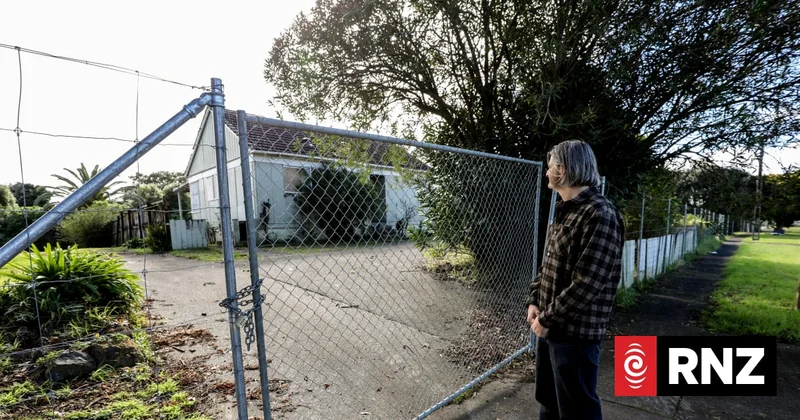
'Left to rot': Auckland residents say Kainga Ora ghost homes attracting illegal dumping
A resident on a central Auckland street say multiple boarded up houses and vacant lots have been "left to rot", after a major Kainga Ora project was stopped last year.
And a city councillor says the community feels "abandoned" after the government pulled the plug on the development, but the housing minister and Kainga Ora say some social homes are being planned.
Hundreds of homes were set to be built on O'Donnell Avenue, as part of the housing agency's Wesley West development.
Demolition began before the agency undertook a nationwide re-set last year.
Resident Stu Harwood said there were more than 30 empty Kainga Ora lots or houses on the street, and some had been fenced or boarded up for two years.
"They've effectively been left to rot.
"Because these houses are just degrading in plain view of everyone in the neighbourhood - it's now become a target for illegal dumping, they haven't been looked after at all. There's rubbish collecting, all up and down the street."
An old suitcase, mattress, spare tyre and mound of building materials are among items RNZ saw had been tossed onto the sections, or grass berms outside them.
Stu Harwood said signs urging against dumping and regular calls to the council hadn't stopped the dumping.
Auckland Council told RNZ it had 56 call-outs for illegal dumping on the street in the last financial year.
Harwood said there was a view among residents that the street had "gone downhill".
"It's a real shame, this street's got a school on it, Wesley Primary, you know it's a great neighbourhood, and it's a real shame to see these properties not used."
Kainga Ora's general manager of urban development and delivery, Nick Howcroft, said the agency had plans to transform 36 state house sites into 331 new medium-high density social and private market units in the area.
Residents were moved out between May 2024 and February 2025, and some demolition started, he said.
But following a government re-set of the agency last year, $72 million from the project was re-prioritised.
Howcroft said Kainga Ora is instead planning 39 2-4 bedroom state homes across four sites, predominantly for families, and had lodged a resource consent application with Auckland Council, with construction expected to start in late spring.
Albany-Eden-Puketapapa councillor Julie Fairey said that's a fraction of what had been imagined.
"It was going to be quite a much larger scale of redevelopment. They were talking about creating effectively a new town centre at the intersection of Sandringham and Stoddard Road.
"There was a lot of discussion with council about the council facilities that would be needed, potentially a new park in the area."
The Cityvision-backed councillor said the Wesely community felt abandoned after the development stopped, while thousands of others across the city needed housing.
"There's nothing happening with these sections...so they're attracting illegal dumping, there could be issues with rats or vermin, so not only is it an under-utilisation of land, but the community feel really abandoned, and that sucks."
Howcroft said Kainga Ora was regularly monitoring the sites for illegal dumping and doing regular ground maintenance on the properties.
"If neighbours are aware of any issues with people illegally accessing the sites or dumping rubbish, we would appreciate them letting us know."
'Big challenge'
Wesley Primary School principal Andy Crowe said he was expecting his school to grow from about 150 to 600 students.
The school was gearing up for multiple stages of development too - and in 2023 moved into new buildings ahead of major construction.
But plans for three more large hubs - the equivalent of 12 extra classrooms - ground to a halt.
He said families in the social houses were forced to move out of the area, including to Ōtāhuhu and Karaka.
"They basically are getting shipped everywhere else but staying in our community. Transience is a really really big challenge.
"One of the key drivers for our kids success, regardless of what school or socio-economic background, is that they get to stay in education, and they get to stay in the community that's supporting them."
Crowe said it's been difficult to re-set as a school, while meeting the strategic objectives of the curriculum.
He said he was pleased to hear the new homes being built on O'Donnell Avenue were predominantly for families, and might contribute to roll growth.
Data from the Ministry of Cities, Environment, Regions and Transport show there are currently 9356 people on Auckland's social housing register.
Fairey said she thought Kainga Ora staff wanted the larger development to go ahead.
"I think that a lot of the people at Kainga Ora would love to be able to progress this, but they do not have support from their minister, they do not have support from this government or Cabinet."
Housing Minister Chris Bishop said while the original development was paused, hundreds of homes had been built in the wider Mt Roskill area - with state homes still coming for Wesley.
"It's a gain in terms of social homes, yes. I mean we have tried to re-focus the Wesley component of the wider Mt Roskill project towards social houses.
"The large scale projects are a mixture of urban renewal for social houses, but also fundamentally just market houses. Just private sector market sales."
Bishop said he'd stressed to officials that empty state homes or land must be looked after to prevent rubbish dumping.
He said Kainga Ora owned 78,000 houses throughout the country and at any given point there would be demolition, sales, and vacancies.
At the end of March 2026 there were 400 empty Kainga Ora homes, down from 1300 when National went into government, he said.
"Sometimes there is a lag between someone moving out of the house and the land being re-developed. I've made a real emphasis on to KO on leaving homes unoccupied for as little time as possible, and we've started to see some good results in that sense."