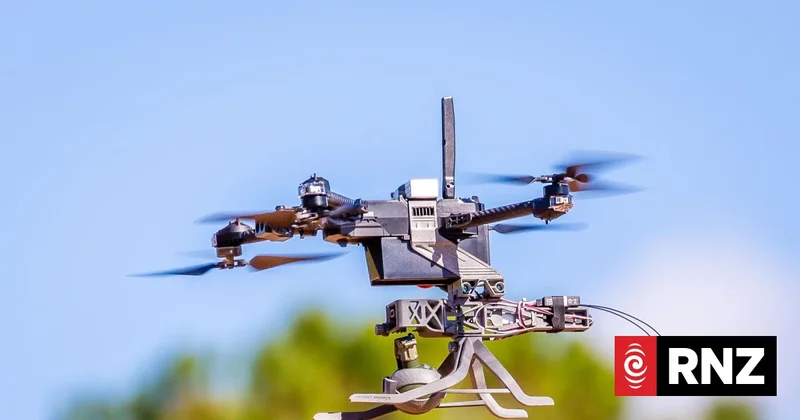
Imagine a drone you can quickly transform on the battlefield, swapping out weapons to deploy bombs, grenades, smokescreens and more.
The US Army is experimenting with this tech in the California desert alongside New Zealand and multinational forces this week.
Project Convergence Capstone is its biggest annual test of high-tech weapons.
The NZDF has sent about 50 personnel there, including some to run exercises.
"New Zealand is pleased to be deepening defence partnerships and operational engagement with the US across the defence enterprise," a recent briefing said.
Pictures showed NZ troops testing aerial drones, however they did not appear to be testing the new "plug-and-play" drone munition system, called Picatinny CLIK.
Ninety other high-tech systems are being tested at Convergence too, including drones that guide other drones equipped with missiles.
Behind all of them sits a data-sharing network the US is pouring billions into building with allies.
Competent integration or passive dependence?
Great-power competition expert and assistant professor Reuben Steff said Convergence exposed New Zealand to command-and-control, fire-control, sensor and human-machine integration experiments on a scale not possible at home - or at least not yet.
Steff, who is now based at Mendel University in the Czech Republic, said New Zealand had the prospect of establishing itself as a "proving ground" where partners could test defence AI in the country's wide open spaces.
"Get it right, and permissive testing becomes one of the few things New Zealand can offer the alliance that its larger members cannot easily reproduce at home," he wrote in a new study, Small Force, Big Data - Defence AI in New Zealand.
But get defence AI wrong and there were many risks, including "entanglement in others' kill chains". A kill chain links sensors - such as cameras on drones - with shooters - such as missile platforms.
"Ultimately, for New Zealand the central choice is not between sovereignty and integration. It is between competent integration and passive dependence," Steff said.
"The defence AI problem is less about whether New Zealand can become a major military technology power than whether it can build enough competence to remain useful, trusted, and sovereign inside allied systems."
'Immediate need'
The NZDF said its capability branch had been preparing for Convergence for months.
''We are building at pace a defence force that is interoperable, if not interchangeable, with our closest partners," a briefing for a bilateral meeting between Defence Minister Chris Penk and US Secretary of War Pete Hegseth in May said.
The test is set to end on Thursday (NZT).
The dominant partner was the US, and on the drone front one of its biggest pushes was to tap into commercially available drones.
"The US Army has an immediate need for lethality integrated onto unmanned systems, in order to achieve and maintain overmatch capability," the Department of War said.
That meant standardising how small, cheap drones could be made lethal easily. Enter Picatinny CLIK, named after the Pentagon's leading ammo development centre in New Jersey, which was also developing low-recoil guns for drones.
"The warfighter can very quickly employ the right payload for the mission at hand, every time," Picatinny Arsenal said.
This approach aimed to avoid getting stuck with one supplier - and at speed.
The NZDF's drone approach mirrored this - "Defence will favour modular and open architecture designs that allow components, payloads, and software to be updated or replaced quickly" - and it wanted quick wins, while at the same time aiming to get drones built locally to lower the risks from international supply chains.
'Ready or not'
For the US, the race is on for the tech to enable it to deploy Human Machine Integrated Formation platoons of ground and air drones next year.
The American Enterprise Institute put it this way in a new report: "Killer Drones: Ready or Not, Here They Come."
"Lethal autonomy is arriving, regardless of preference or treaty," it said.
The kill chain depended not just on the drone or weapon but on the data networks behind them.
Project Convergence had been "stress-testing" these too, as the US funnels fresh billions into joining up the allied data systems under an acceleration programme that began this year.
The Penk-Hegseth briefing said two of the four investment focuses for the NZDF over the next four years were drones and battlefield digital communications with partners.
"Innovation is no longer a supporting activity - it is central to delivery defence outcomes and maintaining readiness," it said.
As well as getting operationally closer to America, NZ is seeking "seamless" operations with the Australian Defence Force by 2035 under a new strategy.
AI to replace nuclear debate?
In his 62-page study, Steff laid out three scenarios for the country's AI defence future: drifting into a gap well behind partners, following Australia and finding niches to specialise in, or full-on allied network integration.
Option three meant "capability is maximised but independent room for maneuver is minimised", Steff said.
"For New Zealand the next sovereignty dispute may not be about whether a ship is nuclear-powered but whether New Zealand data, sensors, software, or operators are quietly embedded in an allied kill chain."
The country needed to get its act together to make any sort of smart choice, and that should include setting up a national defence AI integration office.
"This report has exposed a gap with AI responsibilities scattered."
And it needed debate.
"The country will need a vocabulary capable of discussing the above issues without either sensationalising them or hiding them behind soothing language about innovation. It will need experts who take the manifold issues involved in defence AI seriously.
"At present it has almost none."
Reuben Steff will join Nine-to-Noon on Wednesday morning.