American tariff threats are raising concerns for some New Brunswick businesses that rely on cross-border trade, despite the fact that the provincial government says the direct impact could be less than one per cent of its exports to the U.S.
U.S. President Donald Trump is threatening new 50 per cent tariffs on several Canadian goods, set to take effect Aug. 19 if no agreement is reached between the two countries.
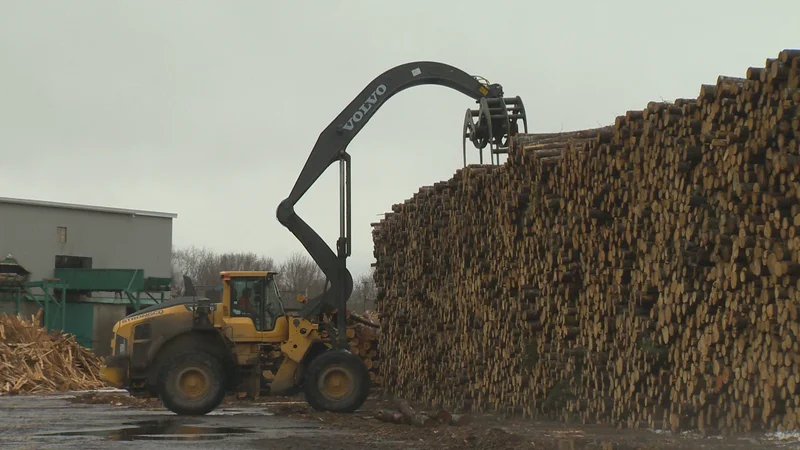
In New Brunswick, wood products — including plywood and finished wood products — are expected to be among the most affected goods.
As well, some paper, food and alcohol producers could be heavily impacted.
In a statement to Global News, the province’s Finance and Treasury Board Department estimated $112.1 million in exports could be affected, which represents 0.8 per cent of total U.S.-bound exports in 2025.
The highest-value good to be affected by tariffs is cartons, boxes and cases of corrugated paper or paperboard, which accounts for $44.2 million of the affected export value.
Get daily National news
Economist Herb Emery says the major concern in this scenario is where that impact lands.
“These tariffs in aggregate may not harm the overall economy, it would appear, but they are going to do significant damage to local communities,” said Emery, who is Vaughan Chair in Regional Economics at the University of New Brunswick.
He adds that many of these businesses may not be resourced to absorb major market changes.
The Canadian Federation of Independent Business (CFIB) says the uncertainty around tariffs is already making it harder for businesses to plan investments, hiring and expansion.
“Small businesses are the backbone of small economies; they hire, they have an impact, they have a social impact in every community,” said Frédéric Gionet, Atlantic director of legislative affairs for CFIB.
Emery points to communities that have lost major employers in the past and says the consequences are far-reaching.
“When you look at a place like Dalhousie, Campbellton, which lost its paper mill in the 2000s, you basically see a community that got gutted and has been shrinking and aging,” he said.
Emergy adds that an important question to ponder is what kind of economy New Brunswick wants to build: one driven by export industries such as forestry, or one that moves more toward government services.
Meanwhile, the province says Opportunities NB is working with companies to help it respond to the possible tariffs, including supporting productivity, market diversification and export development.
But the CFIB points out many businesses are still waiting to see meaningful progress on interprovincial trade.
“We found, and one of the stats we got from our members … nearly 70 per cent, 69 per cent reported not noticing any meaningful change in doing business across Canada over the past 12 months, with 16 per cent reporting that has become more difficult,” Gionet said.