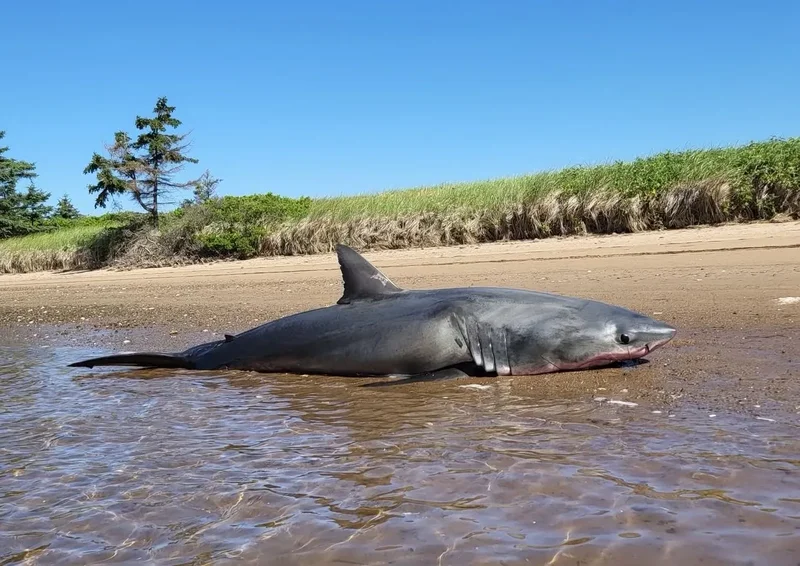
Researchers in northern Nova Scotia have yet to determine what caused the death of a large great white shark that recently washed ashore near Pictou.
The Nova Scotia-based Marine Animal Response Society says the body of the 580-kilogram male shark was discovered Friday on a beach, where researchers spent the weekend conducting a necropsy. The four-metre long fish weighs as much as a fully grown polar bear.
The non-profit group issued an online statement Monday saying Dr. Laura Bourque of the Canadian Wildlife Health Co-operative in P.E.I. could find no obvious cause of death, adding that more testing was needed.
The marine response group said the carcass was still fresh when it was examined.
“The sooner an animal is reported, the more we can learn,” the group said. “Fresh examinations allow us to collect higher-quality samples, document findings more accurately, and gather valuable information about species that are rarely available for scientific study.”
Sightings of great white sharks are being reported more frequently in Atlantic Canada, the group said.
Experts say conservation measures have helped the great white shark population recover from a drastic decline in the 1970s and 1980s, and there is evidence climate change has led to warmer ocean temperatures, making it easier for some ocean species to spread northward.
As well, there is evidence to suggest more great white sharks are coming to the region to feast on an ample food supply, which includes a healthy population of grey seals.
According to the St. Lawrence Shark Observatory, the last time someone was killed by a shark in Canadian waters was July 1953, when a shark rammed a lobster boat, causing it to capsize and one fisherman drowned but wasn’t bitten.
The observatory’s database of shark attacks in Canadian waters includes 30 records dating back to 1691.
There are only four other reports of fatalities, but all of those incidents are considered only plausible. Another 24 shark encounters did not result in any human injuries. The North Atlantic great white population has been protected in Canada since 2011 and in the United States since 1994. And aside from more frequent sightings, there have been reports in Nova Scotia of two attacks in recent years.
In August 2021, the RCMP in western Cape Breton reported that a 21-year-old woman had allegedly been bitten by a shark while swimming near Margaree Island. According to published reports, the woman was airlifted to hospital to get stitches on her thigh.
But an entry in the observatory’s Canadian Shark Attack Registry says there isn’t enough evidence to confirm the woman’s claim, citing a lack of photographs or any forensic analysis of her wound.
“Likewise, no individual directly involved has publicly presented evidence permitting definitive identification of the species responsible,” the entry states. “Based on the available evidence, the Canadian Shark Attack Registry considers this case a plausible shark bite involving a swimmer, with the balance of evidence strongly favouring a white shark.”
In October 2023, an anonymous hunter reported that a shark had killed his dog as it was retrieving a sea duck close to shore, near Port Medway, N.S.