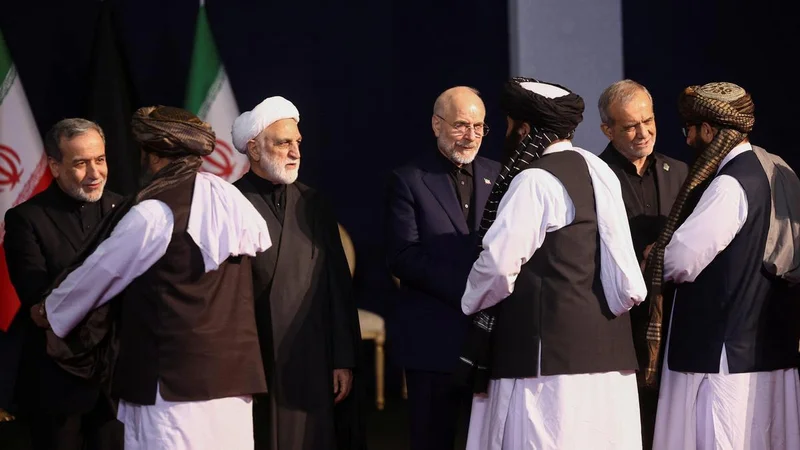
The funeral proceedings of Iran’s late Supreme Leader, Ayatollah Ali Khamenei, that stretched over a week amid a spiralling war and significant internal turmoil at the seat of power for Shiism, saw multiple personalities visit Tehran. Almost unnoticed, however, was the presence of delegations from both the Taliban and the opposition Northern Alliance. The two have been fighting each other, in various iterations, over Afghanistan since the 1990s.
Complex equations
The presence of the Taliban’s Deputy Prime Minister for Economic Affairs Mullah Abdul Ghani Baradar along with Taliban Foreign Minister Amir Khan Muttaqi on the one hand and the Northern Alliance’s Ahmed Massoud, son of the group’s founder Ahmed Shah Massoud on the other, highlighted the delicate game of geopolitics that continues to persist on Tehran’s eastern front. While Iran is the one country which has built the strongest influence with Kabul since the collapse of the government of President Ashraf Ghani (August 2021), it still does not officially recognise the Taliban government. This is hardly surprising, considering that until the 1990s, Iran, along with India, Russia, Tajikistan and other neighbouring and foreign states, supported the Northern Alliance.
The chaotic withdrawal of the United States from Afghanistan, in August 2021, two decades after a post-9/11 war launched against al Qaeda was a critical moment in Tehran. The consistent and massive deployment of western military power on its borders was a perpetual nightmare that had to be factored into its calculations. Pakistan’s support for and incubation of the Afghan Taliban, while simultaneously backing the U.S.-led ‘war on terror’, created a sinkhole of competing interests, where the Venn diagram of who was supporting whom became so convoluted that foreign powers often ceded the upper hand to regional players. The fact that al Qaeda founder Osama Bin Laden was eventually found in Abbottabad, Pakistan (May 2011), in a large house — and not a cave in the infamous Tora Bora — was not a coincidence.
The Afghan chessboard
The Iranian viewpoint on the Taliban and the Afghan landscape changed significantly after 9/11. While Tehran remains sceptical of the Taliban and the future of its rule to this day, it simultaneously recognises that an insurgency-turned-government will always carry a question mark over its long-term stability. The ideological and tribal fissures that persist also require micromanagement, which means creating enemies along volatile borders is not in anyone’s long-term interests.
Following 2021, the Taliban was in search of both power and patronage. Iran could offer some of the power, but only a limited amount of the patronage. The calculation behind this was to free up a major front from as much conflict as possible. The Northern Alliance, largely concentrated in the mountainous northern province of Panjshir, was both weak and disorganised, with infighting having hollowed out any possibility of cohesion and structure. In fact, since February, as clouds of war gathered, the Taliban reiterated that it would support Iran should the country come under attack. Zabihullah Mujahid, a spokesman close to Taliban emir Hibatullah Akhundzada, said in an interview with Iranian state radio that they would support Iran if need be. The nature and extent of such support, of course, remain subjects of debate. Diplomatic support from Kabul has been robust over the past year, including access to the country’s civilian airports.
But the Iranians hosting Masood and the Northern Alliance delegation in Tehran shows that, despite the war in West Asia, Iran is not willing to put all its eggs in one basket when it comes to Afghanistan. The country, and its intricacies, remain a problem that needs strategic management. The fact that the Taliban is still prioritising solidifying its own power and structure, especially between Kabul, the political capital, and Kandahar, the ideological one, highlights that homogeneously supporting the group is still not seen as being wise. For Tehran, this geography remains critical. For example, Quds Force, the powerful Islamic Revolutionary Guard Corps’ (IRGC) elite external operations branch, has been run by Esmail Qaani since the assassination of Qasem Soleimani in 2020 by the U.S. Qaani, is known to be a Khorasan hand (Iran’s north/eastern neighbours such as Afghanistan, Turkmenistan, among others). Qaani’s operational history goes back to the Taliban versus Northern Alliance era of the 1990s.
Ties with Pakistan
The war currently engulfing West Asia is expected to remain a constant for at least a few months to come. Pakistan’s role as a mediator between Tehran and Washington DC, has given a new lease of ‘brotherhood’ between the two. Nonetheless, their aims are divergent. For Pakistan, the objective is to get back into the good books of both the U.S. and Gulf partners (Islamabad now has troops stationed in Saudi Arabia). For Iran, it is about reaching out to the U.S. through a neighbour it knows, if not trusts, better than most. The Iran-Pakistan bilateral relationship is incidental to everything else.
Increasingly, no binaries exist in international diplomacy. Neither do brotherhoods. Every hug is exchanged with one eye always open. These realities predate contemporary politics in South Asia and West Asia, long before the disintegration of western power began to take the shape we are witnessing today.
Kabir Taneja is Executive Director of the Observer Research Foundation Middle East
Published - July 29, 2026 12:08 am IST