Start with what a quantum computer actually is, because the industry never bothers to explain it. Your laptop stores everything as bits, tiny switches that are either 0 or 1. A quantum computer uses qubits, which can be 0 and 1 at the same time, a genuine weirdness of physics that lets the machine explore huge numbers of possibilities at once.
That is why governments and companies believe these machines will one day design new drugs, new batteries and new materials that no normal computer could ever figure out.
But here is the catch nobody puts out: to do any of that useful work, you need thousands of qubits working together. The best machine on earth today only has 98!
Why so few? Because of how the qubits are built. One of the leading methods, called trapped ions, uses single charged atoms as qubits, floating in a vacuum, held in place by electric fields, like marbles balanced in an invisible groove. These atomic qubits are the most accurate ever made. But the invisible groove has a shape, and for twenty years that shape has been a straight line. Atoms sit in single file, one behind the other. Want more? Make the line longer, which gets unstable, or connect several lines with junctions, basically road intersections for atoms, which are so hard to engineer that entire companies have spent a decade on them. The line is why quantum computers have stayed small.
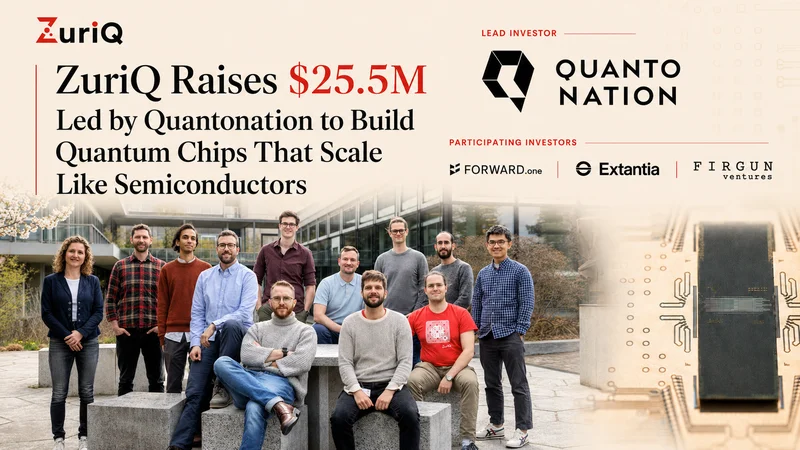
ZuriQ believes the line itself is the mistake. The Zürich based company announced a $25.5 million seed round, led by Quantonation, the Paris and Boston fund that invests exclusively in physics startups, with participation from Forward.one, Extantia, Firgun Ventures, and every investor from its $4.2 million pre-seed, including Founderful. The pre-seed funding round in ZuriQ was led by Founderful with participation from SquareOne, First Momentum Ventures, OnSight Ventures and QAI Ventures.
Total funding now for the deeptech startup stands at $29.7 million, eighteen months after the company spun out of ETH Zürich. ZuriQ's atoms do not sit in a line, they sit on a flat surface, like pieces on a chessboard, and they can slide in any direction, which means there is no single file to maintain and there are no intersections to engineer.
The arithmetic explains why that change matters more than any incremental improvement could. A line with ten positions holds ten atoms. A ten-by-ten surface holds one hundred, and a hundred-by-hundred surface holds ten thousand, on a chip that has barely grown. A line adds capacity one atom at a time, while a surface multiplies it, and that difference is the entire pitch. It is an unusual pitch for a quantum company in 2026, because it contains no claim about being the biggest machine today. It is a claim about which design grows fastest from here, and in a field where every roadmap ends at "thousands of qubits," the growth rate is the only number that decides the winner.
The Most Expensive Design Choice in Quantum Computing
The capital cycle turned before the architecture question was answered, and the gap between those two facts is where ZuriQ's opportunity sits. Investors put $12.6 billion into quantum startups in 2025, more than six times the 2024 total, according to McKinsey, and nearly all of it was private capital rather than government money. Venture funding alone grew 192 per cent in a year, and McKinsey now estimates the technology could generate up to $2.7 trillion in economic value by 2035. Money at that scale is no longer asking whether quantum computers will matter. It is asking which design reaches thousands of qubits first, and despite what the public listings suggest, that question remains open.
The clearest evidence that it remains open is what the current record holder had to build to reach 98. Quantinuum's Helios, the best trapped-ion machine in the world, is superb engineering, and it is also a monument to the line problem. The system needs a rotating storage ring and a junction simply to ferry atoms between its two work areas, which makes it resemble a factory where half the floor space is corridors. Each additional qubit demands more of this internal transport, so the machines grow more complicated faster than they grow more powerful. An architecture whose overhead compounds with its size is an architecture with a ceiling, and every serious roadmap in the field is a plan for negotiating with that ceiling rather than removing it.
Founder-Market Fit, Measured in Atoms on a Chip
If any founding team has earned the right to challenge that design, it is, plausibly, this one. Dr. Pavel Hrmo, Dr. Tobias Sägesser and Dr. Shreyans Jain all worked in the ETH Zürich laboratory of Professor Jonathan Home, one of the most respected trapped-ion researchers in the world, and it was in that lab that the theory behind ZuriQ's flat-surface design was first published. Jain is one of the paper's authors, which means the founders did not license this idea or discover it in the literature. They created it. When they incorporated the company in 2024, Hrmo also said the quiet part out loud, telling interviewers that machines with 20 to 40 qubits would never generate real profits and that the only design worth building was one whose count could grow quickly.
The eighteen months between the two rounds are what closed this one. In January 2025, ZuriQ raised $4.2 million in a pre-seed led by Founderful, the Swiss early-stage fund, with SquareOne, First Momentum Ventures, OnSight Ventures and QAI Ventures participating, at a point when the company had a published theory and exactly one floating atom to show for it. Since then the team has grown from four people to eighteen, hiring engineers away from rivals IonQ, Xanadu and Hamamatsu, which is a meaningful signal in a field where perhaps a few hundred people worldwide can build these systems. Together with ETH Zürich researchers, it demonstrated a working array of nine atoms, each individually controlled, arranged in a 3x3 grid. Nine sounds modest until you learn that it is the largest two-dimensional array of its kind ever demonstrated, and that the previous state of the art for this architecture was a single atom. The chips behind the demonstration were manufactured by Infineon, the German semiconductor group whose processors sit in cars and bank cards around the world.
The step-up between the rounds carries its own information. A 6.1x increase in round size over eighteen months is well above the typical European deep tech progression, and it happened with every pre-seed investor returning, including Founderful, the fund that had watched the demonstrator come together from a board seat. Investors with inside information re-committing at a much higher price is the strongest signal available in private markets, because they are the parties with the least excuse for being wrong. The syndicate also stayed deliberately specialist, anchored by a physics fund rather than a generalist growth firm, which suggests the round was priced on technical milestones rather than on narrative.
The Infineon relationship deserves more attention because it addresses the specific failure mode that kills novel chip architectures. New designs usually die in the factory rather than in the laboratory, as beautiful physics that no production line can reproduce at volume. ZuriQ's design already runs on an industrial line, which its rivals building in university cleanrooms cannot yet claim. The company is not asking investors to believe its chip can be mass-produced someday, because it already holds the invoices that prove it can be produced today.
One Magnet and the Intersections Disappear
The mechanism behind the flat surface is easier to grasp than most quantum hardware. The old designs hold their atoms with electric fields that flicker billions of times per second and it is precisely that flickering that forces the atoms into single file. ZuriQ removes the flickering entirely. It uses one large, steady magnet combined with a chip covered in microscopic electrodes, and in that arrangement an atom can be parked at any point above the chip's surface and slid in any direction, the way a piece moves across a board. The junctions that incumbents spend years engineering are not simplified in this design. They are eliminated because there are no lanes left to connect!
That substitution changes the nature of the scaling problem which is the most analytically important point, we need to understand from a technical perspective. Under the old design, growing a machine means solving fresh physics puzzles, because longer chains bring instability and every new junction is a research project. Under ZuriQ's design, growing a machine primarily means manufacturing a larger chip and manufacturing larger chips is the one problem the semiconductor industry has spent fifty years perfecting.
ZuriQ has, in effect, transferred the hardest problem in quantum computing to the one industry that already knows how to solve it and the Infineon partnership is the evidence that the transfer is real rather than rhetorical.
Nine qubits against Helios's 98 looks like a rout until you compare what each number can become. The incumbents add qubits one atom and one junction at a time, while ZuriQ adds them by enlarging the board and the entire investment case lives inside that difference.
Geometry Does the Heavy Lifting
A quantum computer is a team sport in which qubits constantly need to work in pairs and ideally any qubit should be able to pair with any other. On a line, two distant atoms must be shuffled past every atom between them before they can interact and all of that shuffling wastes time and introduces errors. On ZuriQ's surface, any piece can slide directly to any other piece. Easy pairing is the precise reason trapped ions already hold the best error-correction results in the industry and error correction is the gate through which every commercially useful machine must eventually pass.
Professor Jonathan Home of ETH Zürich, scientific adviser to ZuriQ, explains
What makes this approach powerful is geometry, Hold ions in a line and the count grows one at a time; hold them in two dimensions, and it grows with the area of the chip. On a standard chip, that is the difference between tens of ions and many thousands.
Just as important, the ions can be moved freely in three dimensions, so they can be connected together far more flexibly, and that connectivity is what ultimately makes a quantum computer more capable. Reaching the scale and connectivity that real applications will need has been the central challenge for the whole field."
Home is arguing that ZuriQ keeps the modality's strongest property and removes its size limit at the same time, which is a combination no incumbent currently offers. His endorsement also carries unusual evidentiary value, because he is not a hired adviser lending a name to a deck. He wrote the theory that the company is now testing.
The Founder’s Perspective: The Hard Rebuild Belongs to the Incumbents
Hrmo's core argument, laid out above, is a claim about technical debt (the thing which keeps every software engineer and technical architect awake at midnight) and….it is sharper than the usual challenger positioning. He is not claiming that IonQ and Quantinuum are failing, since both shipped impressive machines in the past two years.
He is claiming that their own roadmaps will eventually force them to rebuild in two dimensions, and that they will be doing it the way a family renovates a house it is still living in: on top of foundations poured for a different building, without breaking the systems that customers already pay for, and while carrying the fixed costs of a commercial operation. ZuriQ built on empty land, and Hrmo frames the extra years his team spent in the laboratory not as lost time but as the price of finding a route that avoids the rebuild entirely. The argument is testable against his own record, because he has been making it in public since January 2025, when his company controlled exactly one floating atom. Eighteen months later he controls nine of them in a grid, with an Infineon production line behind them, which is the difference between a thesis and a track record.
The team behind the argument is as deliberately constructed as the argument itself. The three founders cover the full arc from theory to machine: Jain co-authored the paper that proposed the architecture, Sägesser built the experimental systems that proved single-ion control in Home's laboratory, and Hrmo, whose research career runs through the same group, now carries the commercial case. A founding team that owns its own theory, its own experimental proof and its own narrative does not depend on any external laboratory for its roadmap, which is rarer in quantum computing than the funding announcements suggest.
The recruiting record then functions as an independent audit of the science. Perhaps a few hundred people worldwide can build trapped-ion systems, those people can work anywhere they choose, and eighteen of them, including engineers from IonQ, Xanadu and Hamamatsu, chose an eighteen-person startup in Zürich over a listed incumbent. In a talent market that small and that informed, the migration pattern is a judgment on where the interesting physics lives.
The Investor Thesis: Betting Against the Word "Decided"
Jurczak's view is that the quantum race is not yet decided and should be read as the actual bet rather than as conference-panel politeness and the market context explains why. The past year handed the field its first major paydays, including Quantinuum's stock market listing and IonQ's multi-billion-dollar acquisition run and when a sector begins producing public companies, capital naturally concludes that the winners have been chosen.
Quantonation is structured to take the other side of that conclusion. The firm invests from a fund of roughly €220 million dedicated entirely to physics startups, and its portfolio already holds Pasqal, which builds machines from neutral atoms, and Diraq, which builds them from silicon spins. Read as portfolio construction, the ZuriQ position fills the trapped-ion slot with the one company in that modality whose architecture is not a variation on the incumbent blueprint. A specialist fund does not spread its capital across qubit technologies because it is unsure which physics wins. It spreads because it believes the architecture question is still where the largest returns are made, and this round is that belief expressed as a term sheet.
The rest of the cap table tells the same story at every layer. The pre-seed, closed in January 2025, was led by Founderful, the Swiss fund built specifically to back the country's technical spinouts at their earliest stage, with SquareOne and First Momentum Ventures, two of Europe's dedicated deep tech seed firms, OnSight Ventures, and QAI Ventures, an investor that concentrates on quantum companies specifically. That is a syndicate of specialists, and every one of them returned for the seed at a price roughly six times higher. Investors with board-level visibility into a company for eighteen months hold the most information and the least excuse for being wrong, so their decision to re-commit at the new mark is the strongest signal private markets can produce.
The new names extend the pattern rather than diluting it, because Forward.one brings a hardware and industrial technology mandate, Extantia adds a fund whose thesis runs through energy and computation, and Firgun Ventures rounds out an early-stage bench. There is no generalist momentum capital anywhere on this list, and in a sector currently awash in exactly that kind of money, its absence reads as a choice. ZuriQ is being priced by people who can check the physics, and the people who can check the physics keep raising their bid.
What Has to Go Right
Honest analysis requires naming the hard parts, and ZuriQ has four worth naming. The first is accuracy. Qubits are fragile, and every operation carries a small chance of error. The old designs set a brutal benchmark, because Helios makes fewer than one error per thousand qubit-pair operations. ZuriQ now has to show that its atoms perform just as cleanly while sitting in a magnetic field on a moving two-dimensional grid, and it has to show it at scale. Until those numbers are published, the company has proven that the board holds pieces, not that the pieces play a clean game.
The second is that nine atoms have to become hundreds without the physics fighting back. Atoms packed onto a crowded surface can interfere with one another, heat up in ways that cause errors, and complicate the aiming of the laser beams that control them. Each of those problems worsens as the grid grows, and the company's stated target of hundreds of qubits per chip is exactly the regime where they accumulate.
The third is that the talent flywheel has to keep spinning. Eighteen people are competing against a publicly listed Quantinuum and an IonQ that acquires a company nearly every quarter, and a challenger wins that fight only by remaining the most exciting physics shop in the field. The hires from IonQ, Xanadu and Hamamatsu suggest ZuriQ holds that position today, and it will need to hold it through the unglamorous years of scaling that come next.
The fourth is that Hrmo's own argument can flip against him. If one of the large incumbents produces a workable two-dimensional design before ZuriQ reaches competitive accuracy, the head start shrinks to a footnote, and the company will have spent its lead proving a point the market no longer needs proven.
Final Thoughts
The hardware companies that ended up mattering were rarely the ones with the biggest number at launch. They were the ones holding the better growth curve when the market finally demanded size. The trapped-ion incumbents own today's records, and they earned them honestly. What none of them owns is a design in which adding qubits mostly means manufacturing a slightly larger chip on a production line that already exists, and that specific asset is what $25.5 million has just bought into.
Seed announcements are easy to make and hard to interpret, but this one comes with an unusually clean test. Either ZuriQ's grids grow from nine atoms toward hundreds over the next two years, with accuracy the incumbents are forced to answer for, or they do not. Qubit counts and error rates are public, benchmarked and merciless, and a startup that cannot hide behind its own metrics is, in a field drowning in roadmap slides, the most honest thing this funding round communicates.
Don't forget to like and share the story!
Vested Interest Disclosure: HackerNoon has reviewed the report for quality, but the claims herein belong to the author. #DYOR.