Commentary: Latest excuse for US tariffs somehow arrives at the same conclusion as previous attempts
US President Donald Trump’s tariffs were in search of a legal justification. Forced labour is the latest one, says Hinrich Foundation’s Deborah Elms.
SINGAPORE: First, it was a national emergency, then “international payments problems” and now, forced labour in the supply chain.
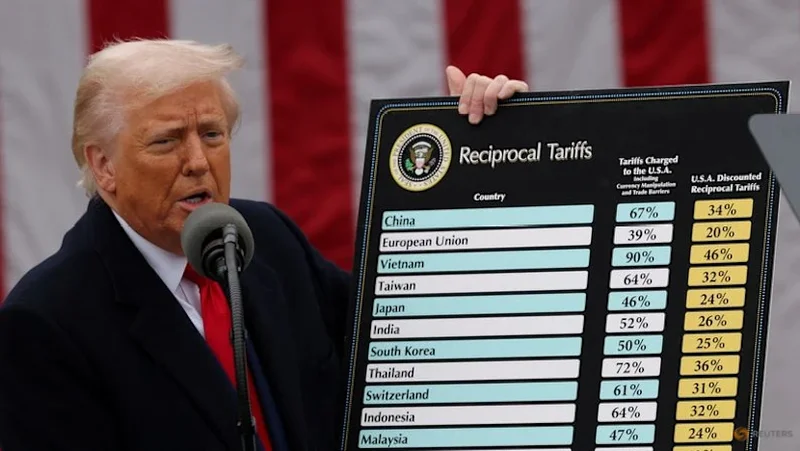
In little over a year, the Trump administration has invoked three legal justifications for its broad tariffs. Three different laws designed to tackle three separate problems, yet they have somehow affected goods trade nearly exactly the same way.
On Friday (Jul 24), the United States imposed tariffs on 60 trading partners, including Singapore, at levels ranging from 10 per cent to 12.5 per cent. The latest excuse is that all 60 were found to inadequately limit trade in goods made with forced labour. Their inability to effectively enforce such bans created unfair trade conditions for American companies, and thus, the White House proclaimed, it was necessary to impose tariffs against all these trade partners to create a level playing field.
That President Donald Trump would rebuild his tariff wall was never really in doubt. The challenge was which law could keep it standing.
THIRD TIME’S A CHARM?
This third attempt is likely to be more legally durable. Section 301 of the Trade Act of 1974 is an established trade instrument, compared to Mr Trump’s use of emergency or temporary powers in the first two rounds.
Mr Trump’s first choice of trade tool was overturned by the US Supreme Court in February, when it rules that he exceeded his authority under the International Emergency Economic Powers Act (IEEPA). Days later, the administration turned to a second option to temporarily reinstate a 10 per cent global tariff on foreign imports.
This temporary protection under Section 122 expired on Friday. At the exact same moment, the new Section 301 tariffs took effect.
Section 301 has a long track record, with more than 100 cases dating back to the 1970s. It gives the US power to investigate and target unfair foreign trade practices that hurt US business. The US could have used Section 301 to build a tariff wall from the start of Mr Trump’s second term in January 2025.
But Section 301 requires that a variety of procedural steps be followed, including an investigation, formal consultations and public hearings, making it harder for a US president to simply impose tariffs on a whim.
STRETCHING THE FORCED LABOUR RATIONALE
While this round of tariffs is potentially harder to overturn by domestic US courts, the application of Section 301 in this circumstance could still face legal challenge.
Section 301 has never been applied so broadly, nor has it been used so rapidly with so little time and attention given to a careful assessment of evidence. Indeed, two small businesses sued Mr Trump and his administration just hours after the tariffs took effect, arguing that Section 301 was a “mere pretext for recreating” the IEEPA regime.
It raises the question: Does the forced labour rationale adequately explain the breadth of the current tariffs?
Trading partners were placed into three basic “buckets”, but the categorisation appeared not to take into account any differentiation of existing prohibitions of forced labour inputs or of the effectiveness of enforcement.
For example, trading partners that simply signed a recent trade deal with the US (none of which are even in force domestically) that includes language of forced labour received a 10 per cent tariff. They got exactly the same tariff treatment as countries with robust domestic legal structures and clear records of enforcement.
Tariffs are now in place against 99 per cent of all inbound trade to the US, but inconsistencies show up in the wide array of exemptions. There are many products not included in the announcement, including goods not produced in the US, goods that would create hardship for the broader US economy if new tariffs were added, and energy and fertiliser products.
Excluding these goods further undermines the official legal justification for tariffs, as some of these product categories might have included items made with forced labour. Conversely, many items are now subject to tariff application with zero evidence that forced labour has been involved in any aspect of the production processes for these goods.
One thing, however, has remained remarkably consistent. The overall tariff coverage, including lists of excluded goods, under Section 301 looks almost identical to the now-overturned IEEPA tariffs imposed in response to a national emergency and now-expired the tariff coverage under Section 122 justified by a balance of payments problem. It could be hard to argue that three different legal routes led to such similar outcomes.
A LAW FOR MANY GRIEVANCES
Even if the current forced labour tariffs are challenged, Section 301 is likely to remain central to the Trump administration’s tariff strategy, because its flexibility allows it to be adapted to pursue very different trade grievances.
Already, 16 US trade partners are currently under investigation in a separate Section 301 case that alleges structural excess capacity. For some of these economies, the US cited their large trade surpluses as de facto evidence of overproduction.
Even those with overall trade deficits with the US were targeted: For example, Singapore was investigated on the grounds of excess capacity in semiconductors. According to Singapore’s written submission to the probe, the US exported US$3.8 billion more in semiconductors than it imported from Singapore. Yet Singapore could still be hit with higher tariffs in the future.
Section 301 tariffs are not the only trade actions being considered by the White House. The US continues to reach for a wider range of trade instruments than used by past administrations.
This includes Section 338, a never-before-used statute from 1930, which allows the US to impose tariffs of up to 50 per cent for discriminating against US commerce. Last week, Mr Trump applied the rule at the maximum rate to imports from Canada, to take effect next month.
The legal justifications may keep shifting but a tariff wall around the United States is here to stay.
Deborah Elms is Head of Trade Policy at the Hinrich Foundation.