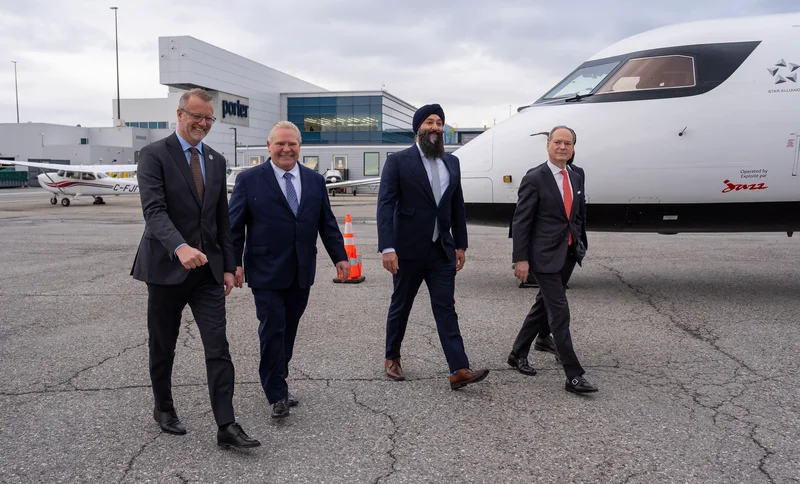
Ottawa bowed to a “small fringe group” when it announced it would block the province’s push for a massive expansion of Billy Bishop Toronto City Airport to allow commercial jets, Ontario Transportation Minister Prabmeet Sarkaria said Tuesday.
“We’ve seen the federal government here listen to a small fringe group in Toronto,” Mr. Sarkaria told reporters at an unrelated announcement in St. Thomas, Ont. “But we as the province will continue to push forward on modernization of this airport.”
Late last Friday – the same day a federal online consultation on the idea had wrapped up – Transport Minister Steven MacKinnon issued a statement saying Ottawa would not proceed with the plan “at this stage.” Mr. MacKinnon said the government had received more than 87,000 responses, mostly from Torontonians.
A federal source told The Globe last week that an overwhelming majority was against the expansion. The Globe did not identify the source, as they were not authorized to comment publicly on the matter.
Opponents have argued that the proposal to allow jets at tiny Billy Bishop – and 10 million passengers a year, more than five times the current number – would spoil the Toronto Islands, harm the harbour and the rest of the city’s waterfront and create traffic headaches. The issue has long been a flashpoint in local politics.
However, Mr. Sarkaria said the province would continue to work with the Toronto Port Authority, the arm’s-length federal agency that oversees the island airport, as the agency develops its expansion plan. He urged the federal government to reconsider.
“It’s also about building big projects,” the minister said. “You know, if Prime Minister Carney and his team, if this is how they’re going to treat bigger projects, I don’t think you’ll get much built.”
In addition, Mr. Sarkaria said that despite a demand from Toronto Mayor Olivia Chow, Ontario would not repeal the legislation it passed earlier this year that expropriated the city, which opposes expansion, of its stake in the airport and its say over the airport’s future.
Toronto City Council is expected to vote this week on a resolution calling for the repeal of the bill. The legislation also gave the province sweeping discretion to choose to expropriate much of the rest of the Toronto Islands, as well as part of a city park on the mainland opposite the existing terminal.
Ontario NDP Leader Marit Stiles said Tuesday that the law, known as Bill 110, should be ripped up. She took aim at Mr. Sarkaria’s “fringe group” comment, saying it was a “pathetic insult to the tens of thousands of people who fought back against this ridiculous project.”
The expansion to allow jets is separate from plans, already approved by the city, to allow the airport to add 150-metre safety buffer areas at each end of its main runway, as required by new Transport Canada rules.
Long before Ottawa’s announcement last week, both Premier Doug Ford and the Toronto Port Authority’s president and chief executive officer, Roelof-Jan (RJ) Steenstra, had said the federal government supported allowing jets.
Prime Minister Mark Carney had called the concept an “interesting vision” in March. But by June, he said he had “not formed an opinion” and pledged public consultations – after several of his Toronto Liberal MPs had issued cautious statements and received negative feedback from constituents. His narrow Liberal majority government faces a by-election in the waterfront riding of Beaches-East York next month.
The Premier’s move to expropriate the city’s stake in the airport allowed the province to take Toronto’s place in what is known as the tripartite agreement, a 43-year-old consensus deal between the city, the Toronto Port Authority and the federal government that governs Billy Bishop and currently bans jets.
Mr. Ford had also vowed to use new powers his government has given itself to declare the airport a “special economic zone” where any provincial law or municipal bylaw could be suspended, in order to speed construction – although this authority has no effect on federal laws, which govern aviation.
Commercial carriers Porter Airlines and Air Canada currently fly 78-seat turboprops out of the airport. Terminal owner Nieuport Aviation, which is controlled by J.P. Morgan Asset Management, had lobbied governments for an expansion.
In an interview with The Globe in April, the port authority’s Mr. Steenstra said a final plan would not be ready for months. He said the concept, which would allow for single-aisle 135-seat jets, entailed adding up to 600 metres to the facility’s 1,218-metre main runway.
That’s in addition to the 300 metres of safety areas already required. In all, it could mean the creation of 900 metres in new artificial peninsulas off the island facility. Mr. Steenstra later told a legislative committee the price tag could be as much as $5-billion.