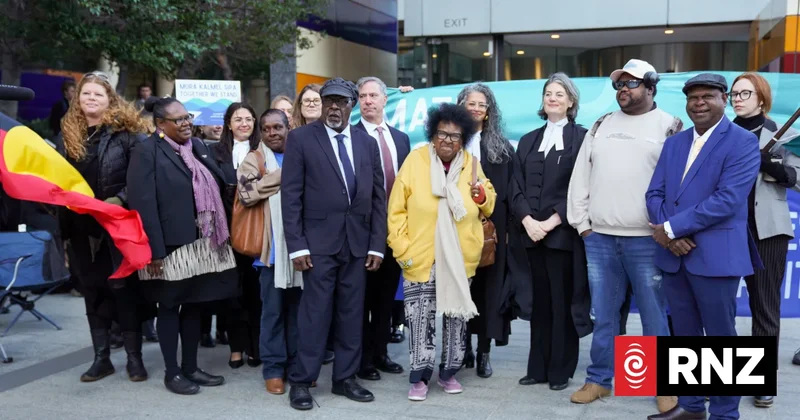
Two Torres Strait community leaders have returned to Australia's federal court this week to appeal the decision of their landmark climate case against the Australian government.
Torres Strait elders challenge climate ruling decision
The two elders, known as Uncle Pabai Pabai and Uncle Paul Kabai, claim the government has failed to protect them from the impacts brought on by the climate crisis.
In 2021, the pair filed the first-ever negligence case in Australia, which was heard last year by a federal judge who found the government "does not owe" https://www.rnz.co.nz/news/world/567046/court-finds-no-duty-of-care-owed-to-torres-strait-islanders-over-climate-change Torres Strait Islanders the duty of care to protect them from climate harm despite presenting scientific evidence.
Uncle Pabai and Uncle Kabai are now challenging that decision, arguing that the government does owe duty of care to Torres Strait Islanders. If this case is successful, it could potentially force the Australian government to rapidly reduce emissions.
The landmark case is modelled on a previous climate case from 2015 https://www.climatecasechart.com/document/urgenda-foundation-v-state-of-the-netherlands_3297 where Dutch environmental group, the Urgenda Foundation supported 886 people to sue the Dutch government, claiming it had a legal responsibility to reduce greenhouse has emissions to protect them. Urgenda Foundation won their case and the court ordered the government to decrease its emissions by 25 percent towards the end of 2020.
Torres Strait or Zenadth Kes is an archipelago made up of over 200 islands, located off the Northeastern corner of Australia, stretching from the tip of Cape York in Queensland to Papua New Guinea's southern border.
Scientists project several islands in the Torres Strait will be uninhabitable by 2050 https://www.fedcourt.gov.au/__data/assets/pdf_file/0020/118307/240429-Applicants-primary-closing-submissions.pdf due to rising sea-levels occurring at higher rates.
Earlier this year in January, Yam island in the Torres Strait was hit by a king tide https://www.theguardian.com/australia-news/2018/feb/01/king-tide-driven-by-super-blue-blood-moon-inundates-torres-strait-island flooding homes in a social housing complex in Mabuiag Point.
Uncle Pabai who is recognised as an indigenous leader of the Guda Maluyligal Nation in the Torres Strait spoke to Pacific Waves on the first day of the appeal hearing taking place in Melbourne.
As a father of five daughters and two sons, he has lived his whole life on Boigu island which is one of the most low-lying islands in the Torres Strait, the highest point is three metres above sea level making it vulnerable to flooding.
During the king tide event in January, a tide of 4.5 metres was recorded on Boigu island.
He told Pacific Waves that he's appealing the decision because he simply wants to "help my people".
Uncle Pabai said he's not only speaking out for Torres Strait but he's also helping "the brothers and sisters in the Pacific" affected by climate change.
"I was born and raised in my community," he said.
"I know what's happening, I know what's impacting my community, I know the weather patterns have changed."
Uncle Pabai said the case has gained the support of youth, as well as people in Australia and around the world.
Uncle Paul Kabai, who hails from Saibai island and is a father of two daughters and six sons said his family has lived on the island for thousands of years.
Before the appeal hearing got underway, he called for solidarity.
"Why is the government turning a blind eye to all Indigenous people of Australia facing climate change? Why does the Australian government keep approving new coal mines and gas projects when it knows the damage?
"Australia is the third largest exporter of fossil fuel emissions in the world. We, Torres Strait Islanders, will be the first climate change refugees. Let's stand together in solidarity and deal with the problem."
Uncle Pabai said he is confident and Uncle Paul Kabai will win this time around.