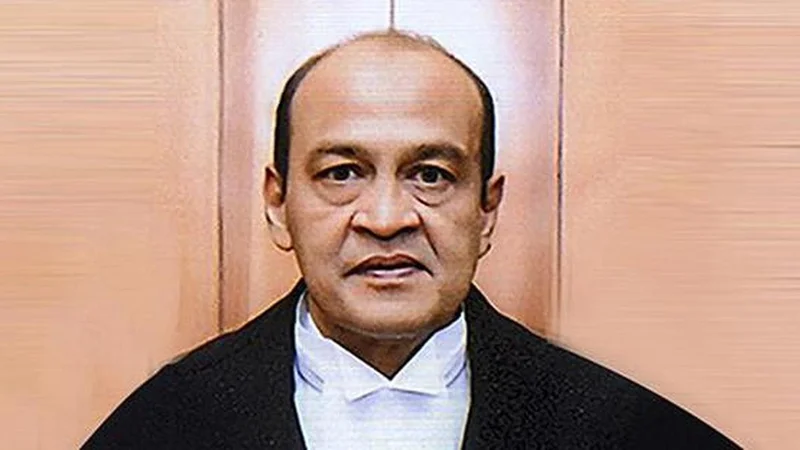
Parliament is set to take up in the coming Monsoon Session the report of the Committee appointed by the Speaker of the Lok Sabha under the Judges (Inquiry) Act, 1968 to investigate charges of misbehaviour against former Judge of the Allahabad and Delhi High Courts, Yashwant Varma, who has since resigned. The allegations against him arise from the discovery in March 2025 of partially burnt currency notes in an outhouse at his official residence. Mystery surrounds his current status and the future course of the pending proceedings in Parliament.
On one hand, three months after his resignation, Mr. Varma continues to be listed by the Allahabad High Court and by the Department of Justice of the Union government as a sitting judge. This has given rise to misgivings about whether his resignation has taken effect or remains subject to acceptance by the President.
On the other, it has been reported that following Mr. Varma’s resignation on April 9, 2026 “with immediate effect”, his status at the Bar was changed to “active” on resumption of practice. Some of his dues and benefits as a sitting judge have reportedly been stopped since the resignation.
Four questions follow.
(1) Is Mr. Varma’s resignation subject to acceptance by the President?
Our Constitution vests 13 constitutional functionaries with the “power to resign at will”: the power to demit office at a time of their choosing, without their resignation being subject to acceptance by any authority. They may resign merely by writing under their hand addressed to an authority specified in the Constitution. No further action is necessary. Needing no acceptance, the power to resign at will is an essential safeguard for the independence of these offices. It protects incumbents from being forced to work under coercion, contrary to their conscience.
The offices vesting incumbents with this power are: the President; the Vice-President; the Deputy Chairman of the Rajya Sabha; the Speaker and Deputy Speaker of the Lok Sabha; judge of the Supreme Court; judge of High Courts; Governors; the Speaker and Deputy Speaker of a State Assembly; the Chairman and Deputy Chairman of a State Legislative Council; and member of Public Service Commissions.
In contrast, Article 101 (3)(b) of the Constitution expressly says that the resignation of Members of Parliament is subject to acceptance by the Speaker of the Lok Sabha or the Chairman of the Rajya Sabha, as the case may be. Under Article 190(3)(b), the resignations of members of State Legislative Assemblies and Legislative Councils are likewise subject to acceptance by the Speaker or the Chairman.
A five-judge Constitution Bench of the Supreme Court in Union of India vs Gopal Chandra Misra (1978) unanimously reaffirmed the power of Supreme Court and High Court judges to resign at will.
Justice S. Murtaza Fazal Ali dissented from the majority Judges who held that a resigning Judge could choose a future date and withdraw the resignation before that date. But Justice Ali reflected the unanimous view of the Bench that no acceptance was needed for resignation of judges. He wrote categorically that “the effectiveness of the resignation does not depend upon the acceptance of the resignation by the President…the resignation acts ex proprio vigore” (automatically without requiring any external action).
At least 12 High Court judges have resigned since 2017. One Supreme Court judge, Justice Dalveer Bhandari, resigned in 2012 to join the International Court of Justice. Publicly available information suggests that these resignations have been handled in compliance with the law described above, coming into effect as the resigning judge stipulated, without the effectiveness of the resignation being dependent on acceptance by the President or by anyone else.
(2) Can Mr. Varma still be held out as a sitting judge; can he continue to draw the benefits of office?
Since Mr. Varma ceased to be a judge on April 9, describing him after that date as a sitting judge of the Allahabad High Court in the Department of Justice’s list or on the website of the Allahabad High Court is clearly wrong.
There is no justification for retaining the name of a person who is not a judge in lists of sitting judges for over three months, as has been done in Mr. Varma’s case. It would only be proper for the Union Department of Justice and the Allahabad High Court to correct the error and delete his name. It would, needless to say, be illegal for him to receive any salary or benefit as a sitting High Court judge.
(3) Do the proceedings survive the resignation, now that removal from office is moot?
The Committee’s report pertains to Mr. Varma’s conduct prior to his resignation. The resignation therefore does not affect the laying of the report before both Houses and its being made public. Indeed, there is a statutory duty to do so. The public also has a legitimate right to know whether the Committee found any proved misbehaviour on the part of a sitting judge of a constitutional court.
If the report finds Mr. Varma not guilty of the charges, the matter ends there. Under Section 6(1) of the Judges (Inquiry) Act, “no further steps shall be taken in either House of Parliament in relation to the report and the motion pending in the House or the Houses of Parliament shall not be proceeded with”, that is, the motion for presenting an address to the President praying for his removal.
Even if the report finds him guilty, the motion for his removal can no longer be moved. Having resigned, Mr. Varma does not hold the office of a judge and cannot be removed from it. Under Section 6, the report is to be discussed by Parliament along with the motion. As the motion lapses and cannot be discussed, the report too cannot be discussed by Parliament under the Act.
(4) Should the Constitution be amended so that judges facing removal cannot evade accountability by resigning?
There is a genuine concern that the framework for judicial accountability through removal proceedings under the Judges (Inquiry) Act, 1968 suffers from a loophole. Judges may resign at will before Parliament takes up the motion for their removal, halting the entire process.
This loophole is best addressed by amending the Constitution, rather than by executive or judicial interpretation of the Constitution or of the 1968 Act. The amendment may provide that the resignation of a judge facing removal proceedings is subject to acceptance during their pendency. To safeguard judicial independence, the power to accept the resignation of a judge should vest in the Chief Justice of India rather than in the President. Should Parliament want to discuss the report submitted by the Inquiry Committee set up under the Act despite the judge’s resignation, the Judges’ Inquiry Act should be suitably amended to allow it. Interpreting inadvertent silences in the Constitution or the Act to suit the concerns of Parliament or the Executive would be against the rule of law.
(G. Mohan Gopal is former Director of the National Judicial Academy and former Vice-Chancellor of the National Law School of India University, Bengaluru. V. Venkatesan is Contributing Editor at Supreme Court Observer. The views are their own)
Published - July 22, 2026 08:00 am IST