Sign in. It’s quick, free and it’s up to you.
An account is an optional way to support the work we do. Find out more.
A “ONCE IN a generation” solar eclipse is to occur in two weeks, and Cork – which is Ireland’s “best-positioned major city” for it – is already preparing for the spectacle.
A solar eclipse is the term used for when the moon moves between earth and the sun, blocking its view from earth.
Up to 96% of the sun is expected to be covered by this eclipse – Ireland is out of its path, so will miss out on the total eclipse that will be experienced by other countries.
Despite this, it will be the eclipse of the greatest magnitude seen by Ireland and the UK since 1999.
These occurrences aren’t rare: a partial eclipse can occur anywhere between two to five times a year, while a total eclipse occurs around once every 18 months. However, they affect different parts of the earth, and for a near-total solar eclipse to reoccur in the same town or city is a phenomenon that happens every few decades, or every few hundred years.
Munster Technological University (MTU) is well-prepared for Cork’s day out of the sun, and is to distribute 6,500 free eclipse glasses across the city ahead of 12 August.
Stock is currently available to collect at MTU Blackrock Castle Observatory on Castle Road in Cork.
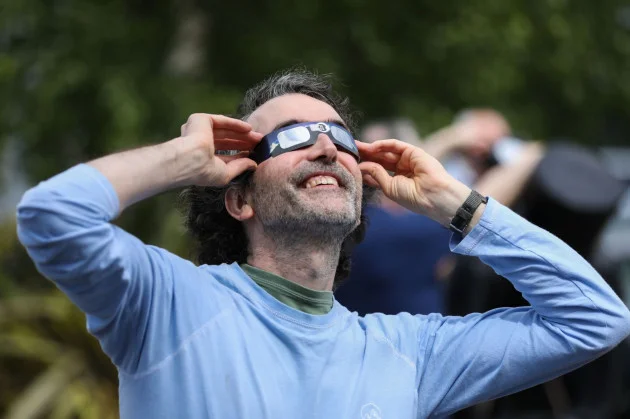
Experts in astronomy from the observatory have advised the public that anyone looking directly at the sun should wear certified ISO 12312-2 eclipse glasses, as ordinary sunglasses do not offer adequate protection.
Cameras, binoculars, and telescopes require correctly fitted solar filters, while pinhole projectors offer a safe, indirect alternative.
Free public viewing events will take place at MTU Blackrock Castle Observatory, Tramore Valley Park and Bell’s Field from 6pm to 8.30pm on Wednesday 12 September.
Members of the public will be able to meet astronomy experts, learn about safe eclipse viewing, and enjoy music and family activities. Solar eclipse lino-printing and pinhole-projector activities are also planned at Tramore Valley Park and Bell’s Field, MTU said.
The eclipse will begin at approximately 6.15pm, reach its maximum at 7.13pm and end at approximately 8.08pm. It will be the largest eclipse visible from Ireland until 2090, the university said.
Head of research at MTU and head of the observatory Dr Niall Smith said safety must be at the centre of everyone’s plans to view the eclipse. He advised everyone to collect their glasses in advance.
“Cork’s position in the south-west means it is Ireland’s best-positioned major city for the solar eclipse, and Ireland’s natural ‘Eclipse Capital’,” Smith said.
“It will be a spectacular moment and a rare opportunity for people across Cork to experience a major astronomical event together.”
To embed this post, copy the code below on your site