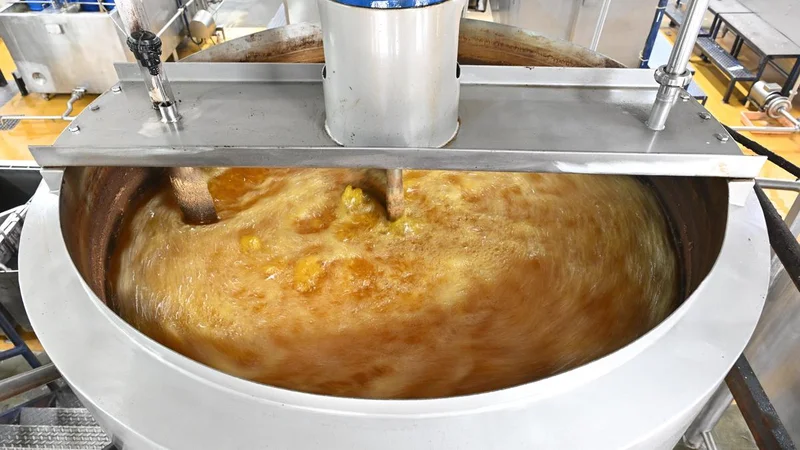
When I am planted next to a mammoth stainless-steel boiler of molten ghee, my mind starts playing games. The sweet smell is intoxicating. But the heat from the container which can hold 2,000 litres of ghee, that is at touching distance, sends me into a tizzy. For RKG Ghee’s workers in blue uniforms, who go about turning levers and adjusting the intricate system, the scent, heat, and vision of cloud-like tufts of butter transforming into grainy, sunshine-yellow ghee, are routine.
For, this scene plays out every day at the 94-year-old family-run brand’s factory in Kangayam.
The making of ghee here is a coordinated process that starts at its Atmos dairy in nearby Dharapuram. “We collect up to 1,50,000 litres of milk every day from 10,000 farmers in and around the town,” says G Aravind, the managing partner. The milk, once churned into butter, arrives as gigantic blocks to the factory in trucks.
There are over 200 men and women working at the factory, which is spread across 80,000 sqft in the town that is 95 kilometres from Coimbatore. We go behind the scenes to see how ghee is made by the family-run establishment that supplies to states such as Tamil Nadu, Kerala, Karnataka, and Andhra Pradesh, apart from exporting to West Asia, New Zealand, Australia, Singapore, and the US.
Smooth sailing
K Prakash, the plant manager, leads us inside the freezer where the butter is stored at a temperature of -20°C. “We leave the blocks outside to thaw so that they reach ambient temperature before they are tipped into butter melting vats,” he explains. These vats send molten butter to the ghee boilers. “After around 20 minutes, the ghee is sent for settling,” he adds. This is a process where protein granules left behind after butter is clarified, settle at the bottom of the container.
The ghee is not quite ready yet. Prakash says that to rid it entirely of the brownish protein granules, it is further sent to a clarifier before which it is left to settle overnight. We follow its trail through pipes to tanks on a floor above, where it is left undisturbed for 48 hours to acquire its defining grainy texture. It is only now that it is ready.
The ghee, produced over four days of precise monitoring, now enters an automated system of electronic devices and conveyors, to be packed and sent away to store shelves. Human hands work hand-in-hand with machines at the packing section, tightening caps and checking for seals to double-check the packaging of ghee in various sizes — from 15-kilogram tins to tiny sachets that can hold 0.09 ml. This section, that mostly consists of women, functions like clockwork — tins and jars with the company label slide on conveyors to be stacked in cartons.
The sticky smell of ghee hangs in the air as the women work in almost robotic precision. “Man power is a crucial link in the packaging section,” Prakash notes.
Many years ago, 94 to be precise, RKG was a completely different entity. “As per our earliest records, the company was started in 1932,” says Aravind, adding that the founders — three men from the family — started selling ghee from the 1920s onwards. “They would gather butter from villages such as Padiyandipalayam, Veeranampalayam, and Madathupalayam through collection agents, to make ghee to be sold in tins,” he says, adding that these are stories passed down generations in the family.
That was a time when mud pots and cold water kept butter from turning sour, and bullock carts were employed to transport the end product. Today, people such as 31-year-old K R Vikneswaran, who is from the fourth generation in the family, are experimenting with offering something more than just one product.
Vikneswaran, who has a love for cooking, is helming RKG Ghee Stories, an ‘experience centre’ at a complex on Karur Road near the factory. “Here, people can watch a scaled-down version of the processes that unfold at our factory,” he says, talking about the ‘ghee brewery’ where people can watch live butter being clarified into ghee. “They also get to buy fresh ghee,” he adds.
The space has a counter for sweets and savouries and a restaurant with a fusion menu in which ghee is the star ingredient. We try the ghee mushroom cappuccino and the ghee Pallipalayam paneer. The soup comes with a drizzling of ghee on top, and is followed by arisi paruppu sadham, a Kongu staple that arrives with a side of nei kathirikkai.
Rice, paruppu, and ghee: a match made in heaven. No, Kangayam.
Published - July 29, 2026 03:08 pm IST