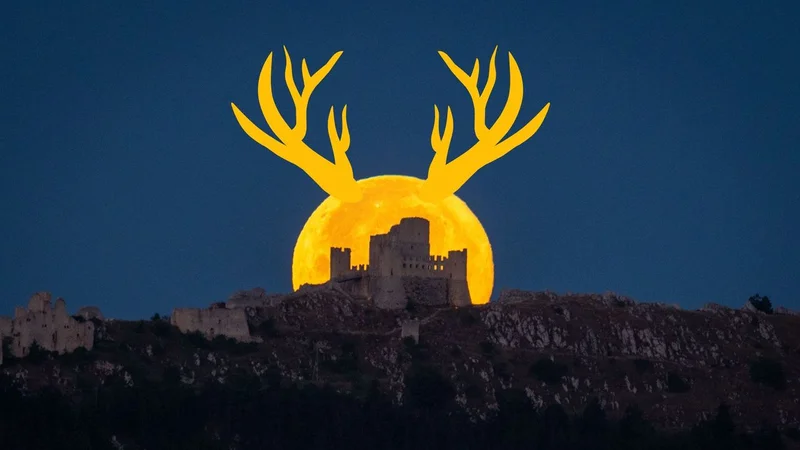
The July full "Buck Moon" rises tonight to lead Saturn, Mars and Mercury in a spectacular mini planetary parade through the summer sky. Here's what you need to know.
July's full moon phase occurs at 10:36 a.m. EDT on July 29 (1436 GMT), when the lunar disk will appear fully illuminated. It's often called the Buck Moon, to reflect the time when young male deer grow out their antlers. It has also been named the Berry Moon by the indigenous Anishinaabe people and as the Thunder Moon by the Western Abenaki people, according to the Old Farmer's Almanac.
Look to the southwestern horizon at sunset to catch the full Buck Moon as it creeps slowly into the summer sky. The moon may appear particularly large at moonrise thanks to a phenomenon known as the "Moon Illusion", where our brains trick us into perceiving it as larger than it actually is while close to the horizon. You might also see it adopt a yellow-orange hue as Earth's atmosphere scatters the bluer wavelengths of its light as it travels low in the sky.
These are our best binoculars for moon views. The 15x magnification and 70mm objective lenses deliver sharp contrast along the terminator and lunar details that pop, but make sure you grab a tripod for steady views.
_
Sunlight strikes the moon head on during July's full moon phase, leaving no shadows to emphasize the presence of the countless craters that litter the lunar surface. It's a perfect time to explore the dark lunar seas that scar the moon's surface, where ancient lava flows once flooded networks of impact basins, then hardened billions of years ago, repaving vast swathes of Earth's natural satellite.
Grab a pair of binoculars or a telescope and look a little closer. You'll find a network of bright streaks intersecting as they travel outward from youthful impact craters. These features are known as ejecta rays, and were created when material cast out in violent impacts fell back onto the lunar surface. Every crater on the moon once had its own set of ejecta rays. However, all but the most recent have since faded into obscurity due to space weathering.
Venus will appear as a bright evening star to the west after sunset, serving as the opening act for a magnificent planetary procession in the hours that follow. Saturn, Mars and Mercury will rise in the east to trail the moon in a majestic arc as it treads a ponderous path from east to west through the summer sky.
Want to capture the incredible predawn lineup for yourself? Then be sure to check out our guide to photographing the planets, along with our expert tips on photographing the moon. You can also read our roundup of the best cameras and lenses for astrophotography to ensure that you're ready for the next big skywatching event.
Editor's Note: *If you would like to share your astrophotography with Space.com's readers, then please send your photo(s), comments, and your name and location to spacephotos@space.com. *
Anthony Wood joined Space.com in April 2025 after contributing articles to outlets including IGN, New Atlas and Gizmodo. He has a passion for the night sky, science, Hideo Kojima, and human space exploration, and can’t wait for the day when astronauts once again set foot on the moon.