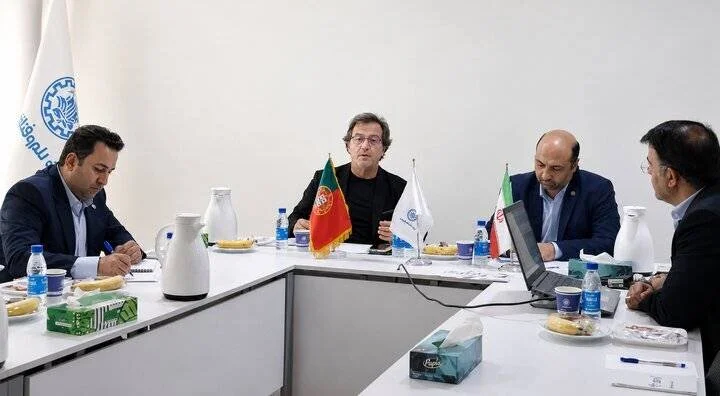
Iranian, Portuguese sci-tech parks explore potential to develop ties
TEHRAN – Iran’s Sharif University of Technology and Portugal’s Taguspark have explored avenues to promote scientific and technological cooperation between the two institutions.
The executive director of Taguspark, Eduardo Baptista Correia, paid a visit on Sunday to Sharif University’s technology center to become familiar with the university’s activities and capacities, as well as its technology and innovation ecosystem, ISNA reported.
Highlighting the capabilities and role of Taguspark in the development of science, technology, and innovation in Portugal, the official expounded on the activities of the accelerators, the domestic and international companies based at the park, as well as their economic impacts.
For their part, Sharif University officials elaborated on the development of the university’s science and technology park over the past two decades, as well as educational, research, and international capacities of the university for the expansion of collaborations between the two technology parks.
They also proposed establishing collaboration networks, exchanging experiences, and fostering cooperation between accelerators and knowledge-based companies of the two sides.
Both parties agreed to follow up on discussed issues through holding meetings, reciprocal visits, and developing future cooperation programs.
Iran’s high scientific capacity
In June, Minister of Science, Research, and Technology, Hossein Simaei-Sarraf, delivered a speech at the 7th Turkey Educational Technologies Summit (known as TETZ 2026), highlighting the country’s high scientific and research capacities despite sanctions.
“Despite illegal sanctions, Iran secures first place in cognitive sciences among Islamic nations and ranks ninth globally in advanced materials. Numerous prestigious Iranian universities and institutions are included in international rankings. These accomplishments underscore the country’s scientific capabilities,” IRIB quoted Simaei-Sarraf as saying, addressing the TETZ, held in Istanbul from June 26 to 28.
Iran serves as a great opportunity to invest in higher education and modern technologies. The country has one of the largest higher education systems in the region, with more than three million students and over seventy thousand faculty members and researchers, he added.
Highlighting that the rapid development of emerging technologies, including AI, is fundamentally transforming human relationships and higher education systems around the world at an unprecedented pace, Simaei-Sarraf said that effective use of smart technologies requires the establishment of a system based on algorithmic transparency, educational justice, accountability, protection of learners’ rights, and responsible data governance.
According to science minister, cultural and social requirements need to be institutionalized in the design and deployment of these technologies, which will help pave the way to promote social trust, facilitate the use of smart education, and its acceptance without posing data governance risks at national and international levels.
The official went on to say that the development of smart education requires the enhancement of synergy, the exchange of expertise, and the utilization of shared capacities of countries more than ever. He expressed hope that the summit would lay the basis for the expansion of academic ties, the exchange of knowledge, and the development of collaborative initiatives in the smart education sector, which would in turn expand higher education at national, regional, and global scales.
The Ministry of Science, Research, and Technology in cooperation with the Vice Presidency for Science, Technology, and Knowledge-Based Economy, developed an action plan for artificial intelligence (AI), which highlights the pivotal role of AI in the country’s scientific advancement, IRNA reported.
The action plan was unveiled during a meeting held on December 3, 2025, with the presence of First Vice-President Mohammad-Reza Aref.
The main pillars of the action plan include ‘transformation in education and training human resources, ‘empowering research and innovation capacity building’, ‘promoting and commercializing AI’, ‘expanding science diplomacy and international cooperation’, and ‘improving the scientific status of the country’.
Empowering research and innovation capacity building involves the establishment of five national laboratories in selected universities, development of interdisciplinary majors at post-graduate programs focusing on AI, the inclusion of ‘AI and digital transformation’ for undergraduate students, essential for engineering majors, and supplementary for other majors.
Promoting and commercializing AI focuses on selecting and supporting a number of universities as the country’s AI research and development center. Supporting the development of at least 3 fundamental AI models (including language vision models) based on domestic data, and launching a platform to collect and share research and educational data securely.
Expanding science diplomacy and international cooperation highlights expediting the formation and growth of AI startups and holding AI competitions.
Expanding science diplomacy and international cooperation involves enhancing educational and research collaborations with top universities from Shanghai and BRICS member states, as well as members of the Organization of Islamic Cooperation (OIC).
Cooperation on AI regulations, standardization, and collaboration with Iranian elites and experts living abroad are among other goals.
Improving the scientific standing of the country underlines maintaining and improving the country’s international ranking in AI, indexing at least 8 specialized journals in the first and second quartiles, increasing support for top researchers and patents, as well as strengthening scientific associations and national AI networking.
MT/MG