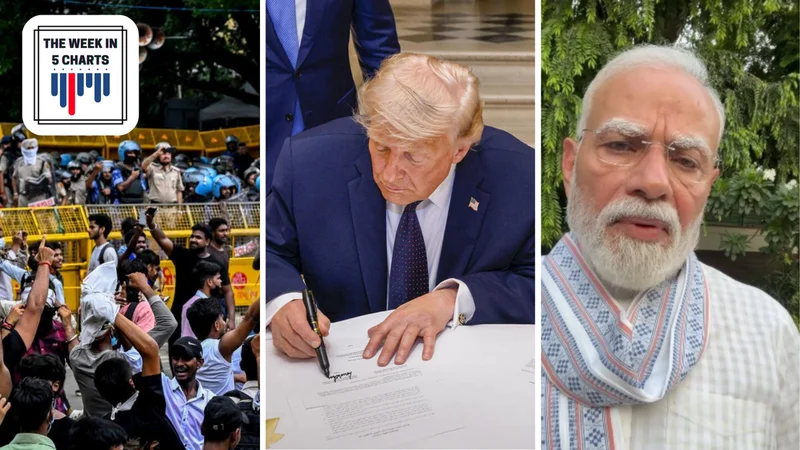
(1) Union Education Minister Dharmendra Pradhan resigns, a win for CJP
In a significant win for the protesters from the Cockroach Janata Party, the Union Education Minister Dharmendra Pradhan resigned on Saturday last week (July 25, 2026) following massive protests calling for his removal after the NEET UG paper leak, and bungled CBSE on-screen marking.
The development marked the culmination of a 36-day protest in Delhi and reports of police brutality. Ever since its inception in May this year, the CJP has grown from a small community to an organisation with nation-wide footprint and empathetic supporters across the country who demand accountability from the government for several policy failures.
Here is a timeline tracking its inception, the protest, how the government and security forces responded and its aftermath.
(2) U.S. and Saudi Arabia sign civilian nuclear deal
The U.S. and Saudi Arabia signed a landmark civilian nuclear deal that gave U.S. nuclear equipment suppliers and manufacturers a stronger foothold in the West Asian country, which is looking to expand its nuclear power facilities.
While the U.S. has pitched the deal as one that would bolster the U.S. economy as well as promote clean energy, critics have cautioned that Saudi Arabia can use the deal to start a nuclear weapons program and start a weapons race in the region.
Uranium enrichment is the hardest in the initial stages. Weapons-grade enrichment is relatively easier to achieve past initial enrichment challenges, and with American support, Saudi Arabia will have the technology and the expertise to handle the latter.
Moreover, the lack of an ‘Additional Protocol’ in the deal means that the International Atomic Energy Agency (IAEA) will not have the enhanced permissions to conduct more extensive audits of nuclear facilities and uranium use.
The U.S. has said that uranium enrichment within Saudi Arabia will only be done post a joint study to see such a measure is warranted. Such assurances aside, the deal can throw a hammer in the talks with Iran.
(3) U.S. applies 10% tariffs on Indian imports
The U.S. announced on Friday last week (July 24, 2026) that it will apply 10% tariffs on Indian imports, as a measure against countries that allow forced labour within their borders. India was one among 60 such countries that the U.S. identified in an earlier report.
While India is one among 18 countries that now face the 10% ‘forced labour’ tariffs, the other countries identified in the report face 12.5% tariffs. Goods including engineering goods, textiles and garments, chemicals, machinery, plastics and other products amounting to 70% of India’s exports will face the 10% tariffs. These tariffs are applied over those the products already face under Most-Favoured-Nation rates.
The 10% tariffs comes on the back of several previous tariff announcements and continuing talks for a trade deal between the two countries.
(4) Parliament’s monsoon session begins with NDA’s renewed strength
Since June, there have been major rifts in the Trinamool Congress and the Shiv Sena (Uddhav Balasaheb Thackeray). Twenty MPs from the Trinamool rebelled to merge with the National Citizens Party of India, a Tripura-based, registered, and unrecognised political party. On June 19, 2026, six MPs from the Shiv Sena (UBT) defected to the Eknath Shinde camp of Shiv Sena. As a result, and amid the Opposition’s claims of these “illegal” and “unconstitutional” switches, the National Democratic Alliance’s strength in the Lok Sabha swelled by 26 seats.
The two graphics below show these 26 MPs, from the Trinamool and Shiv Sena (UBT), who joined the NCPI and Shiv Sena, respectively.
The NCPI aligns itself with the BJP-led NDA. With the addition of 26 MPs, the alliance’s strength in the Lok Sabha has increased to 318 from 293 seats.
Here is how the altered map of West Bengal’s Lok Sabha constituencies look like.
(5) Modi’s Task Force formed to recommend steps to make exam system leak-proof
Prime Minister Narendra Modi on Sunday (July 26, 2026) announced the constitution of a high-powered task force, to be headed by former UIDAI chairman Nandan Nilekani, to recommend steps to make the country’s examination system leak-proof and technology-driven.
Mr. Nilekani has worked with the Union Government in the past to set up the Aadhaar ecosystem and Unified Payments Interface (UPI). He is also the chairman of the governing body of the economic policy research think tank, the National Council of Applied Economic Research (NCAER), and a co-founder of Infosys.
Other members of the task force are the following:
Published - July 29, 2026 06:33 pm IST