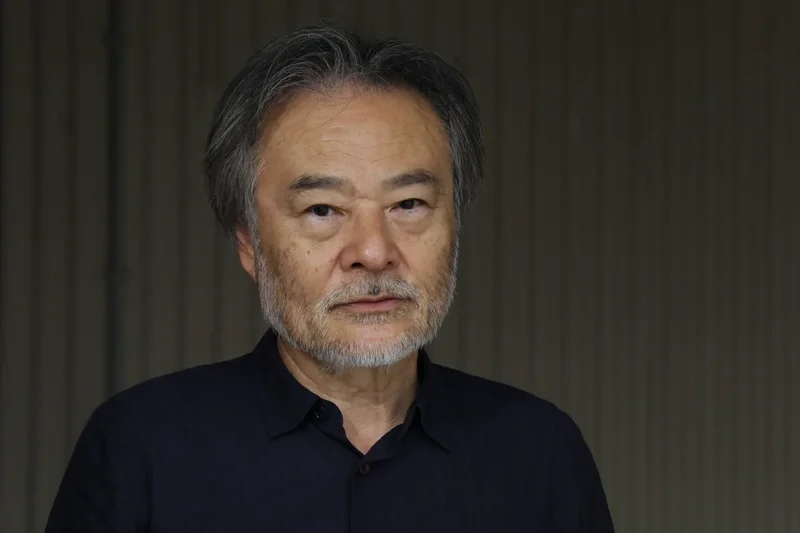
Kiyoshi Kurosawa, the acclaimed Japanese director often hailed as "the master of horror," was initially worried about how viewers would react to his first samurai film but his concerns proved unfounded.
The Samurai and the Prisoner, set to premiere in New York and Los Angeles on July 31 before a wider U.S. release throughout August, garnered an enthusiastic reception at its Cannes Film Festival debut in May.
The film is already proving to be Kurosawa’s most popular work to date, following its successful earlier release in Japan. This marks a significant achievement for a director whose extensive filmography includes the 2020 Venice Film Festival’s Silver Lion-winning Wife of a Spy and the 2008 Cannes Un Certain Regard Jury Prize winner Tokyo Sonata, a poignant exploration of family conflict.
Despite his prolific career, Kurosawa admits to a persistent sense of wonder about his craft.
"Filmmaking remains a mystery for me," he said, describing it as a complex endeavor that merges the tangible world being filmed with the intangible narrative that must be conveyed.
"I don’t understand it. And that’s why I keep making films," he told The Associated Press in a recent online interview from New York, adding that he constantly questions why he cannot emulate the likes of Yasujiro Ozu or Alfred Hitchcock.
Kurosawa’s previous works, such as his 1997 film Cure, which features Koji Yakusho as a detective pursuing a serial killer, are typically characterized by a chilling creepiness that unfolds within ordinary settings. Yet, the samurai genre inherently establishes a fictitious, otherworldly realm where everyday normalcy is absent, a departure Kurosawa acknowledged.
The Samurai and the Prisoner delves into a rivalry between warlords, employing the familiar Shakespearean plot twists common to samurai films.
Kurosawa explained the genre's core elements: "There is, first of all, power. A feudalistic society is built on a hierarchical relationship of those at the top and those at the bottom. Then there’s betrayal."
He added, "People try to grab power, and in so doing get thrown into confusion. That exists in any society, historically and perhaps even today. And so this is also about what’s eternal."
Tackling a samurai movie presented Kurosawa with new challenges, including the fundamental task of directing actors in a genre where, unlike modern dramas, there were no predefined parameters for line delivery. He also faced the common wisdom that directors venturing into new territory risk alienating fans, compounded by the fact that the traditional samurai genre, or "jidaigeki," is increasingly unfamiliar even to many Japanese audiences.
However, once production commenced, everything seamlessly fell into place. The authentic sets, costumes, props, wigs, and makeup collectively transported the actors to the film’s otherworldly setting. Kurosawa was fortunate to film in historic temples and castles across Kyoto. The movie retains his signature long shots and almost claustrophobic dialogue scenes, where a palpable tension builds, promising an impending, unimaginable horror.
His latest work embodies the aesthetic of an orthodox samurai film, staying true to the genre’s legacy of depicting the horrors and pathos of war. It even features wide shots of armored warriors on a hilltop, reminiscent of Akira Kurosawa’s Ran and Kagemusha, though the two directors are unrelated.
Kiyoshi Kurosawa found the experience of making The Samurai and the Prisoner so enjoyable that he hopes to direct another samurai film, this time incorporating more spectacular sword-fighting sequences akin to the Zatoichi series. He also expressed interest in exploring new genres, perhaps even a musical.
He pledged to continue making horror films, provided audiences aren't weary of his distinctive style, which often features prolonged periods where "nothing appears to be happening."
He voiced concern that his slow-burn approach might seem dated in an era where popular films, both in Japan and globally, are characterized by a rapid succession of explosive events designed to keep viewers on the edge of their seats.
"A scary thing generally doesn’t happen every five minutes in my films," Kurosawa noted, concluding, "But if that’s OK, then I’d like to make my film."