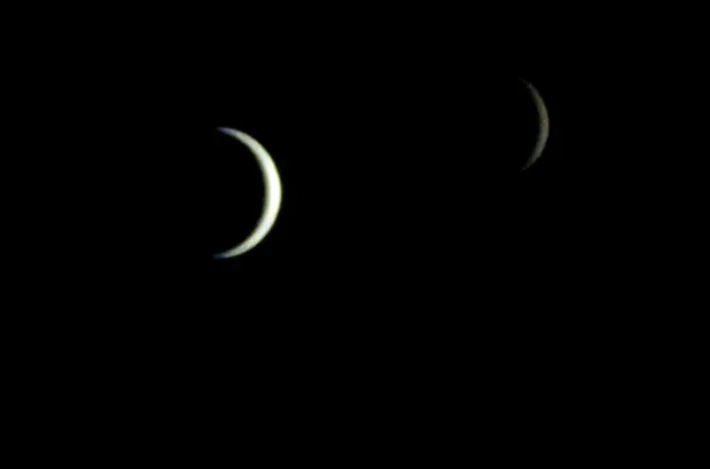
The innovative Mars ESCAPADE mission recently snapped a unique portrait of the Earth-Moon system.
Sometimes, you have embark on a journey to appreciate home. The Escape and Plasma Acceleration and Dynamics Explorers (ESCAPADE) mission recently gave us just such a view of our homeworld and our large natural satellite, as seen from the spacecraftsâ temporary orbit around the Sun-Earth L2 Lagrange point.
ESCAPADEâs goal is to study the current state of the Martian magnetosphere, and how the planet lost most of its now tenuous atmosphere to the solar wind. ESCAPADE will use two spacecraft (dubbed Blue and Gold, the school colors of the University of California at Berkeley) to make simultaneous measurements from separate vantage points.
The twin Blue and Gold ESCAPADE spacecraft ahead of launch. Credit: Astrotech.
The mission is part of NASAâs SIMPLEx (Small Innovative Missions for Planetary Exploration) program, seeking to field low cost, $55 million dollar cost cap missions. UC Berkeleyâs Space Sciences Laboratory runs the mission, which launched on a Blue Origin New Glenn rocket on November 13th, 2025. The twin Blue and Gold spacecraft were built by Rocket Lab, and the missions were processed at Astrotechâs Space Operations Facility in Titusville Florida prior to launch.
The two spacecraft will arrive in orbit around Mars several days apart late next year in September 2027.
The images were captured using the missionâs visible and infrared sensors. The Sun-Earth L2 point is 1.5 million kilometers distant. The images were captured earlier this month on July 3rd.
Both Earth and the Moon are 8% sunlit crescents in the scene, with the Sun just out of frame to the observerâs right. Though it seems counter-intuitive, the dim Moon is actually closer to the spacecraft at the time when the image was captured, at a range of 186,100 kilometers versus the Earth which is 584,600 kilometers distant.
The image offers a good study in albedo or reflectivity. Earth is around 30% reflective overall, mostly due to brilliant light reflecting off of our cloud-tops. In contrast, the Moon is a dull 7%, about the same as worn asphalt. The image also managed to get the Moon sized nearly the same as the Earth. Earth is almost a four times the diameter of the Moon, but the Moon is just over a third the distance of the Earth as seen in the image.
Earthâs glowing night-side in infrared really gives it away, shinning at -10 to -44 Fahrenheit. That might might seem chilly, but itâs still 250-280 Kelvin above absolute zero. The nighttime side of the Moon, however, is a frigid 280 F (100K).
Earth (left) and the Moon (right) seen in ESCAPADE's infrared view. Credit: NASA/UCB-SSL/NAU-Radiant/Lucint.
But the images are more than just pretty pictures of home. Mission researchers are using the opportunity to test and calibrate spacecraft instruments.
"We are thrilled that ESCAPADE was able to accommodate these excellent space-qualified cameras which will search for visible Martian aurora and investigate thermal properties of the Martian surface and atmosphere,â says Rob Lillis (UC Berkeley) in a recent press release. âSince Earth and the Moon are well-known targets, imaging them provides an important calibration check for ESCAPADEâs cameras.â
The missionâs innovative path to Mars by sending ESCAPADE to loiter or âhang outâ at the L2 point means that it was able to launch outside of the normal Mars window. This flexibility means that ESCAPADE didnât need to wait for the 26-month launch window offering an optimal flight trajectory to the Red Planet, and could instead launch at a time of the mission controllersâ choosing. ESCAPADE was originally slated to hitch a ride with NASAâs Psyche mission, which just flew past Mars on May 15th.
ESCAPADE is currently tracing out a kidney-shaped track around the Sun-Earth L2 point. Missions often orbit L2 in a stable Lissajous or halo orbit. An L2 rollcall includes ESAâs Gaia and Euclid missions, and the James Webb Space Telescope.
ESCAPADE's looping path to Mars. Credit: NASA/JPL.
Weâve seen Earth via flybys and courtesy of outbound missions before, including Galileo, the Voyager missions, and Cassini in 1999. Osiris-REX captured a portrait of Earth during the 2017 flyby:
Osiris-REX's view of Earth during the mission's 2017 flyby. Credit: NASA/JPL.
Good luck to ESCAPADE and the mission team on the journey Marsward next year, and keep sending back those amazing images.