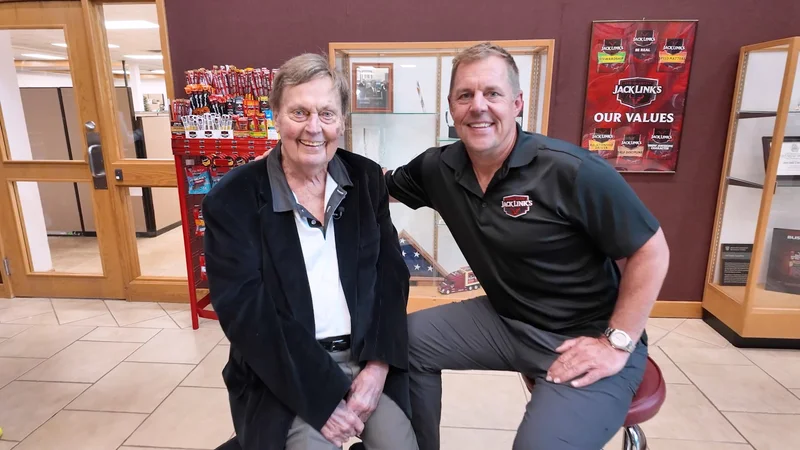
The first time Jack Link cured a batch of beef jerky, he was trying to save his business.
It was 1985 and Link was a 40-year-old father of two teens living in Minong, Wisconsin. The slaughterhouse he'd bought from family members in 1978 had just filed for bankruptcy protection. Its failure left him searching for a way to provide for his wife and children, and prove that he could turn a small family-run business into something bigger.
His family owned other local ventures: a general store they'd opened in 1885 and a meatpacking business that produced varieties of sausage for the store. Link believed he could turn around his fortunes with one big, game-changing product, so he spent time in the meatpacking facility trying everything from frying potato chips to making Rice Krispie bars, says his son Troy, who was 15 years old at the time.
After a hunting trip in northwest Wisconsin, Troy Link says he brought home a few packs of convenience store jerky, prompting his father to examine the price tag. Based on the elder Link's experience raising cattle and selling meat at his family's general store over the years, he wondered whether his family business could make and sell its own version for less. Today, meat snacks — including beef sticks and steak strips — form the core of Link Snacks' multibillion-dollar global portfolio, spanning eight flagship brands including Jack Link's, Lorissa's Organic Snacks and Country Fresh Meats.
DON'T MISS: The communication skill that can help you accelerate your career growth
The company is one of the world's biggest players in a meat snacks market that's thriving amid a modern-day protein craze: The industry saw more than $5 billion in brick-and-mortar U.S. sales in 2025, according to estimates from Nielsen IQ Retail Management, and the category's U.S. sales have increased by 42% since 2023, according to market research firm Circana. Link Snacks alone generated more than $1.6 billion in 2025 brick-and-mortar retail sales, according to data collected by Nielsen IQ and shared with CNBC Make It by Link Snacks.
Link Snacks remains family-owned and privately-held. Retaining family control — and hearkening back to Jack Link's willingness to experiment — has helped the company respond effectively to challenges, says Troy Link, who succeeded his father as Link Snacks CEO in 2013. Recent years have dealt more than a few wild cards for the business, from consumer trends like health-conscious snacking to the Trump administration's tariffs, which have increased beef prices worldwide.
"We're constantly looking at consumer [research] and where the customer wants to buy our stuff, as well as what kind of stuff they want to buy [and] when," says Troy Link, now 54.
Though no longer CEO, the elder Link has his own views on how the company will continue handling challenges, too: "Good hard work [and] good product," says the now 80-year-old founder, who has served as chairman since 2013. At Link Snacks, he says, "we made a real high-quality beef jerky," and with the contributions of employees and locals around Minong, the business "kept on going, growing [and] growing ... That's how it happened."
Using family-owned smokehouses and a recipe Jack Link says originated with his great-grandfather, a German-born sausage-maker, the Link family started out selling packages of beef jerky marketed as "Beef Steak" at their local general store. It proved popular, and moved into local grocery and convenience stores. The company was profitable from the start, says Troy Link.
The company then started buying small competitors throughout the Midwest to expand its reach and manufacturing capacity, helping put its products — including its original beef jerky and shelf-stable snack packs featuring local Wisconsin cheese — into more convenience and grocery stores nationwide. As the Atkins Diet and its emphasis on protein swept the nation in the 1990s, Jack Link's grew alongside competitors like Oberto, which had sold its flagship jerky in national Safeway stores since the mid-1960s, and Slim Jim's meat sticks.
"Everybody wanted to eat meat, and it was a huge deal," Troy Link says. Over the ensuing decades, Link Snacks has been able to ride similar trends, from the Paleo diet in the 2010s to the current protein craze driven, in part, by the popularization of GLP-1 weight-loss drugs. By the early 2000s, Troy Link says the business brought in more than $300 million in annual sales.
Around that time, the younger Link — who had studied business and marketing at the University of Wisconsin-Stout, and became Link Snacks' president in 2003 — started to put his own stamp on the company. He was set on nailing a unique and splashy national marketing campaign to tell customers that the family-owned Jack Link's wasn't just another "big corporate-America brand," he says.
Along with Minneapolis-based ad agency Carmichael Lynch, Link Snacks built an ad campaign around brazen protagonists fueling up with meat snacks before antagonizing an irritated-yet-intimidating Sasquatch alongside the tagline: "Feed your wild side."
The ads went viral on YouTube a year after the streaming platform launched, and the company started paying for them to air nationally in 2006. Link Snacks spent $10 million in 2008 to air the commercials on national networks like ESPN, Comedy Central, and Discovery, according to the Minnesota Star Tribune. During those first two years of airing the commercials nationwide, Jack Link's annual sales grew by 47%, according to the company.
After taking over as CEO, Troy Link took some more risks. In 2014, Link Snacks purchased Unilever's meat snacks business for an undisclosed amount, including European brands BiFi and Peperami, and a manufacturing plant in Ansbach, Germany. A company spokesperson declined to share the extent to which the acquisition grew the business' footprint. More recently, Link Snacks built a 412,000 square-foot, $450 million manufacturing facility in Perry, Georgia, that opened in 2025.
Troy Link plans to continue opening new facilities around the world and rolling out new product lines to facilitate continued growth, he says: "We should be doubling the company, minimum, every 10 years. I'm hoping to be faster than that."
Finding avenues for continued growth as an already-large company is a unique challenge, and Link Snacks' ambition is already encountering obstacles. Beef prices hit record highs in 2026, for example, partly due to tariffs on foreign beef imports imposed by the Trump administration.
Troy Link, a prominent supporter of Donald Trump's 2024 presidential run, told the Milwaukee Business Journal in February 2025 that global economic headwinds, including tariffs, increased the company's costs and resulted in a decision to raise product prices by at least 10% in 2025. More than a year later, he says that fluctuating meat prices are nothing new in an industry that is dependent on a "worldwide supply chain."
Link Snacks must also contend with steep competition from a variety of rivals. Multinational food processing company Hormel Foods and Slim Jim parent company Conagra Brands have market values above $14 billion and $7 billion, respectively. Upstart brands like Chomps and Archer Meat Snacks are growing in market share while touting what they call "clean" ingredients and products without sugar or artificial preservatives.
Troy Link believes his company can compete against those newcomers with a portfolio that includes Lorissa's, an organic meat snacks brand that also sells plant-based products, and a new "clean ingredient" line from Jack Link's, announced in March. The CEO also says he's confident that his company can weather the industry's ups and downs, particularly due to its experience adjusting to evolving customer tastes, and the depth and breadth of its portfolio.
From sourcing cattle to handling the vast majority of their own processing and packaging in-house, Link says "we really control everything from the cow to the consumer. So if we don't like something, we've only got one place to look — and that's in the mirror."
Want to get ahead at work? Then you need to learn how to make effective small talk. In CNBC's new online course, How To Talk To People At Work, expert instructors share practical strategies to help you use everyday conversations to gain visibility, build meaningful relationships and accelerate your career growth. Sign up today!