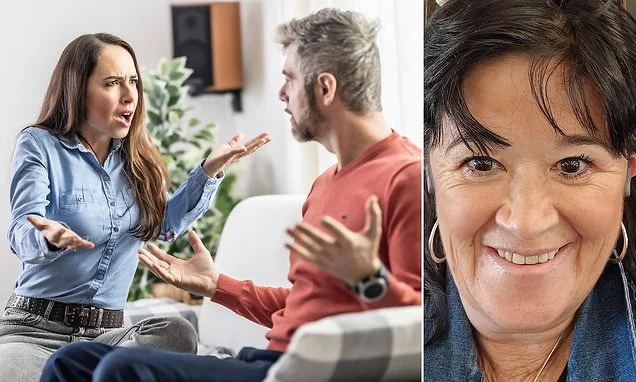
It was when my husband yelled, 'I'll pour hot oil over you so nobody will recognise you – and I won't go to jail because I'll be looking after you', that I knew I was getting my relationship choices very badly wrong.
I knew he meant it, and I didn't dare respond because he would beat me up. Instead I stayed, hid my feelings, stopped going to see friends, stopped seeing my family – one night, he had even threatened my mum and dad.
He had kicked me in the face, cracked my left eye socket, broken my nose, ribs, jaw and my thumb – once simply 'because I wore shorts'. I later found out he was taking drugs throughout our relationship. Eventually, I escaped with my children during the night – just as I had with a previous partner.
That was way back in the 1980s. And yet it wasn't until two years ago, as I approached my 60th birthday, that I finally understood the deep-seated reason why I repeatedly fell for damaged, violent men – and why I always stayed, long after it became obvious that the relationship was a disaster.
It was in early 2024 that my daughter Angelique, now 37, shared her medical diagnosis, which led to my own life-changing epiphany. Now, I look back and, at last, I understand that I have a life-long neurological disorder which was driving my poor choices and impulsive decisions all along.
My first marriage began in 1980. Back then I lived in South Africa, where my family moved when I was eight. There, you can get married in the year of your 16th birthday. I got married a month before, though now I see that I was still a child.
He was three years older than me and in the army. Very quickly, I'd find myself alone as he would go out and simply not come home. When he did, he'd break the doors and punch the walls. I later discovered he was addicted to marijuana.
Though we had a baby, the marriage lasted just four years – and although the break-up was so traumatic, I told myself it was a difficult, early experience and I'd move past it.
It wasn't until two years ago, as Joy Gwatkin approached her 60th birthday, that she finally understood the deep-seated reason why she repeatedly fell for damaged, violent men
In fact, for four decades, I found myself trapped in a repeating cycle of unhealthy relationships that left me emotionally exhausted, financially entangled and terrified for my safety.
I married twice and had several long-term partners in between, and although each relationship began with hope and optimism, the pattern almost always ended the same way: control, manipulation, emotional – sometimes physical – harm and the total collapse of my confidence.
The problem was, although I didn't know why, I was attracted to biker 'bad boys'. I grew up around motorbikes and I loved going riding. The initial attention and passion were magnets to me and I'd go in all guns blazing – but a few months in, they'd revert to their true selves and I'd discover they'd cheated or they would become abusive and controlling.
One partner was seven years older than me, and I'd known him for years. He seemed so calm in comparison, but I gradually discovered he was both paranoid and controlling. One night, there was a huge storm and flood – it wasn't safe to drive home from work and I phoned to ask if he'd collect the children. He said: 'It's not that bad – so I know you're going to go and f*** somebody.'
What had once felt like care and attentiveness had slowly transformed into something much darker, a pattern of coercive control that eroded my independence and confidence. He even punched me once, but again I stayed, partly because I kept hoping the person I had originally fallen in love with would return. I told myself that relationships required work and compromise, and that leaving would mean I had somehow failed.
The final relationship that completed this long cycle began in 2012. He was charismatic and loving and, after all the disasters, I felt we could build a life together. I now see there were red flags from the outset.
He was an alcoholic, which caused constant turbulence. We'd lurch from periods of calm as he tried to quit to chaos and conflict when he relapsed. In 2019 we returned to the UK at his request. I moved to set things up while he was in rehab, and I hoped for a fresh start.
Instead, within six weeks he was drinking again, the relationship deteriorated dramatically and, in early 2023, he hit me over the back of my head. In my shock and pain, I finally called the police. There was no going back.
Joy grew up around motorbikes and loved going riding but later found herself attracted to biker 'bad boys'
Devastatingly, though I packed that night, leaving was impossible. All my money was tied up in the jointly owned house. When I tried to go, he threatened to destroy the property. He even went through my packing and destroyed the most sentimental items.
I hadn't managed to make close friends in the UK, and the financial and legal situation was so complex, we ended up living under the same roof in different areas of our three-bedroom house for over three years. I installed locks on my doors and CCTV cameras, but he'd say 'you're not going to get rid of me', and I truly came to believe I never would.
Finally, last year, the property sold and I had enough to rent a flat of my own in Clevedon, North Somerset.
I was also able to get an injunction against him. I was exhausted in every possible sense – emotionally, mentally and financially – but I was also free. That was when my life truly changed, at the age of 60.
I'd always wondered what was wrong with me when it came to relationships. At work as a logistics manager I was focused and capable, while friends described me as resilient and positive. Yet with men, it all fell apart, and I always blamed myself.
Soon after, my daughter had been feeling burnt out at work. She told me: 'There's a possibility I've got ADHD.' When she had a positive assessment, she said, 'Mum, I'm your mini-me. I think you should do it too.'
I had never even considered it – but when I researched the condition, so much began to make sense. When I was at school I was clever, but couldn't show how I reached my answers. I was always in trouble, despite trying my hardest to get things right. I had terrible insomnia and instead of resting I'd get up and work, surviving on two or three hours' sleep then crashing.
I had many different jobs, multiple hobbies, I took endless courses, hyper-focused on research for hours – and I discovered that all the traits that made me so drawn to staying with the wrong men were facets of my ADHD, too: impulsivity, intense empathy, an optimistic tendency to see the best in people, and difficulty recognising warning signs.
Once I understood the neural patterns that had been driving me, it all fell into place. I did think: 'If only I'd known.' I could have saved myself and my loved ones so much pain. But with the help of medication, I've learned to look back at my life with more pride.
I'd had therapy in the past, but my therapists could never understand why I stayed with these men, and why I truly believed things would get better. Nobody ever suggested that I had ADHD.
After the diagnosis I started medication and I'm now on 40mg of a stimulant drug called Medikinet. Almost immediately, my thinking became clearer, calmer and more measured – the constant background noise in my mind had finally quietened. I was able to focus on solving problems instead of becoming overwhelmed and thinking myself into knots. Now I can step back, analyse and see the way to the solution. I even get six hours' sleep.
I can see why so many other people with ADHD dub it the 'divorce drug' on internet forums, for the sudden mental clarity it brings to relationships.
I also received cognitive behavioural therapy through the NHS, which helped me understand how ADHD affects emotional regulation, decision making and relationships. For the first time, I could see how my empathy, optimism and impulsivity had made me so vulnerable to partners who were manipulative or controlling. Understanding that was utterly liberating.
Most importantly, I now approach relationships very differently.
I'm currently seeing someone new, but we're taking things slowly and thoughtfully. We enjoy each other's company, but we also maintain our own homes and independence. It's developed from a friendship, and he is nothing like my past 'type'. This time, it's built on respect, honesty and clear boundaries – something I'd rarely experienced before.
At 61, I feel as though I am beginning an entirely new chapter of my life – and, at last, it's one shaped not by shame or self-doubt, but by true understanding and clarity.