Space Verdict
Small enough to slip into a jacket pocket yet capable of capturing nebulas, star clusters and sunspots, this smart telescope is nevertheless designed for convenience rather than ultimate image quality.
Pros
- +Small size
- +Simple smartphone-controlled operation
- +Automated image stacking
- +Magnetic solar filter included
- +EQ tracking mode for longer exposures
Cons
- -Low 2MP image resolution
- -Image integration time
- -The battery lasts about four hours
- -No tripod included
Why you can trust Space.com
The best smart telescopes have transformed astrophotography over the past few years, combining small telescope optics and automated mounts with dashcam-style camera sensors and image-processing software. The result? Compact devices that can be controlled entirely from a smartphone. Impressively, the DwarfLab Dwarf Mini pushes that concept even further.
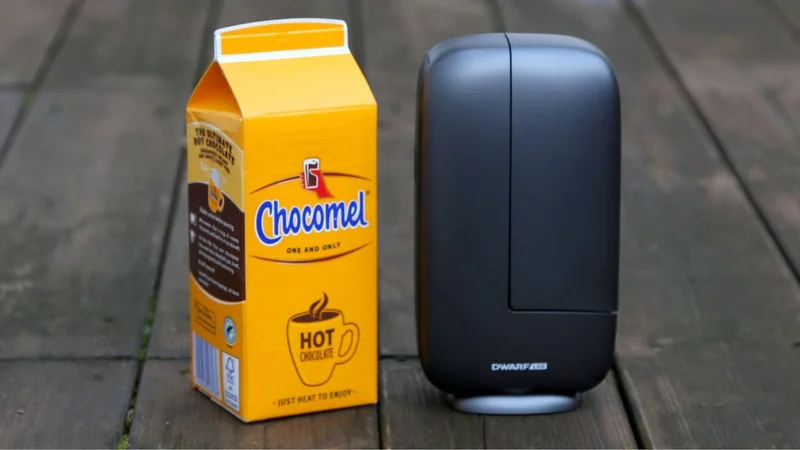
Roughly the size of a thick paperback book, it’s one of the smallest smart telescopes yet produced — tiny enough to fit in a jacket pocket while still capable of imaging nebulae, star clusters, the moon and even sunspots. It's also one of the best telescopes for beginners.
Positioned below the larger Dwarf 3 in DwarfLab’s lineup, the Mini sacrifices aperture and resolution for portability. It uses a 30mm refractor paired with Sony’s IMX662 sensor and relies on automated stacking to gradually reveal deep-sky objects. The telescope connects to a phone via Wi-Fi or Bluetooth and handles alignment, tracking and imaging automatically through the DwarfLab app.
With built-in filters, optional equatorial tracking, and advanced software features such as Mega Stack and Stellar Studio processing, the Dwarf Mini is aimed at beginners and traveling astrophotographers who want a compact, automated imaging system that doesn’t require lots of extra kit — and works well even in light-polluted cities.
DwarfLab Dwarf Mini smart telescope review
DwarfLab Dwarf Mini: Design
- Ultra-compact 30mm refractor telescope
- Internal motorized filter wheel
- Magnetic solar filter
- Lightweight design
- Ideal for travel and eclipse chasing
The defining characteristic of the Dwarf Mini is its size. The body includes a 360-degree rotating base and an articulating lens arm that moves through 225 degrees, allowing the telescope to cover most of the sky. It's significantly smaller than its competitors, including the larger Dwarf 3, making it easy to pack for travel. In fact, it’s easily small enough to slip into a camera bag or carry-on luggage, making it an appealing option for traveling astrophotographers — perhaps including eclipse chasers preparing for the upcoming trio of total solar eclipses beginning in 2026, since a magnetic solar filter is included in the box. Nice touch!
The telescope itself is a 30mm f/5 refractor with a focal length of 150mm. This produces a field of view of about 2.4 degrees, roughly five times the apparent diameter of the full moon. That optical system is paired with a Sony IMX662 sensor, a 1/2.8-inch sensor capable of 2.1MP resolution (1080p). This sensor is all about low noise and sensitivity, making it well-suited to short astrophotography exposures, but not to high-resolution images. Compared with the Dwarf 3’s Sony IMX678 Starvis 2 sensor, which delivers 8.3MP and 4K resolution, the Mini is a step down in terms of detail. However, in practice, the difference is smaller than expected, particularly after image stacking and processing.
Optical design: Apochromatic refractor
Aperture: 1.18 inches (30mm)
Focal length: 150mm (5.91 inches)
Focal ratio: f/5
Field of view: 50.59 x 45.06 degrees (wide)/2.5 x 2.14 degrees (telephoto)
Total kit weight: 1.8 lbs (840 g)
Size: 7.24 x 3.94 x 2.4-in (184 x 100 x 61 mm)
Mount type: Alt-azimuth and equatorial (EQ)
Storage: 64GB internal memory
Battery: 7,000 mAh rechargeable (4 hours)
The device also features a motorized internal filter wheel, allowing users to switch between broadband and dual-narrowband filters directly in the app to mitigate light pollution and better image nebulae. This avoids the need to install external filters, which are an add-on accessory with some smart telescopes.
The box includes a magnetic solar filter, a USB-C charging cable and a lens cloth. However, a small tripod is not included in the box, which feels like an omission given the Mini’s travel-friendly design. That's not a deal-breaker since any small tabletop (or full-size) tripod can be used, but the all-in-one feel is sacrificed.
DwarfLab Dwarf Mini: Performance
- Reveals deep-sky objects even under light pollution
- Plate-solves stars and stacks short exposures
- Mega Stack combines data from multiple sessions
The Dwarf Mini performs surprisingly well considering its small optics. During testing, it proved capable of capturing bright deep-sky targets such as the Orion Nebula (M42) and the Pleiades (M45), as well as open clusters like M44, even from suburban skies.
Smart telescopes compensate for small apertures by stacking many short exposures over time, gradually building up a deeper image. In standard alt-az mode, exposures are typically limited to around 10-15 seconds to prevent field rotation (which can cause blur). This technique allows the telescope to perform well even under heavy light pollution and/or strong moonlight, making it particularly useful for urban astronomers, where the chance of seeing faint nebulae is virtually zero.
One particularly useful feature is Mega Stack, which combines multiple imaging sessions of the same targets. Instead of capturing everything in a single session, data from several shorter sessions can be added later — even months or years later — to produce deeper images. That's handy when windows of clear skies are few, or if you plan occasional trips to dark skies where better data might be possible.
For more advanced imaging, the telescope also supports an equatorial (EQ) tracking mode, something professional astrophotographers insist upon. EQ mode may not be essential on a travel-friendly smart telescope like this, but its inclusion is impressive. It requires the purchase of an equatorial wedge, such as Dwarf Mini’s Mini Tripod accessory, which we were not able to test during this review. After a simple alignment with Polaris, the mount tracks the sky’s rotation, allowing exposures of up to 90 seconds. It can make a marked difference with very faint targets — though it’s not an essential feature on a smart telescope aimed at beginners.
Daytime performance is also strong. With the included solar filter, the Mini easily captured sunspots and solar activity, while lunar images also showed impressive crater detail.
The main limitation is resolution. The 2MP sensor produces images that look excellent on smartphones and social media, but they lack the detail needed for large prints or serious astrophotography. But for a telescope this small, the results are genuinely impressive.
DwarfLab Dwarf Mini: Functionality
- Smartphone control via Wi-Fi or Bluetooth
- Sky Atlas feature for automatic target selection
- Manual pointing and mosaic imaging modes
The Dwarf Mini is designed to be controlled entirely through the DwarfLab smartphone app, which connects via Wi-Fi or Bluetooth.
Once connected, users can browse a built-in sky atlas, which displays objects currently visible from their location. Selecting an object prompts the telescope to plate-solve the surrounding stars, automatically align itself, slew to the target and begin stacking exposures. Imaging sessions can be stopped at any point if you’re happy with the result so far. The app also displays session details such as exposure count and total integration time.
For users who want more control, the telescope can also be manually aimed at any patch of sky, which is particularly useful when imaging newly discovered comets or objects not yet included in the atlas database. For objects larger than its field of view, such as the Andromeda Galaxy (M31), Mini has a mosaic mode, which allows the telescope to capture multiple adjacent frames and stitch them together.
Captured images can then be processed using Stellar Studio, DwarfLab’s built-in image processing software, which is very good at removing noise and adding contrast. Images can be saved in JPG, TIFF or FITS formats, giving beginners a set of sharing-friendly options and more advanced users the chance to download files into desktop processing software.
It’s all remarkably easy to operate once you’re comfortable with how the app works. Beginners can capture solar, lunar and deep-sky images within minutes of set-up, while more experienced astrophotographers can still access advanced features such as EQ tracking and mosaic imaging.
Firmware updates are frequent and install easily through the app, so it’s worth connecting the telescope to your home Wi-Fi before heading to a dark-sky site — you never know when new features will appear!
Should you buy the DwarfLab Dwarf Mini smart telescope?
✅ You want an ultra-portable smart telescope for travel, urban observing or eclipse expeditions.
✅ You’re new to astrophotography and want an automated system that works straight from your phone.
❌ You want high-resolution astrophotography results for printing or detailed processing.
❌ You prefer traditional telescopes with eyepieces and manual control.
The DwarfLab Dwarf Mini offers a tempting combination of portability, automation and surprisingly capable astrophotography performance. It won’t replace a full astrophotography setup, but for beginners, urban astronomers, travelers and eclipse chasers, it provides an easy way to capture the night sky — and the sun — without bulky and expensive equipment.
If the DwarfLab Dwarf Mini smart telescope isn't for you
If you're after something with a little higher resolution, the DwarfLab Dwarf 3 is a larger, more powerful version with a 4K sensor and a slightly larger aperture.
ZWO Seestar S30 is a similar smart telescope with automated tracking and an included tabletop tripod, though it's recently been surpassed by the slightly pricier ZWO Seestar S30 Pro, a higher-resolution alternative that boasts superior optics and imaging.
For an overview of the top telescopes in this category, read our 2026 guide to the best smart telescopes.
User reviews
Online reviews of the Dwarf Mini often highlight its portability, simplicity and image quality. One reviewer described it as a “great piece of kit for deep space astrophotography.”
Another wrote: “I had no trouble getting it imaging within a few minutes out of the box,” praising the image quality, autofocus, GoTo accuracy, tracking, and the app. “It's a brilliant piece of kit,” said another user.
However, several users also reported poor quality in planetary images — and that’s certainly true (though it can find the moons of Jupiter).
How we tested the DwarfLab Dwarf Mini smart telescope
Our observations took place on a few clear nights during February and March 2026, in temperatures down to lows of 43 degrees Fahrenheit (6 degrees Celsius) and highs of about 54 F (12 C). Light pollution was between 5 and 6 on the Bortle scale — urban conditions with bright city lighting. Battery life averaged around 4 hours, though longer imaging sessions were supported using an external USB power bank connected to the telescope's USB-C slot.
Jamie is an experienced science and travel journalist, stargazer and eclipse chaser who writes about exploring the night sky, solar and lunar eclipses, the Northern Lights, moon-gazing, astro-travel, astronomy and space exploration. He is the editor of WhenIsTheNextEclipse.com, author of A Stargazing Program For Beginners, co-author of The Eclipse Effect, and a senior contributor at Forbes.