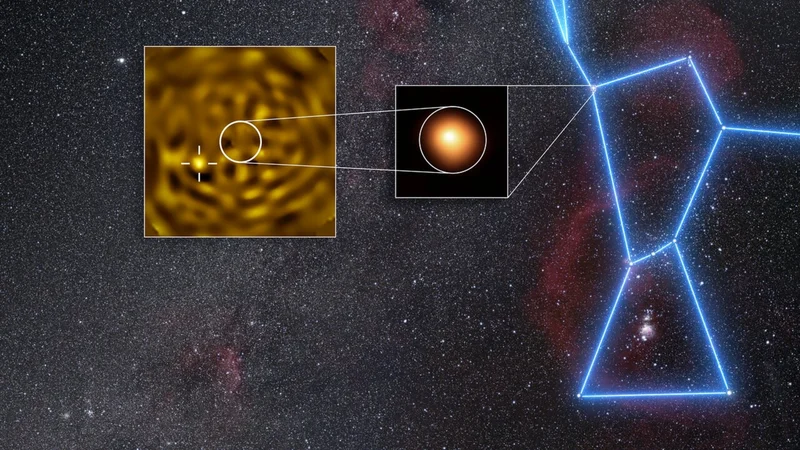
Betelgeuse, the bright reddish star that marks Orion's shoulder, has kept skywatchers company for thousands of years — and it may have had company of its own the whole time.
Astronomers say they've captured the clearest image yet of a faint star orbiting tightly around Betelgeuse, in what they're calling the strongest evidence so far that the famous red supergiant isn't flying solo. The find was announced __by the European Southern Observatory (ESO) on Tuesday (July 28) and detailed in a new paper in the journal __Astronomy & Astrophysics.
Betelgeuse, usually one of the top 10 brightest stars visible from Earth, naturally swells and shrinks as it pulses across a cycle of 400 days, according to NASA, which causes the star to wax and wane in brightness. But for decades, scientists have puzzled over an extra pattern: a slower dimming and brightening outside of this 400-day cycle that repeats roughly every six years.
Two independent teams — one led by astrophysicist Morgan MacLeod of Harvard University, the other by Jared Goldberg, a postdoctoral fellow at the City University of New York — each modeled that long-term wobble using decades of brightness and velocity data, and converged on the same explanation: the pattern comes from a hidden companion star, orbiting so close to Betelgeuse's bloated surface that it's nearly impossible to see.
However, their calculations suggested that there might be a moment, in December 2024, when that companion would swing far enough away from Betelgeuse that we might be able to photograph it.
So that December, a team led by Paris Observatory astronomer Miguel Montargès trained the European Southern Observatory's Very Large Telescope on Betelgeuse. They then spent months combing through the data, and the effort paid off: they found what looks to be this companion star, now nicknamed Betelgeuse B.
"The fact that we can still discover a nearby companion, more massive and brighter than the Sun, around such a well-studied star is remarkable," Montargès said in an ESO statement. "These are among the best moments in science: seeing something new, unexpected."
Get the world’s most fascinating discoveries delivered straight to your inbox.
RELATED STORIES
- Betelgeuse's mysterious spin could be a cosmic illusion caused by its enormous 'boiling' surface
- Astronomers share best-ever evidence that Betelgeuse has a secret companion star — and they've nicknamed it 'her bracelet'
- Betelgeuse, Betelgeuse? One of the brightest stars in the sky may actually be 2 stars, study hints
One surprise: the companion turned out to be beefier than expected. Scientists had guessed it was roughly as massive as our sun, but the new images suggest it's actually two to three times heavier — which also makes it brighter and easier to spot than predicted.
However, the researchers say they need one more image of this star. To be certain that the companion is really there, we still need to observe it in one year on the other side of the star, but there is very little space left for doubt,"adds Montargès.
If confirmed, the discovery could reshape how astronomers think about Betelgeuse's fate. As a red supergiant, it's in the final stage of its life and will eventually end in a supernova explosion — though pinning down exactly when is notoriously difficult, says Montargès. "The question is … whether this companion is going to have an impact on the evolution of the red supergiant," Montargès said.
De Ugarte Postigo, A., Фатхуллин, Т. А., Jóhannesson, G., Gorosabel, J., Соколов, В. В., Castro‐Tirado, A. J., Balega, Y. Y., Spiridonova, O. I., Jelínek, M., Guziy, S., Pérez-Ramírez, D., Hjorth, J., Laursen, P., Bersier, D., Pandey, S. B., Bremer, M. N., Monfardini, A., Huang, K. Y., Urata, Y., . . . Трушкин, С. А. (2006). Extensive multiband study of the X-ray rich GRB 050408. A likely off-axis event with an intense energy injection. Max Planck Digital Library. https://doi.org/10.1051/0004-6361
Olivia Maule is a science journalist whose beats include space, biotechnology and the environment. She holds a B.A. in biology and a B.S. in anthropology from the University of Florida and completed a master's degree in science communication at U.C. Santa Cruz. A 2025 AAAS Mass Media Fellow, she wrote stories and produced videos during a summer at El Nuevo Día, Puerto Rico's largest newspaper, and has written for Eos, Mongabay, Science magazine and Stanford Report. Olivia is a native Spanish and English speaker.