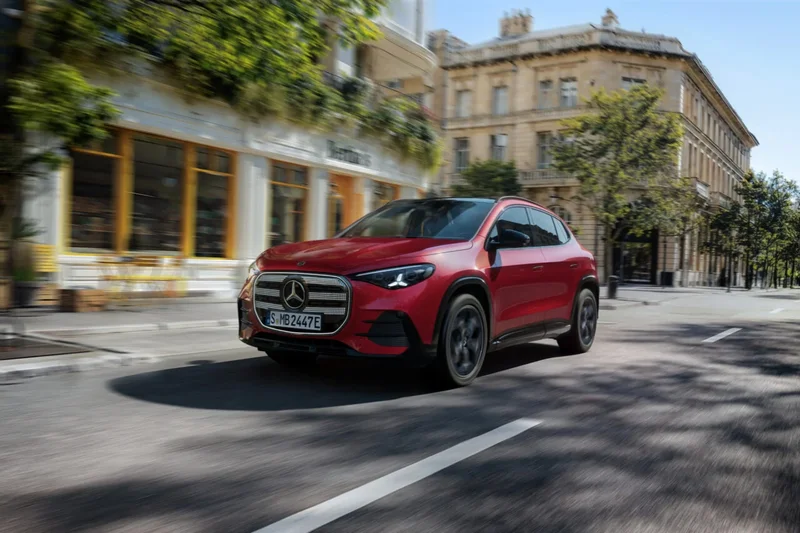
Mercedes-Benz is moving quickly to correct its early-2020s EV missteps, rolling out a string of new electric models. The CLA, GLC, and C-Class have all gone electric within roughly the past year, and now the GLA Electric is joining them. It will not go on sale until next summer, but it boasts impressive stats as sophisticated new electric cars emerge from just about every corner of the industry.
As before, the GLA is the small-SUV counterpart to the CLA small sedan in Mercedes’ lineup. Both use the Mercedes Modular Architecture (MMA), which will underpin the company’s other small, typically front-wheel-drive vehicles. Unlike the platforms used for the new C-Class and GLC EVs, as well as the older EQE and EQS, MMA supports both electric and internal-combustion models. Even so, the electric versions are the most notable additions to the third-generation GLA.
Mercedes will release final U.S. specifications closer to the GLA’s launch, but two versions are planned initially: the 268-horsepower GLA 250+ Electric and the 349-horsepower, dual-motor GLA 350 4Matic Electric. Both use the same NMC battery with 85 kWh of usable capacity.
Building off of the CLA introduced last summer, the GLA EV uses an 800-volt electrical architecture. Mercedes says it can charge at up to 320 kW on a 400-volt DC fast charger, adding as much as 165 miles of range in about 10 minutes. A built-in NACS charging port comes standard.
Mercedes estimates that the longest-range GLA could earn an EPA rating of 347 to 367 miles, extrapolated from its European WLTP figures, although it has not yet received an official rating. For comparison, the CLA EV’s EPA ratings range from 317 to 374 miles. If the GLA lands within Mercedes’ estimate, it would be competitive with the base and Long Range versions of the Tesla Model Y and comfortably surpass more direct rivals such as the Audi Q4 E-tron and Volvo EX40.
Still, the Model Y comparison only goes so far because the GLA is substantially smaller. Its wheelbase has grown by more than 2 inches to 109.8 inches, but that is still 4 inches shorter than the Tesla’s, and the vehicle itself is more than 6 inches shorter overall. That difference shows up in rear-seat room and cargo capacity. Although the new GLA is roughly an inch taller than its predecessor, it remains close to the line between a hatchback and an SUV.
Like nearly every recent Mercedes, whether gas or electric, the GLA’s interior is dominated by screens. The standard setup pairs a 10.25-inch instrument display with a 14-inch touchscreen running the Google-backed MBUX infotainment system, which incorporates Automotive AI into its native Google Maps app. The optional MBUX Superscreen adds another 14-inch display for the front passenger, creating a wall-to-wall screen effect. That display supports native Disney+ and Sony Ridevu apps, audio streaming, and video conferencing through services such as Microsoft Teams.
The revamped MBUX Voice Assistant draws on AI systems from Google, ChatGPT, and other providers. Mercedes says this ‘multi-agent approach’ should make interactions more intuitive and improve responses both in apps such as Google Maps and when controlling vehicle functions such as climate and audio.
Beyond the Superscreen and an optional 16-speaker Burmester 3D surround-sound system, the GLA offers a Sky Control panoramic roof that can switch from transparent to opaque in 10 to 20 milliseconds, depending on how many of its seven segments the driver adjusts.
Unfortunately, Mercedes is still in the game of offering options as digital add-ons, or ‘Digital Extras’ to use its term. These include a 360-degree camera system with a curb-warning function and an electric route planner that identifies charging stations while accounting for traffic patterns and driving style. Mercedes says future versions could even factor in wind conditions and the vehicle’s height when estimating range.
Some driver-assistance features are also sold as Digital Extras, including Distance Assist, which uses eight cameras and more than a dozen sensors, and MB.Drive Assist Plus, which can recognize stop signs and traffic lights. Mercedes has not yet mentioned MB.Drive Assist Pro, the system it previewed at CES 2026 and plans to offer in the CLA later this year. The map-based highway-assistance system appears comparable to General Motors’ Super Cruise and Ford’s BlueCruise, though that comparison still needs to be verified.
For buyers not ready to go fully electric, the GLA will also be available as a âmildâ hybrid, like the CLA. Its 1.5-liter four-cylinder engine is paired with a 48-volt electrical system that can power the vehicle on electricity alone in certain low-speed situations and while coasting above 60 mph.
Pricing has not been announced, but if the electric CLA is any guide, expect the GLA Electric to start at around $50,000 when it reaches the U.S. next summer. Even a restrained trip through the options list could push it toward $60,000. The GLA will not be one of the affordable EVs the market badly needs, but it will offer another long-range option for buyers who do not want a massive vehicle just to reach their destination or the next charger.