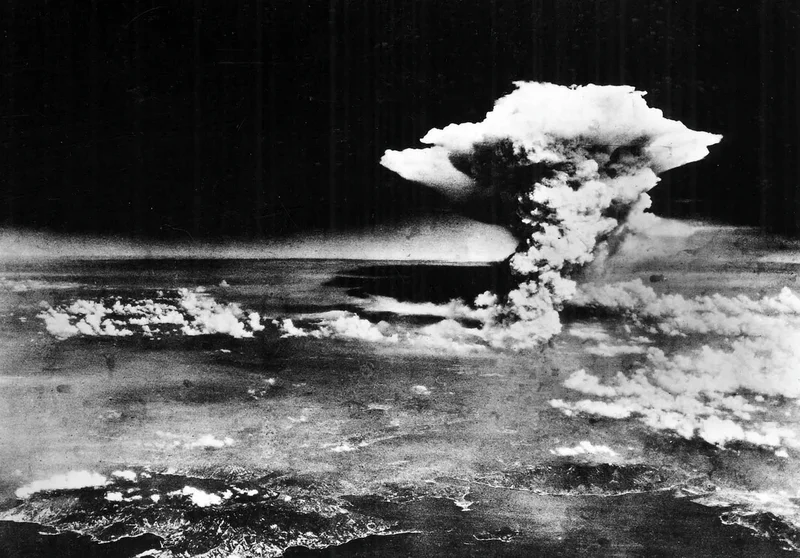
When an atomic bomb detonates, it produces a unique chemical environment that’s nearly impossible to mimic in a lab—and amid its destruction, the explosion can create something completely new.
One of the most devastating explosions ever on the planet—the 1945 atomic bombing of Hiroshima—created a metallic material that was never seen before in a lab or nature. Luca Bindi, an earth scientist at the University of Florence in Italy, found the alloy while collecting microscopic debris from along the beaches of Hiroshima Bay. “Even decades later, a grain only a few micrometers across can retain a detailed record of conditions that existed for only fractions of a second,” he says. “These particles are not simply melted debris. They are physical archives of the explosion.”
A nuclear explosion hits its environment like a lightning or meteor strike: The air gets surface-of-the-sun-level hot and then cools down quickly, and different materials vaporize and come together in ways they usually wouldn’t. Because this all happens so fast, vaporized metals don’t have time to stabilize as they typically would, and “every small droplet effectively [becomes] an independent experiment,” Bindi says.
On supporting science journalism
If you're enjoying this article, consider supporting our award-winning journalism by subscribing. By purchasing a subscription you are helping to ensure the future of impactful stories about the discoveries and ideas shaping our world today.
In this case, one of thousands or perhaps millions of such “microexperiments” in the Hiroshima explosion formed a metallic alloy mainly made up of iron, chromium, nickel, manganese, molybdenum, silicon and aluminum mixed in a homogeneous cubic lattice. The material and structural composition have never been seen before—typically, this mix of elements would stabilize into a simpler crystal structure with fewer ingredients, but here it retains a complex cubic form.
Scientists have found new substances that were formed by nuclear or other extreme conditions in the past. Among them is trinitite, a glassy material that was created by the Trinity nuclear bomb test in July 1945. Trinitite contains a novel, cagelike clathrate crystal and quasicrystals, rare materials, once thought impossible, that contain nonrepeating atomic structures. Quasicrystals have also been uncovered in meteorites. Though the alloy found in Hiroshima Bay is not a quasicrystal, its structure can help us understand them better, Bindi says, because it’s similar to some of the atomic arrangements within quasiperiodic materials.
This discovery, published on Wednesday in Science Advances, opens questions around what kinds of substances extreme events can create and whether they are “isolated curiosities” or part of a “more general class of materials,” Bindi adds. “If that broader pattern is real, then atomic-blast debris may help us discover principles of matter formation that also apply to meteorite impacts, lightning strikes and other violent events throughout nature.”
The finding reflects “a whole world largely untouched” of materials that are difficult to create under thermodynamically stable conditions—and difficult to find in places with mundane histories, says Michael Widom, a physicist at Carnegie Mellon University, who wasn’t involved in the study but has worked with Bindi in the past. “[Bindi] rightly recognizes that if you want to find new materials, they’re going to be in unusual places.”