Tehran11:29 p.m. July 29
Latest
American and Saudi fighter jets attacked Iranian-linked militias and their Iranian advisers in Iraq on Wednesday, and Iran fired missiles at military bases in Jordan. It ended a dayslong pause in direct fighting between the United States and Iran and further widened the scope of the war.
Since the collapse of a cease-fire between the United States and Iran this month, Iran-linked groups across the region have opened new fronts and reopened old ones, embroiling forces in Saudi Arabia, Iraq, Lebanon and Jordan in the war that until recently had been contained to countries along the Persian Gulf.
The United States accused the Iranian military on Wednesday of directing its allies in Iraq to attack “U.S. forces and Saudi energy infrastructure.” The Iranian foreign ministry condemned the U.S.-Saudi strikes as an attempt to broaden the conflict.
On Egypt’s Mediterranean coast, meanwhile, two ships, including a U.S.-owned gas storage tanker, caught fire after an explosion at a shipping hub, according to Kpler, a maritime tracking firm. A second maritime tracking company, Ambrey, reported that a drone attack had caused the blast.
President Trump, speaking to reporters in the Oval Office on Wednesday afternoon, said he had been briefed on the explosion and implied that Iran was responsible without offering details. He said the incident was “more of the same” and that the United States was “going to be hitting them very hard, because it’s our turn to hit them.”
Saudi Arabia’s joint attack with the United States on Iran-allied militias in Iraq was an escalation. Since the U.S.-Israeli war on Iran began in late February, the kingdom has avoided becoming a direct combatant, though it has launched some secret retaliatory strikes on Iran, according to senior U.S. officials. This week, Saudi Arabia has faced dozens of drone attacks against its oil facilities, and the Iranian-allied Houthi militia in Yemen said it had targeted a Saudi oil tanker in the Red Sea, another vital passageway for energy supplies, on Tuesday.
On Wednesday, the Saudi foreign ministry said in a statement that the country was not seeking escalation but would respond to any aggression.
Mr. Trump said Iran’s latest strikes were a surprise in a Wednesday morning interview on “Fox & Friends.” American forces had only a few minutes’ notice to shoot down the incoming Iranian missiles, he said.
Also on Wednesday, the Jordanian military said it had shot down five missiles that Iran’s Islamic Revolutionary Guards Corps claimed were fired in retaliation for American aggression.
The U.S. military said that the strikes in Iraq were in retaliation for more than 30 drone attacks by Iranian proxy groups in the past 72 hours. A U.S. official, who spoke on condition of anonymity to discuss operational matters, said the strikes killed about 20 Iranian military and technical advisers.
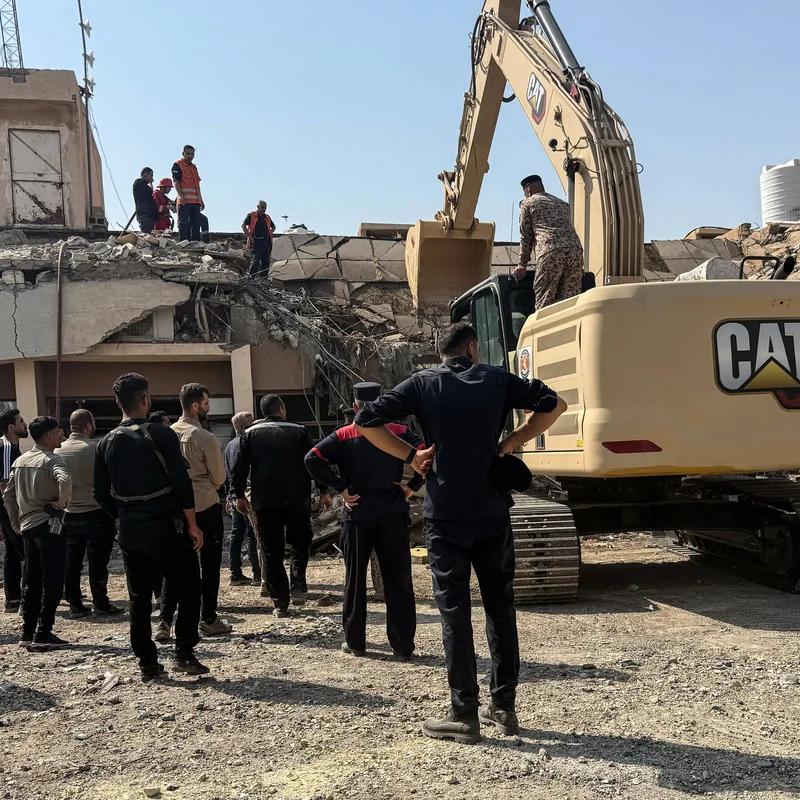
Prime Minister Ali al-Zaidi of Iraq called the U.S.-Saudi strikes “an unacceptable aggression.” The Popular Mobilization Forces, an umbrella group of Iraqi militias, many of which have close ties to Iran, said in a statement that at least 20 of their fighters were killed in the strikes.
Separately, the Revolutionary Guards said its forces had struck three tankers, but it did not say where the ships were located.
Here’s what else we’re covering.
-
Iraqi militias:The P.M.F. is an umbrella group of Shiite militias that banded together in 2014 to fight the Islamic State group in Iraq. It has come under the authority of the national security forces in recent years, but some militias still operate with a large degree of independence. Read more ›
-
Oil prices jump:The price of Brent crude, the global benchmark, and West Texas Intermediate, the U.S. benchmark, rose sharply on Wednesday following the attacks. Read more ›
- Lebanon:The Israeli military said Wednesday that Hezbollah had launched an explosive drone at one of its vehicles in southern Lebanon. A Hezbollah spokesman said the group did not claim responsibility for an operation in the ridge area. Read more ›
President Trump, speaking to reporters in the Oval Office, suggested that an attack on Iran was forthcoming in response to an attack on a U.S.-owned liquefied natural gas carrier in Egypt. He said that he had been briefed, and that “we’re going to be hitting them very hard, because it’s our turn to hit them.”
The explosion that set two ships carrying natural gas afire in an Egyptian port was believed to be caused by a drone attack, which hit at least one of the ships, Joshua Hutchinson, the chief commercial officer of the maritime tracking firm Ambrey, said in an interview. Ambrey has not identified the source of the attack.
Attacks
IRAN
said it targeted U.S. military assets in Jordan.
IRAQ
jordan
SAUDI ARABIA and U.S.
struck Iranian proxies in
Iraq after proxies attacked
Saudi oil facilities.
YEMEN
Arabian
Sea
HOUTHIS
claimed fresh attack
on Saudi tanker.
Attacks
IRAN
said it targeted
U.S. military assets
in Jordan.
IRAQ
jordan
SAUDI ARABIA and U.S.
struck Iranian proxies in
Iraq after proxies attacked
Saudi oil facilities.
Red
Sea
Arabian
Sea
YEMEN
HOUTHIS
claimed fresh attack
on Saudi tanker.
The U.S. military said on Wednesday that it continued to strictly enforce its naval blockade of Iran. In a social media post, U.S. Central Command said that as of July 29, its forces had redirected 20 commercial vessels, disabled two and boarded two others since it reinforced the blockade on July 14.
Two ships, one of them a U.S.-owned gas storage tanker, caught fire after an explosion at a shipping hub on Wednesday in Egypt, according to Kpler, a maritime tracking firm.
It was unclear what caused the explosion.
Reuters and The Associated Press, quoting the Ambrey maritime tracking company, reported that a drone attack had caused the blast but that account could not immediately be confirmed.
Kpler said both vessels had been moved away from the port on the Mediterranean Sea. There were no confirmed injuries or deaths, Egypt’s ministry of petroleum said on social media.
A U.S. official said that Tuesday night’s U.S.-Saudi strikes in Iraq had killed about 20 Iranian advisers, a combination of members of the Islamic Revolutionary Guards Corps and technical advisers, the official said, speaking on the condition of anonymity to discuss operational matters. The sites in Iraq were deliberately targeted for that reason, as well as to knock out the ability of Iran-backed militias to launch missiles and drones, the official said.
Iraq is home to dozens of armed militias, a legacy of the 2003 U.S.-led invasion of the country and the war against the extremist group Islamic State. Now, some of those militias have once again been drawn into the broader conflict engulfing the Middle East.
At least 20 fighters of the Popular Mobilization Forces, or P.M.F., an umbrella group of Iraqi militias with ties to Iran, were killed in a wave of U.S. and Saudi airstrikes across Iraq targeting the group’s headquarters, the P.M.F. said in a statement on Wednesday.
Iraq maintains close ties to both Iran and the United States and has often found itself caught between the warring sides, with Iraqi territory at times turned into a proxy battlefield. Iraq has also struggled with exerting tighter control over the militias.
Here’s what you need to know about the Iraqi militias.
What is the P.M.F.?
Iraq’s many militias first formed after the U.S.-led invasion and occupation of Iraq in 2003, which led to widespread anti-American sentiment in the country. Neighboring Iran, which, like Iraq, has a majority Shiite Muslim population, responded by helping to train and arm Iraqi Shiite militias to attack occupying American forces in Iraq.
In 2014, as Iraq was battling the rapid spread of the Sunni extremist group Islamic State, many Shiite militias banded together under the grouping known as the Popular Mobilization Forces to fight the group, which had seized large parts of Iraq. Some of the militias within the P.M.F. receive military and financial backing from Iran.
Some of those militias at the time also cooperated with the U.S.-led coalition fighting the Islamic State.
Among the P.M.F. forces that succeeded with American and Iranian support in ousting the Islamic State from much of the country was a militia called the Badr Organization. It was also accused at the time of atrocities against members of Iraq’s Sunni Muslim minority. The militia was one of the groups targeted in the Wednesday airstrikes.
In recent years, the P.M.F., which gained political influence as some of its leaders moved into ministerial positions, has agreed to come under the authority of Iraq’s national security forces. But it has never been fully integrated, and some of the militias under its umbrella continue to operate with a large degree of independence and maintain close ties to Iran.
How did the P.M.F. get drawn into this latest conflict?
The joint U.S.-Saudi airstrikes targeting the P.M.F. were carried out early Wednesday morning. The United States said it attacked Iranian proxy armed groups in Iraq in response to recent drone strikes launched by those militias.
The U.S. Central Command said in a statement on social media that under the direction of Iran’s Islamic Revolutionary Guards Corps the Iraqi militias had launched more than 30 drone strikes this week on U.S. forces in the Middle East and on Saudi energy infrastructure.
None of the Iraqi militias claimed responsibility for these recent attacks.
The Saudi foreign ministry said in a statement on Wednesday, published by state media, that the country was not seeking escalation but would not hesitate to respond to any aggression.
The Badr Organization, one of the most powerful groups in Iraq and known for its close ties to Iran, strongly condemned “the heinous and unjustified attack targeting the sovereignty of Iraq and its armed forces” and called on the Iraqi government to take a firm stance against the strikes.
On Feb. 28, when the United States and Israel launched the war on Iran, the headquarters of another Iraqi militia, Kataib Hezbollah, was hit with airstrikes. The strikes killed three militia members and wounded others.
Neither U.S. Central Command nor the Israeli military claimed responsibility but the P.M.F. blamed the “Zionist-American forces.”
Kataib Hezbollah, along with other Iran-allied armed groups in Iraq, immediately threatened to retaliate against the United States and Israel. The militias said they were defending Iraq’s sovereignty and supporting Iran.
In early March, the U.S. Embassy in Baghdad was targeted in a rocket attack. No group took responsibility. Since then, Kataib Hezbollah and other militias have launched regular drone and rocket attacks on U.S. targets in Iraq.
The group has also claimed responsibility for high-profile kidnappings, including the abduction this year of Shelly Kittleson, a U.S. journalist in Baghdad. She was freed after one week.
Kataib Hezbollah has long been closely tied to Iran’s Quds Force, the overseas arm of Iran’s powerful Revolutionary Guards. In 2009, the U.S. designated it as a foreign terrorist organization.
Both Kataib Hezbollah and the Badr Organization are among the militias that operate partially outside state control.
What is the Iraqi government position?
The Iraqi presidency condemned the U.S. and Saudi strikes on the P.M.F. headquarters and said it “considers this an unacceptable attack and a blatant violation of Iraq’s sovereignty and targeting its official security institutions in contravention of international law and the Charter of the United Nations.”
The statement on Wednesday also said the government rejected the use of Iraqi land “as a launching pad or arena for attacks on neighboring countries or for settling regional and international scores.”
Soon after he came to power in April, Iraq’s prime minister, Ali al-Zaidi, ordered the country’s militias to come under direct state control in an attempt to rein in the armed groups. It was not the first time Iraq has tried to bring the militias under tighter government control, but previous attempts have failed.
Some of the most powerful Iran-linked militias rejected the latest government attempt.
Falih Hassan contributed reporting.
Saudi Arabia entered the U.S.-Iran war on Wednesday with airstrikes in Iraq. Its delayed entry, six months into the war, illustrated the bind the kingdom faces as it tries to deter attacks without getting sucked into the broader conflict, analysts say.
The kingdom’s defense ministry announced the airstrikes, accusing Iran-backed militias in Iraq of attacking Saudi oil facilities earlier this week. No Iraqi militias have claimed responsibility for those attacks.
Iraq’s National Security Council said in a statement that the strikes had caused the deaths and injuries of “a number of innocent people,” and Prime Minister Ali al-Zaidi of Iraq called the strikes “an unacceptable aggression.” The Saudi government did not immediately respond to a request for comment.
However, Saudi government statements appeared keen to portray the strikes as a limited reaction to specific attacks, rather than an entry into the wider U.S. and Israeli war with Iran.
“The kingdom confirms that it is not seeking escalation but that it will respond to any aggression,” said a Saudi defense ministry spokesman, Maj. General Turki al-Malki.
His statement invoked the right to self-defense and quoted a line from the Quran calling for believers to attack those who attack them in a similar manner.
His language underscored the dilemma that Saudi Arabia has faced since the United States and Israel attacked Iran in February, setting off a military conflagration across the region and threatening the kingdom’s security and economic ambitions. While Saudi Arabia has long had antagonistic relations with Iran, Saudi officials had been pursuing warmer ties for several years — viewing them as the most pragmatic way to manage the threat posed by Iran.
The war dashed those efforts at diplomacy. In retaliation against U.S. attacks, Iran launched thousands of missiles and drones at Persian Gulf states that host U.S. military installations, including Saudi Arabia.
This month, the kingdom also entered into a renewed confrontation with the Iran-backed Houthi militia in Yemen, which has claimed responsibility for several attacks on Saudi soil and declared a blockade against Saudi oil tankers in the Red Sea.
Analysts say that while Saudi Crown Prince Mohammed bin Salman probably saw benefits to the potential weakening of Iran, the war has, in reality, posed major risks for his plans to turn Saudi Arabia into a business and tourism hub.
It has also imposed an economic cost on Saudi Arabia by restricting routes for the export of oil, which provide the lifeblood of the Saudi government budget. As fighting has dragged on, it has strained the kingdom’s relations with the Trump administration, with American and Saudi officials increasingly at odds over how to approach security in the region.
The joint Saudi-American strikes marked the first time the kingdom acknowledged direct involvement in the U.S. war effort, although Saudi Arabia had carried out secret strikes against Iran earlier in the war.
Abdulaziz Alghashian, a senior nonresident fellow at the Gulf International Forum, a Washington-based research organization, said the Saudi leadership likely decided to take overt action this week because it was aware that its reluctance to enter the war “has been misunderstood as acceptance” of attacks against it.
The kingdom is now trying to deliver a message, to its enemies on all sides, that “there are costs to attacking Saudi Arabia,” he said.
Faisal Al-Hamad, a retired Saudi Air Force brigadier general and defense analyst, called it an attempt to “draw clear red lines” to deter further attacks.
This is the first time that Saudi Arabia has acknowledged any attacks against armed groups in Iraq, noted Hasan Alhasan, a senior fellow for Middle East policy at the International Institute for Strategic Studies.
The strikes could also be read as a warning to Iran that escalating further could push Saudi leadership to align even more closely with the United States, he said.
Iraqi militias allied to Iran released a joint statement on Wednesday threatening retaliation for the U.S.-Saudi strikes on Iraq, but said they would not act until after Tuesday, the end of the ongoing Arbaeen pilgrimage, when hundreds of thousands of Shiite Muslim pilgrims visit the holy shrines in the Iraqi city of Karbala. “Our response to the American enemy is inevitable and will come,” the statement said, “and we may target its tools in Saudi Arabia if the situation demands it.”
The statement also said the militias would give Iraq’s central government, which has been pressuring the Iran-aligned groups to disarm and become part of the state, a “deadline” of next Tuesday to respond to the strikes.
Iraq’s National Security Council condemned deadly U.S. and Saudi airstrikes on a number of Iraqi militias, which killed at least 20 people, during an emergency session Wednesday.
The council decided on a security plan to confront any violation of the country’s sovereignty and to prevent any party from threatening neighboring countries. The council confirmed its “firm position rejecting all hostile acts, regardless of the party that carries them out or the justifications invoked for them.”
Several Iranian advisors were killed in the U.S.-Saudi strikes on Iraq, according to images released by Sabereen news, an agency affiliated with the Kataib Hebzollah, a powerul Iraqi militia linked to Iran. A photograph and video of the funeral procession released by the group showed at least five coffins wrapped in Iranian flags.
The Israeli military said Wednesday that Hezbollah had launched an explosive drone at one of its vehicles on a strategic ridge in southern Lebanon, raising fears of a renewed escalation on one of the most volatile front lines in the Middle East.
The attack threatened to undermine a fragile cease-fire between Israel and Hezbollah, the Iran-backed militant group that dominates Lebanon. The truce has barely held as Israel and Lebanon have worked to implement a separate framework agreement aimed at ending months of fighting. Hezbollah has rejected the agreement between Israel and Lebanon.
On Wednesday, the Israeli military said Hezbollah had launched the drone toward an engineering vehicle operating on the Ali al-Taher ridge, a commanding hilltop about six miles from the Israeli border. The Israeli military said there were no injuries from the incident.
A Hezbollah spokesman said the group did not claim responsibility for an operation on the ridge area, and accused Israel of using “false pretexts” to continue its attacks in Lebanon.
The latest conflict between Hezbollah and Israel erupted on March 2, after the group attacked Israel in solidarity with Iran following the U.S.-Israeli strikes that began the war. The fighting has killed more than 4,300 people in Lebanon, displaced more than one million residents and Israel now occupies large areas of southern Lebanon. Israeli officials say at least four Israeli civilians and more than 30 soldiers have been killed.
In recent months, the ridge has become one of the most strategically significant areas in the conflict. Lebanese and Israeli officials believe Hezbollah has established one of its largest underground installations beneath the ridge. Israel says the complex has for years served as a command center for planning and launching attacks against its territory. The ridge overlooks much of southeastern Lebanon, including the city of Nabatieh.
As recently as May, the ridge was beyond the area that Israel had occupied several miles inside southern Lebanon. Israel marks the boundary of this zone with a yellow line on its maps and says it regards any armed individual operating south of that line as a security threat and a legitimate military target. In June, however, Israel redrew those boundaries, extending the yellow line to include the ridge.
Fighting has flared in the area since.
In mid-June, Hezbollah said in a statement that it had targeted Israeli troops attempting to advance into the area. Later that month, the Israeli military said thousands of its troops had surrounded a vast underground Hezbollah fortress beneath the ridge, trapping dozens of the group’s fighters inside.
The latest episode occurred as Israel and Lebanon seek to implement a framework agreement intended to wind down the conflict that was negotiated during months of talks in Washington and Rome. It calls for Israel to gradually withdraw from territory it holds in southern Lebanon while the Lebanese Armed Forces move in to secure those areas and facilitate the return of displaced residents.
The first areas slated for implementation, described as “pilot zones,” are intended to test the broader agreement reached last month. Three villages have been designated in the first phase of the withdrawal plan.
But the framework has been criticized in Lebanon because it sets no fixed timetable for Israel’s withdrawal, and is tied to the Lebanese government’s tentative efforts to disarm Hezbollah — a process that has proved difficult.
Hwaida Saad contributed reporting from Beirut, Lebanon.
Satellite images show smoke rising earlier this week from two oil facilities in Saudi Arabia. The United States said joint U.S.-Saudi airstrikes on Iran-allied groups in Iraq early on Wednesday were in response to drone attacks the groups had launched. Saudi Arabia has faced dozens of attacks against its oil facilities this week. The Iranian-allied Houthi militia in Yemen also said they had targeted Saudi energy facilities.
According to “Fox & Friends,” President Trump described Iran’s recent strikes in Jordan as a surprise attack, telling the program that American forces had only a few minutes’ notice to shoot down the incoming Iranian missiles. “We’ll be hitting them hard,” Trump said in an interview, according to a correspondent for the program.
Ships transporting energy products out of the Middle East face a heightened risk of attack in two critical waterways, further disrupting the supply of oil and natural gas to world markets.
Fighting continued in the Middle East on Wednesday, with the United States and Iran launching missile attacks, and the conflict has slowed traffic through the Strait of Hormuz, the primary route for oil shipments out of the Persian Gulf.
Now, the conflict is also increasingly disrupting navigation through the Bab al-Mandab Strait in the Red Sea, which has become a critical valve for Saudi Arabia’s oil exports that can’t make it through the Strait of Hormuz.
The number of vessels passing through Bab al-Mandab is down by one-fifth since July 20, according to Windward, a maritime data agency.
Since the war in Iran started five months ago, Saudi Arabia has reduced its reliance on the Strait of Hormuz by pumping much of its oil through a pipeline and loading it onto tankers in the Red Sea, which runs along the west of the Arabian Peninsula. Most of the tankers then carry the oil south through the Bab al-Mandab Strait, which Yemen borders, making the vessels vulnerable to attacks by the Iranian-backed Houthi militia, which announced a blockade on Saudi Arabia’s Red Sea ports on July 20.
The Houthis claimed to have struck a Saudi tanker in the Red Sea off the coast of Yemen on Tuesday, according to Yahya Saree, a Houthi spokesman, though it was unclear if the ship was actually hit. The United Kingdom Maritime Trade Operations, which is administered by Britain’s Royal Navy, recorded a report of “suspicious activity” in the southern Red Sea in which a ship’s master reported hearing an explosion. The vessel and crew were safe.
Even as the Houthis target Saudi-linked vessels, some Chinese vessels appeared to be broadcasting their nationality and sailing through freely. China has close ties to Iran, the Houthis’ main sponsor.
One Chinese-flagged vessel transited the Bab al-Mandab Strait to Jeddah, a Saudi Arabian port city, with its location transponder on and without any GPS manipulation, according to Windward. The ship’s transponder broadcast the messages “CHINA SHIP CREW SUEZ” and “CHINA SHIP CREW.”
David Smith, an executive at the insurance broker McGill and Partners, said insurance costs for vessels in the Red Sea had increased across the board, even for vessels with no Saudi links. And some insurers are not providing coverage at all for ships that pick up cargo at Saudi ports, he said.
Although 41 ships passed through the Bab al-Mandab Strait on Tuesday, a rise from 39 on Monday, “higher traffic should not be mistaken for lower risk,” said Kpler, a ship-tracking firm. The location transponders on four of those ships were turned off, it added, reflecting the elevated risk levels because the ships may have been trying to avoid detection.
In June, before the Houthi threats, 355 crude tankers passed through the Bab al-Mandab Strait, an increase of more than 50 percent from the 197 that made the transit in February, according to data from Lloyd’s List, a maritime analysis firm.
If the Houthis manage to reduce the number of tankers using the Red Sea in the long term, it would be a big blow to an effort that is moving a lot of oil out of the Persian Gulf, particularly as traffic through the Strait of Hormuz remains at less than one-tenth of prewar levels.
Just 12 ships passed through the Strait of Hormuz on Tuesday, with traffic evenly split by direction, from eight a day earlier, according to data from Kpler. Ten of the ships transited through the Iranian-designated route, and the route taken by the other two was undetermined, the data showed. Iran’s Islamic Revolutionary Guards Corps said it had struck three tankers that ignored its warnings and proceeded on an “illegal” route, though it did not say where the ships were hit.
Starting in 2023, the Houthis carried out many attacks on commercial shipping in the Red Sea after the onset of the Gaza war. The attacks prompted many large shipping lines to avoid the Red Sea and the Suez Canal. They diverted their ships around the southern tip of Africa instead, a route that takes longer and costs more.
The Israeli military said Hezbollah, the Iran-backed group in Lebanon, had launched an explosive drone overnight at an Israeli engineering vehicle in the Ali Taher Ridge area of southern Lebanon. No injuries were reported in the attack but the Israeli military called it “a blatant violation of the ceasefire agreement.” The ridge has emerged as a focal point of the fighting in recent weeks, the site of a Hezbollah underground complex.
Hezbollah has not claimed responsibility for the attack.
Israel and Lebanon have agreed a series of ceasefires and extensions since April, but none has succeeded in stopping the fighting completely. Israel has continued to occupy much of southern Lebanon, where it has carried out strikes and demolitions.
The Popular Mobilization Forces is an umbrella group of Shiite militias that banded together in 2014 to fight the Islamic State group, which had seized large parts of Iraq. Some of the militias within the P.M.F. receive military and financial backing from Iran.
In recent years, the group has gained political influence, and has agreed to come under the authority of the national security forces. But it has never been fully integrated and some of its militias continue to operate with a large degree of independence.
Iran’s foreign ministry has condemned the overnight U.S.-Saudi strikes on Iran-aligned militia groups in Iraq, accusing Washington and Israel of seeking to widen the war across the region. The ministry said the strikes violated Iraqi sovereignty and hit stations serving Arbaeen pilgrims, referring to Shia Muslims traveling to the Iraqi city of Karbala in one of the world’s largest annual pilgrimages.
Iraq’s Popular Mobilization Forces, an umbrella group of Iraqi militias, many of which have close ties to Iran, said at least 20 of its fighters had been killed in the attacks.
Israel has not said it was involved in the attacks.
Today’s attacks, following a dayslong pause in strikes, are the latest in an on-again-off-again dynamic that has defined the war since the United States and Iran agreed a cease-fire in April. Here are the seesaws between fighting and fragile truce that have brought the two sides to this point.
The risk levels for ships navigating two critical waterways in the Middle East is increasing, both in the Strait of Hormuz and in the Bab al-Mandab strait in the Red Sea.
The Iran-backed Houthi militia in Yemen struck a Saudi oil tanker on Tuesday, according to Windward, a maritime data agency.
While 41 ships passed through the Bab al-Mandab strait on Tuesday, a rise from the previous day, “higher traffic should not be mistaken for lower risk,” said Kpler, a ship-tracking firm. The location transponders on four of those ships were turned off, it added, reflecting the elevated risk levels.
At least 20 fighters of the Popular Mobilization Forces, an umbrella group of Iraqi militias, many of which have close ties to Iran, were killed in the U.S. and Saudi airstrikes, the group said on Wednesday. More than 30 fighters were also wounded and military vehicles and equipment were destroyed in the strikes, it added.
After tumbling last week, oil prices reversed direction on Wednesday, topping $90 a barrel, as attacks resumed in the Middle East, jolting investors concerned about the flow of energy out of the region.
The United States and Saudi Arabia said they had struck Iranian-backed militias in Iraq, and Iran said it had fired missiles at U.S. military targets in the region.
In addition, the Iranian-backed Houthi militia in Yemen said on Tuesday that they had launched missiles at a Saudi oil tanker, the group’s latest attack since announcing a blockade of Saudi shipping in the Red Sea.
The Houthis’ efforts to restrict traffic in the Bab al-Mandab strait at the southern end of the Red Sea, which Saudi Arabia has used as an alternative to Strait of Hormuz, has created a new front in the war with Iran.
Threats of the blockade had helped push up global oil prices, which then eased this week along with several days without full-blown fighting between the United States and Iran.
Oil prices rise.
-
The price of Brent crude, the global benchmark, rose more than 7 percent to $90 a barrel. That is for oil to be delivered in September.
-
West Texas Intermediate crude, the U.S. benchmark, rose about 7 percent to around $88 a barrel.
- Oil prices have fallen from their recent highs, but are still up more than 20 percent since the beginning of the war.
- Investors and analysts are focused on the continued disruption to shipping in the Strait of Hormuz, the narrow waterway between Iran and Oman that is a vital trading route for oil and natural gas that normally carries as much as one-fifth of the world’s oil supply.
Global stocks were mixed.
-
The S&P 500 dipped slightly - Stocks in Asia, where markets have experienced a sell-off related to fears about tech companies overspending in the artificial intelligence race, were mixed. Chinese indexes showed small gains. South Korea’s KOSPI index fell 6 percent, and the Nikkei closed 1.5 percent lower.
-
In Europe, the Stoxx 600, a broad index that tracks the region’s largest companies, ticked lower.
Gasoline prices tick lower.
- Gas prices fell 1 cent on Wednesday to a national average of $4.09 a gallon, according to the AAA motor club. The increase has raised the cost for drivers by about 37 percent since the war began.
- Gas prices don’t move in lock step with crude, usually trailing increases or drops by a few days.
- The average price of diesel rose 1 cent to $5.33 on Wednesday, up 42 percent since the start of the war.
What they are saying: ‘Caught in the crosswinds’ of oil prices and tech stocks.
- The renewed fighting is weighing on investors, who “were again caught in the crosswinds of volatile oil prices and an ongoing chip rout,” analysts at Deutsche Bank wrote in a research note.
- The Federal Reserve is not expected to raise interest rates, but the escalation in the Middle East is “complicating the inflation outlook,” the analysts wrote.
The new attacks appeared to have spooked energy investors. West Texas Intermediate crude, the U.S. benchmark, rose about 3.5 percent to about $82 a barrel. The price of Brent crude, the global benchmark, was up 3.7 percent at $87 a barrel.
Oil prices spiked last week amid fears of a blockade of Saudi shipping by the Iranian-allied Houthi militia in the Red Sea, but had calmed in recent days.
The United States and Saudi Arabia on Wednesday jointly struck Iran-aligned militias in Iraq in response to recent drone attacks launched by those groups. U.S. Central Command said in a statement on social media that under the direction of Iran’s Revolutionary Guards, the militias in Iraq had launched more than 30 drone attacks this week on American forces and Saudi energy infrastructure.
Saudi Arabia said that it had launched the strikes after Iranian-backed militias in Iraq targeted Saudi oil facilities. The Saudi foreign ministry, in a statement published by state media, said the country was not seeking escalation but would not hesitate to respond to any aggression.