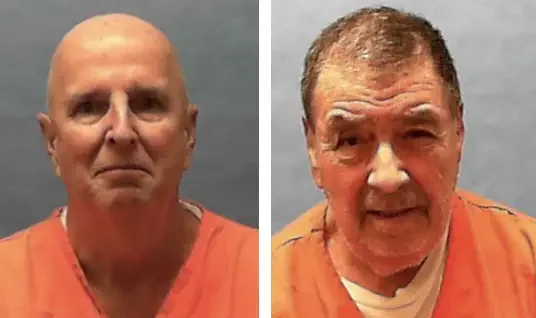
Florida has become the first state in almost a decade to execute two death-row inmates on the same day, one of whom was the second-oldest prisoner known to receive a lethal injection in modern U.S. history.
Eighty-year-old Dominick Anthony Occhicone was pronounced dead on Tuesday evening hours after former police officer Aren Duckett, 68, received a lethal dose in the same death chamber.
Duckett was convicted of raping and drowning 11-year-old Teresa McAbee while he was working as a police officer in central Florida in 1987.
Occhicone, who was convicted of fatally shooting his ex-girlfriend’s parents in June 1986, is the oldest known prisoner executed in Florida since it began modern record-keeping 100 years ago.
Republican Gov. Ron DeSantis has made Florida’s death chamber the nation’s busiest at the end of his final term, saying too many families have waited too long to see justice.
This week’s lethal injections were the first nearly back-to-back executions since Arkansas put two men to death three hours apart in 2017.
DeSantis has the power to set execution dates and opted to schedule Duckett’s and Occhicone’s on the same day.
Nationwide, the use of the death penalty had seen a decline over the last 20 years, but that number has climbed with the increased pace of executions in Florida.
Get breaking National news
There were 47 executions nationwide in 2025; this year there have been 19, almost all of which — dating back to the 1970s when the death penalty was reinstated — have been carried out by state authorities.
Florida has carried out 12 of the 19 to date — more than all other states combined.
DeSantis oversaw a record 19 executions last year, more in a single year than any other Florida governor since the death penalty came back into force in 1976.
Occhicone’s scheduled execution time was 6 p.m., the Associated Press reported.
Given the opportunity to speak his final words, Occhicone thanked all of his Christian brothers for visiting him over the years. He also apologized to the family of the victims and to his own family for his actions.
“Sorry for all the hurt I caused,” he said.
“I know it don’t mean much, but I’m sorry,” Occhicone added. “I never meant to do what I did.”
He was pronounced dead 13 minutes later.
Afterward, the children of Occhicone’s victims released a statement saying his death marked “the end of a long and painful journey.”
“The years since June 10, 1986, have been filled with sleepless nights, empty chairs at family gatherings, and those one-on-one conversations that were lost,” they said.
“Today does not erase that pain and it does not undo the harm, but it does close a door and end a chapter in our lives that has just lingered on far too long.”
Earlier in the day, Duckett had refused an opportunity to say any final words and became unresponsive within minutes of receiving the injection. He was pronounced dead at 1:19 p.m.
Relatives of the girl he killed spoke after his death, saying, “I waited nearly 40 years to have him dead,” Dorthy Tula, the victim’s mother, said.
“This man took advantage of his badge,” Tracy McFall-Buskirk, the girl’s cousin, added.
Lethal injection remains the most common method of execution in the U.S., but has a higher rate of being botched than most others.
A few executions have been aborted as prison officials struggle to find a vein on a strapped-down prisoner. Opponents of the method say autopsies of executed people’s lungs show they experienced drowning before dying from the pentobarbital, which they argue amounts to a torturous death, according to Reuters.
Evidence of higher-than-normal dosage amounts and medical complications in previously executed inmates have also raised concerns in some states, including in South Carolina where prisoners have to choose between lethal injection and firing squad.
On Jan. 31 2025, South Carolina inmate Mario Bowman was administered double the typical lethal injection dose. Most states use five grams of a combination of chemicals, but Bowman was given 10 grams of pentobarbital.
His autopsy revealed that he suffered from pulmonary edema, a collection of blood and fluid in the lungs.
Similarly, the autopsy of Richard Moore, who was executed on Nov. 1, 2024, revealed he was administered the same dose of pentobarbital, delivered in two separate shots, 11 minutes apart.
Death by firing squad has also proven problematic at times. Last May, a South Carolina inmate suffered a prolonged death after shooters missed their target.
–– with files from the Associated Press and Reuters