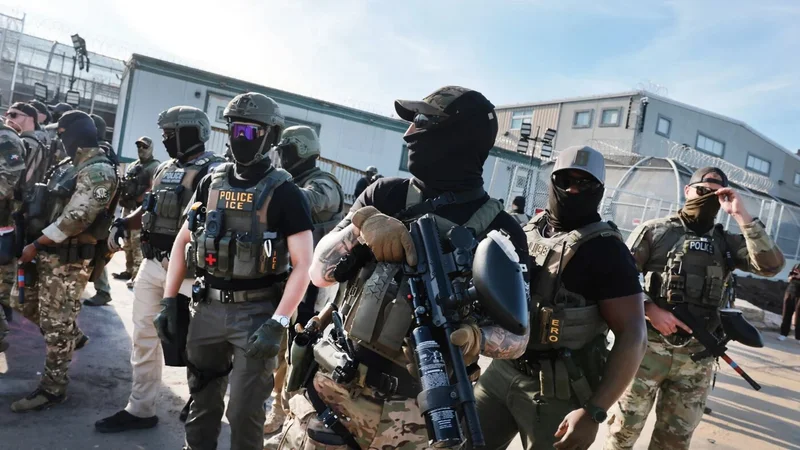
US immigration agents are patrolling airports to arrest visa overstayers
Immigration and Customs Enforcement (ICE) agents are now patrolling US airports looking to arrest people who have overstayed their visas and are taking domestic flights around the country, ABC News reported on Tuesday.
Visa overstays have typically been a civil violation rather than a criminal offence, given these are foreigners who entered the US legally.
Many in the US also often find themselves in a risky position because their Green Card applications for US permanent residency do not get processed in time - before their visas expire.
At least 27 people have been arrested across nine states using this strategy so far, ABC News found. ICE is using traveller data from the Transportation Security Administration (TSA), which runs airport security and scans every person who is scheduled to fly, whether domestic or international.
The Department of Homeland Security (DHS), which oversees ICE, said in a statement that any visa overstayers will only be permitted to use US airports to "self-deport".
The move comes as the Trump administration, under the new DHS Secretary Markwayne Mullin, aims to boost arrest numbers and meet the president's campaign goal of one million deportations a year of "illegals", or those who entered the country undocumented.
Many say they are seeking asylum, but that pathway has now largely been shut down.
A surge
Last month, ICE had its highest number of bookings into its immigration detention facilities since Trump assumed power in January 2025.
More than 43,000 people were taken into custody to await deportation, with an average of 1,500 arrests per day in June, ICE's own data showed.
DHS maintains that it does not have an arrest quota, but ICE agents themselves have been overheard discussing receiving bonuses if arrests surge.
Media coverage has largely died down since Trump ended the violent Operation Metro Surge in Minneapolis earlier this year, but ICE's tactics have not changed.
Agents killed two people earlier this month in Texas and Maine, neither of whom had a criminal record.
The agents are in many cases in plainclothes with their faces and their eyes covered, prompting detainees to believe they are being kidnapped when they are suddenly tackled to the ground while working, shopping, or walking on the street.
Social media videos of hundreds of such incidents prompted outrage across the country last year.
They may have also changed minds.
A Gallup poll from earlier this month showed that while 55 percent of Americans wanted to reduce immigration in 2024 - the year Trump was elected - only 30 percent feel the same now.
The shift reverses a four-year trend, Gallup shows.
Overall, nearly 80 percent of Americans, a record high, now say immigration is a good thing for the country.
Temporary protected status
A key component of Trump's immigration policy has been to end temporary protected status (TPS) for hundreds of thousands of non-immigrants who cannot return home.
TPS is a designation for a limited period that allows non-citizens to obtain a US work permit while they await conditions to improve in their own countries, if they are deemed by the US government to be too dangerous to return to. It can be extended for up to 18 months at a time, with no overall limit set in stone.
TPS has so far been eliminated for Myanmar, Venezuela, Honduras, Nepal, Nicaragua, Afghanistan, and Cameroon.
Haiti and Syria's designations are set to end this week, meaning citizens of those countries who have been under TPS since 2010-2011 will now be subject to arrest and detention by ICE.
There are more than 350,000 Haitians in the US on TPS, and at least 6,000 Syrians.
“Enforcement will be carried out," DHS warned in a post on X.
"You can wait for DHS to deport you or you leave now by visiting DHS.Gov/CBPHOME."
DHS has said it offers foreigners up to $2,500 in reimbursements if they use the "CBP Home" app to book their flight and leave the country of their own accord, but it's unclear if anyone has received that money.