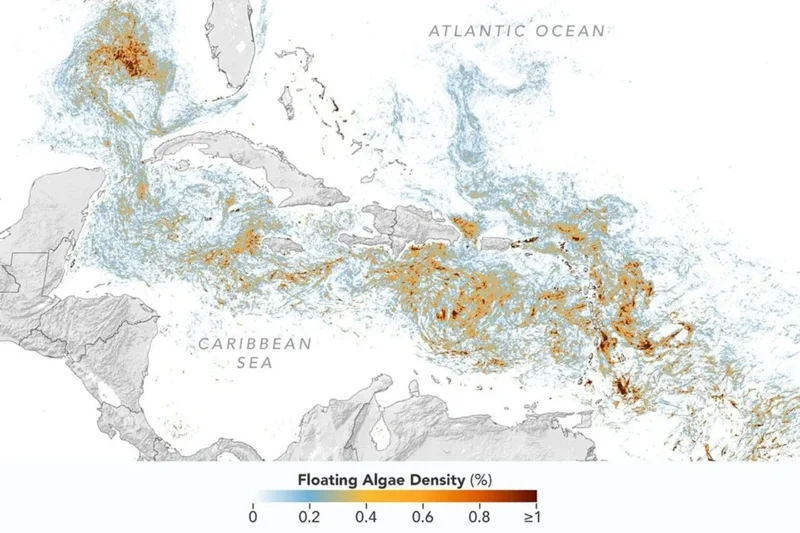
Picture this: You’ve been waiting weeks for your tropical vacation, only to find the beach covered in piles of brown seaweed that reeks of rotten eggs. The water is full of it too, and swimming through it could put you in contact with organisms that cause skin irritation. According to new data from NASA, this problem is particularly pervasive this summer.
In June, the agency’s Plankton, Aerosol, Cloud, ocean Ecosystem (PACE) satellite observed near-record levels of seaweed in the Great Atlantic Sargassum Belt, which stretches across the Caribbean Sea and the Gulf of Mexico. The belt’s sargassum abundance last month made 2026 the second-highest sargassum year in the satellite record, just behind 2025, scientists at the University of South Florida (USF) College of Marine Science report. They are collaborating with NASA to produce sargassum maps based on data from PACE.
Last month, the total amount in the Gulf nearly doubled the historical record, reaching 5 million metric tons, according to a bulletin from the USF Optical Oceanography Laboratory. The Caribbean Sea also saw record-high sargassum levels.
“Major beaching events have occurred and will continue to occur along the southeast coast of Florida as well as around the Caribbean,” the bulletin states. This is when massive mats of sargassum wash ashore, clogging shallow waters and covering beaches. Mats can entangle and suffocate marine life, and those that sink can also smother corals and seagrasses, according to NASA.
As the seaweed decomposes on land, it emits hydrogen sulfide and ammonia, producing a pungent, off-putting odor. Hydrogen sulfide is a corrosive, toxic gas, and prolonged exposure to it can cause upper airway irritation, nausea, headaches, vertigo, confusion, memory loss, and other neurocognitive impacts.
The world’s largest seaweed bloom
Christopher Columbus first reported floating mats of sargassum in the center of the North Atlantic in the 15th century, but until recently, they have been limited and discontinuous. Since 2011, the density and extent of these mats have increased, aggregating seasonally into a giant belt that stretches 5,500 miles (8,850 kilometers) from West Africa to the Caribbean Sea and the Gulf of Mexico. The Great Atlantic Sargassum Belt is the largest macroalgae bloom in the world.
âSince the initial appearance of the Great Atlantic Sargassum Belt in 2011, the total Sargassum amount in the Atlantic Ocean has increased substantially, more than doubling every five years,â Chuanmin Hu, an optical oceanographer at USF, said in a NASA statement. Scientists are still investigating why, but it’s likely related to ocean warming, multiple nutrient sources (including human-caused nutrient pollution), and the fact that large mats of sargassum attract organisms that supply additional nutrients to sustain further growth, he added.
This is a major problem for economies in the tropical North Atlantic that depend heavily on tourism. When the belt’s sargassum levels peak in June, vacationers are often deterred from the beaches of Mexico, the Caribbean, and the southeastern United States. That’s exactly what’s happening now.
Tourism taking a hit
According to Reuters, environmental officials in Quintana RooâMexico’s easternmost state and one of its most popular tourist destinationsâexpect 119,000 tons of sargassum to wash ashore by the end of the year, surpassing last year’s record of 96,000 tons.
“The drop in tourism is extremely serious,â Tulum Councilman Eugenio Barbachano told the publication, pointing to sargassum as the cause. âThe low season is not just low, it is critical.â
At beaches along Quintana Roo’s Riviera Maya, workers are attempting to clear away smelly mounds of sargassum, but the worst of the season may still lie ahead, Reuters reports. A study published in April found that sargassum cleanup workers in the Mexican Caribbean suffered from itching, burning sensations, headaches, dermatitis, and fatigue during the unprecedented 2025 bloom.
Cleanup efforts are also expensive. Governor Mara Lezama previously said that managing sargassum currently costs about 11% of the stateâs GDPâabout $2 billion annually. On top of losses from reduced tourism, sargassum has become a significant financial burden, not to mention a threat to public health and marine wildlife.
Satellite monitoring is a powerful tool that has helped researchers gain a much better understanding of this rapidly growing threat to coastal communities and ecosystems. While the Great Atlantic Sargassum Belt only emerged recently, it’s clear it won’t be going away anytime soon.