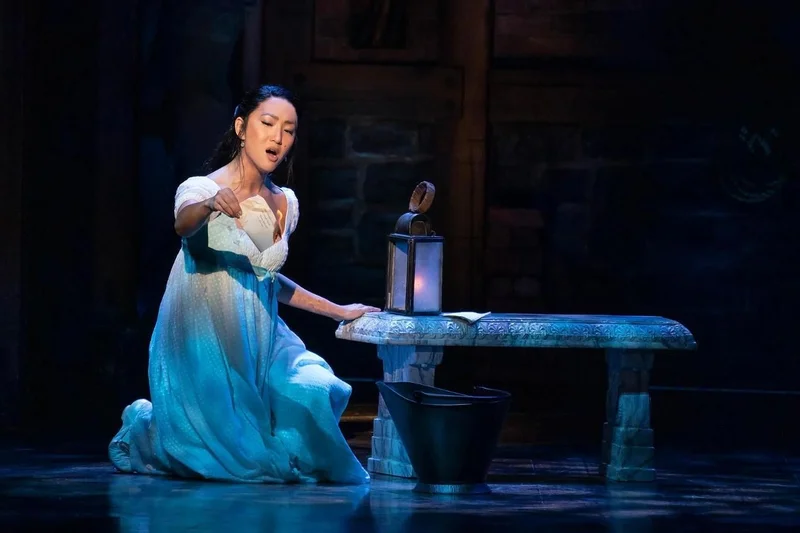
When Stephanie Jae Park was first considering a career in music, the problem was never a lack of options. It was that she loved too many of them.
Opera captivated her. So did jazz, pop and R&B. She wanted to act. She wanted to dance. Choosing one path meant giving up another.
"So I chose musical theater," she said with a laugh. "I chose it out of my inability to choose one thing."
In August, Park will join the Broadway cast of "Six" as Catherine Parr, becoming the first East Asian performer officially cast in the role in a principal production of the hit musical. The high-octane pop concert reimagines the six wives of Henry VIII as modern-day divas, each reclaiming her own story.
It marks another milestone in a career that has rarely stayed within a single lane: Broadway leading lady, concert soloist and now co-creator of an original musical still in development.
"It took me so long to realize that I didn't have just one dream," she said. "I'm somebody who really loves the diversity of art."
That refusal to be boxed in has extended beyond artistic genres.
As one of very few Asian women on Broadway, Park has spent much of her career living with an uneasy contradiction: invisibility and hypervisibility.
When she first entered musical theater, she set limits on herself long before the industry had the chance to.
"I never saw other Asian Americans playing lead roles on Broadway. I thought I was just going to be in the ensemble where they always have that one Asian person. I thought that was going to be me for the rest of my career."
Then "Hamilton" exploded onto Broadway, and with it, Park's assumptions about who she could become. The musical's color-conscious casting redrew the visual language of Broadway, inviting actors of color to inhabit historical figures long portrayed as white. For Park, it was more than a groundbreaking production. It dismantled the limits she had accepted for herself.
"For the first time, I was like, 'Okay, maybe I can play non-Asian roles'," she recalled.
Years later, she would spend five years portraying Eliza Hamilton, becoming part of the very production that had expanded her imagination.
Yet visibility, she soon discovered, came with its own burden.
Often the only Asian performer onstage, she found herself shouldering expectations that stretched far beyond a single performance. On nights when she felt like she had fallen short, she recalled thinking, "I felt like I betrayed all of Asia."
The feeling may sound exaggerated now, she acknowledged, but it was real.
Today, that burden has given way to something closer to purpose because Park recognizes she has become the kind of performer she once searched for herself.
"If there's some Asian child in the audience, I want them to think, 'Okay, I can also be that person.'"
Park's character Parr, the sixth and final wife of Henry VIII, is the only one to outlive the king. She closes the musical not with spectacle but with a call for women to reclaim their own narratives. Park found herself unexpectedly identifying with the queen's quiet confidence.
"A lot of what I do and why I do it is to empower the people who don't see themselves as that powerful," she said.
That impulse has been shaped, in part, by her own childhood.
Born on Guam to Korean parents who had immigrated to the United States for college, Park grew up surrounded by music. There were choir rehearsals, piano lessons and classical singing. Her mother, who studied operatic voice, was her first teacher but never pursued music professionally after growing up in Korea, where an artistic career had never seemed like a realistic path.
She didn't want her daughter to make the same compromise.
Looking back, Park believes her mother's unwavering support came partly from recognizing a dream she herself had once been forced to leave behind.
"I'm kind of like fulfilling this secret dream that she never got to have."
But discovering her voice was not only an artistic journey. It was also a search for where she belonged.
After moving from Guam to Colorado at age 11, Park often wished she were white. Her occasional visits to Korea brought a different kind of dislocation.
"In America, they only see me as Korean, but I go to Korea and they mostly see me as American," she said.
It took adulthood, repeated trips back to Korea and finding a community of Korean Americans in New York for those seemingly conflicting identities to stop feeling contradictory.
"The older I get, the more I love what makes me different," she said.
That same instinct continues to guide her ambitions.
Alongside her Broadway career, Park is developing an original musical, "The Lich, an Undying Musical," a genre-bending science-fiction story where power is determined through singing competitions. She hopes it will move effortlessly between theatrical storytelling and contemporary music — another project that refuses to set rigid boundaries.
For someone who has spent her life resisting categories, it feels like the most natural next act. Now, she is building a career where all of them can exist at once.