‘I am dying slowly’: Gaza professor blocked from cancer treatment by Israel’s siege
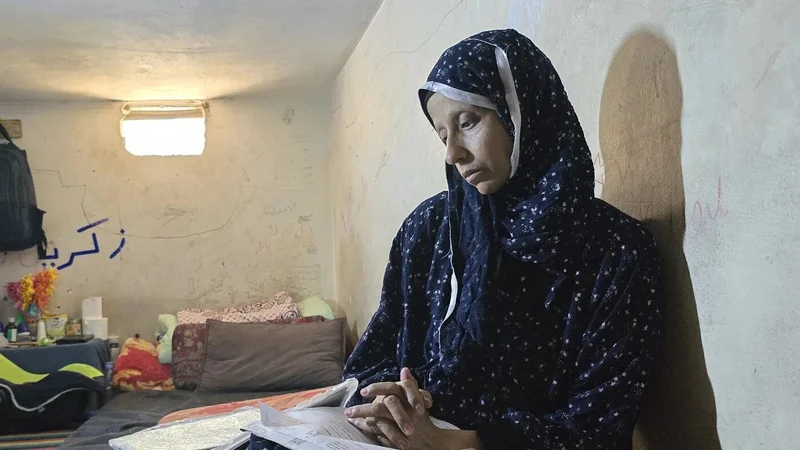
In a cramped space beneath the staircase of a school-turned-shelter in southern Gaza, university professor Kholoud Abu Sahmoud is slowly losing her battle with cancer.
After 15 rounds of chemotherapy, the 33-year-old Palestinian mother of two was told she could no longer continue treatment because the drugs available in the war-ravaged enclave were not suitable for her type of cancer.
“I was first diagnosed with liver cancer immediately after giving birth to my daughter, about nine months ago. But after several chemotherapy sessions, my condition only continued to worsen,” Abu Sahmoud told Middle East Eye.
“The doctor told me that the treatment was not suitable for my body or my condition. The chemotherapy never treated my cancer. It only caused my hair and nails to fall out. Almost every day, parts of my nails come off.”
Nearly 10 months after the ceasefire agreement in October 2025, Israeli authorities continue to restrict the entry of essential and life-saving medicines and medical supplies into Gaza, including cancer drugs, chemotherapy medicines, antibiotics, anaesthetics, laboratory supplies, diagnostic equipment and surgical consumables.
By March, around 46 percent of essential medicines and 66 percent of medical consumables were already completely out of stock, according to UN agencies and international organisations.
This month, the Palestinian Ministry of Health in Gaza announced that chemotherapy treatment for several types of cancer had largely ground to a halt, including breast, colorectal and gastrointestinal cancers, head and neck tumours, and sarcomas, as stocks of specialised oncology medicines reached critical levels.
The ministry said that, of Gaza's nearly 11,000 cancer patients, at least 4,000 have been issued medical referrals and are still waiting for permission to leave the strip for treatment.
"We have been forced to use some medicines that had already expired because of the severe shortages. Now even those have run out," Dr Muhammed Abu Nada, director of the Gaza Centre for Cancer, told MEE.
"This is clearly increasing the mortality rate."
Abu Nada said Gaza was facing its worst shortage of chemotherapy drugs in years.
"For example, the breast cancer medication we still have is barely enough for existing patients. If new cases are diagnosed, we have no treatment to offer them."
Instead of following standard treatment protocols, doctors have increasingly been forced to rely on single-drug therapy.
"This obviously reduces the effectiveness of treatment, worsens outcomes and can lead to further complications," Abu Nada said.
"We are also facing shortages of immunotherapy drugs, which further increases the risks for our patients."
‘Endless waiting’
Abu Sahmoud's medical referral was approved shortly after her diagnosis because the treatment she needs is unavailable in Gaza. Nine months later, she is still waiting to leave.
"Doctors told me the treatment I need is available in Jordan or Turkey, and there was no way to improve my condition here," she told MEE.
"I've been waiting for urgent medical evacuation for nine months."
Medical referrals allow patients in Gaza to receive specialist treatment unavailable in the strip, with pathways directing towards hospitals in the occupied West Bank, East Jerusalem, Egypt and Jordan.
Although referrals are typically issued and funded by the Palestinian Authority's Ministry of Health, patients still require permission to leave through crossings controlled by Israel or Egypt.
Since the genocide in Gaza began in October 2023, Israel has severely restricted medical referrals and evacuations from the strip, preventing thousands of critically ill and wounded Palestinians from accessing care unavailable locally.
'My health deteriorates every day with this endless waiting'
- Kholoud Abu Sahmoud, Palestinian cancer patient
Four months after the October ceasefire agreement, Israel partially reopened the Rafah crossing with Egypt for medical evacuations under a tightly controlled mechanism, allowing only around 50 patients a day to leave - subject to Israeli approval.
More than 20,000 people in Gaza, including around 4,000 children, are awaiting urgent medical evacuation, according to the Palestinian Ministry of Health.
Since Rafah reopened in February, only 1,655 patients have been evacuated as of 30 June. More than 1,570 people have died while waiting for permission to leave since October 2023.
“My health deteriorates every day with this endless waiting, and there is an unlimited number of patients awaiting evacuation before me,” Abu Sahmoud said.
“I suffer from shortness of breath and abdominal swelling due to fluid retention, and my weight is dropping abnormally; I lost around 20kg so far. There are long periods when I cannot eat because of the fluid buildup in my abdomen; whenever I eat, the fluid increases.”
The mother of a five-year-old boy and a nine-month-old girl says she has been unable to hold her youngest child since giving birth.
“I cannot fulfil any of my responsibilities towards my children. Because of my illness, I have become bedridden. I never leave my bed and cannot make even the slightest effort,” she said.
“Now, I cannot even walk for long. I become extremely exhausted after walking short distances. I am dying slowly.”
Fighting cancer in displacement
Many patients awaiting medical evacuation have seen their conditions deteriorate as Israeli attacks have crippled Gaza’s healthcare system and forced repeated displacement into overcrowded shelters with little access to clean water or sanitation.
Since the genocide began, Abu Sahmoud says she has been forcibly displaced around 30 times after her home was destroyed.
'I love learning. My whole life has been devoted to education'
- Abu Sahmoud, Palestinian cancer patient
Most recently, she was forced to move into a tent in Mawasi al-Qarara, west of Khan Younis.
Soon after moving there, her health began to deteriorate.
“I couldn’t cope with living in a tent. The conditions were extremely unhealthy, and I needed a better place, so I turned to my older sister,” she said.
"My sister is also displaced and lives beneath the stairs of Ahmed bin Abdul Aziz School. I had no choice but to move in with her. Today, our two families - around 10 people in total - live here.
"The environment is completely unsuitable for someone in my condition. Even a healthy person would struggle to live here, let alone a cancer patient."
Beside her mattress sits a box of medication, carefully kept away from rats. Next to it is a bag containing nearly 50 academic certificates she earned through years of study and professional training.
Before cancer changed the course of her life, family and friends knew her as a "bookworm".
"After completing my master's degree, the Islamic University of Gaza honoured me as the first student in its history to finish a two-year master's programme in just one year and four months," she said.
She went on to begin a PhD before becoming an assistant professor at the same university, specialising in curriculum and teaching methods.
"I love learning. My whole life has been devoted to education.
My dream was to become a professor and continue my academic journey beyond my PhD. I never wanted to stop learning.
"But the illness has taken all of that away from me.
"The hardest part is waiting for treatment, with no end in sight."