Every year, Hyderabad draws into its fold students and young IT professionals in large numbers. Families also move into the city following a work transfer and migrant workers take up construction jobs, contributing to the city’s demographics. What many of them look for is food that reminds them of home.
Beyond restaurants, cloud kitchens and food delivery apps, the city has small kitchens operating from rented apartments and rudimentary shops. Word-of-mouth publicity and contacts shared by friends through WhatsApp messages have made these kitchens popular.
An unplanned kitchen
One of these kitchens is managed by Neha Gupta, who moved to Hyderabad from Uttar Pradesh when her husband got a job as a security guard. Their income was not enough, and as a young mother, it was tough for her to step out for work. She turned to her passion for cooking to earn an income. A B.Com graduate, Neha had been cooking north Indian food for 15 years.
Nearly eight months ago, she started Navya Rasoi from her flat in Gopanapalli. Now she has a fixed menu for each day, and serves parathas at ₹49 and unlimited thali at ₹100 per person. Her menu includes regional specials such as litti-choka and sattu parantha.
What made her take the leap? She observed the inmates in the nearby PG clusters and learnt that the students did not take too easily to the mess food since it was unfamiliar to them. The texture of the rotis were different and so were the flavours of the curries. Neha could relate to their plight and began cooking homestyle food, the kind she would make for her daughter.
Sudheer Kumar, a master’s student at the University of Hyderabad,
Neha runs the kitchen on her own, has an FSSAI food license, manages a WhatsApp group and shares her daily menu with college groups. Now, she caters to 60 to 70 people each day,
A dream that became a lifeline
Prahlad Rout and his wife Rukmani, who hail from Odisha, have been managing Swadhnika Kitchen near the University of Hyderabad gate for a year and a half. Prahalad initially worked as a helper to a chef at a restaurant in Kondapur. Since the salary was not sufficient, he toyed with the idea of opening their own kitchen. Today, the kitchen has a team of seven, all of whom are paid family members. The kitchen runs for 13 hours a day, from 11am to midnight, with no tiffin service and no monthly plans. Every day begins without knowing exactly how many customers will walk in. The food pricing ranges from ₹49 to ₹200 for both vegetarian and non-vegetarian meals.
At one point, the kitchen tried delivering food orders. The staff would travel several kilometers for a single order, earn ₹40, and realise that the packaging cost them almost as much as their profit. So Swadhnika stopped delivering and only focused on walk-in customers. They wanted to serve authentic Odia food, but there was not enough demand. So, they listened to what customers wanted and began making Chinese specials.
Rachit Vardhan, an IT professional who had lived nearby for a year, found Swadhnika through a friend one night, when he returned home too tired to cook for himself. He had tried tiffin services earlier, but the food always arrived early and was cold by the time he ate. Swadhnika offered a place where he could sit and spend time with people after a long day, along with freshly served food. His friend and colleague Kanishk Seth began accompanying him after tasting the parathas that reminded him of his mother’s cooking.
The family at the tiffin centre
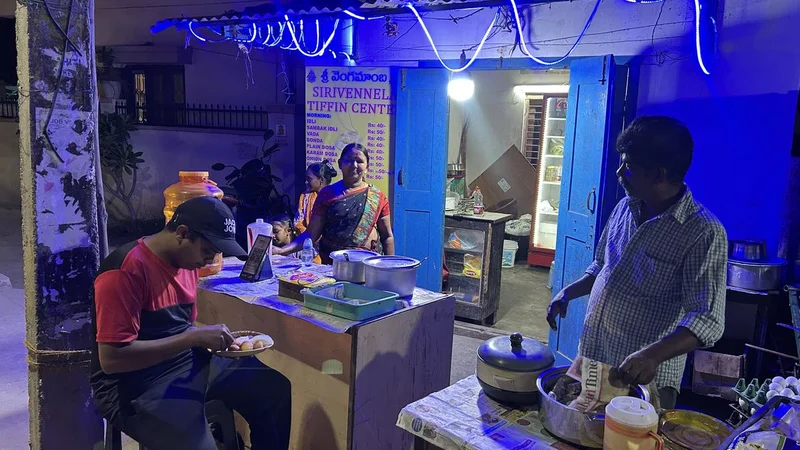
Chenna Krishna Amma, along with her husband, runs Sirivenella Tiffin Center from a rented shop near Lingampalli railway station. They moved from Andhra Pradesh five years ago, joining their son who was already working in Hyderabad. As their family grew and finances became tight, they rented a shop for ₹7,000 a month and started serving South Indian breakfasts to daily commuters.
Their customers are mostly travellers and students from nearby schools who stop by after classes. They served only South Indian dishes at first, starting at ₹40 for a plate of idli and dosa, and later expanded the menu with pakoras and other items for the same price as evening snacks.
Their son Ashok, who manages the shop on Sundays, wants to help popularise the kitchen founded by his parents. Their rule is simple: everything is made fresh, and nothing is kept for the next day.
Trust is what makes customers come to these kitchens. They are not typical restaurants or regular tiffin services. These are families that brought their food traditions to the city. The kitchens that serve homesick students also feed IT professionals who have been living in Hyderabad for years, but still find that the food that reminds them of home is made by someone who also came from another city.
(The writer is an intern)
Published - July 30, 2026 04:47 pm IST