The WNBA media suddenly wants everyone to stick to basketball.
Well, some members of the WNBA media do. Just not until they’ve decided which players are allowed to speak and which answers are acceptable.
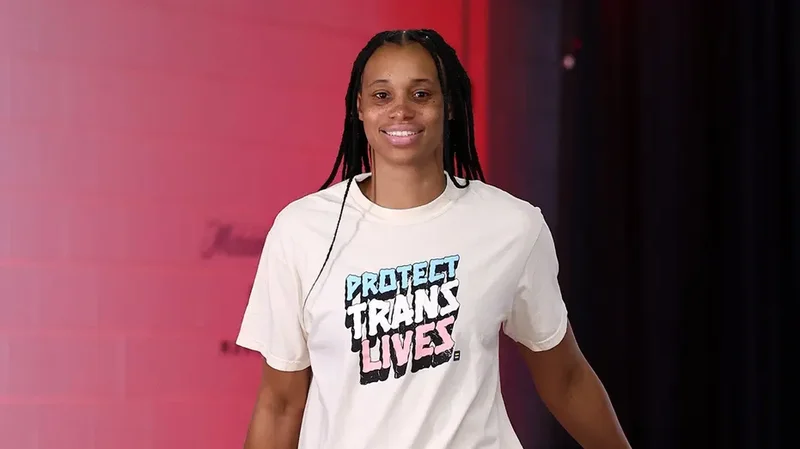
The contradiction was on full display Tuesday night in Seattle, where Storm center Stefanie Dolson arrived for a game against the Indiana Fever wearing a shirt that read, "Trans rights are human rights."
Nobody needed help connecting those dots. Dolson wore the shirt one week after Fever guard Sophie Cunningham publicly opposed allowing biological males to compete in women’s sports.
The Storm then promoted Dolson’s shirt on its official social media accounts, adding three speaking-head emojis to make sure no one missed the message.
After the game, a credentialed member of the WNBA media attempted to question Fever coach Stephanie White about a pregame demonstration outside the arena supporting Cunningham’s position.
Except the "reporter" didn’t frame it as a demonstration supporting women’s sports. She called it an "anti-trans rally" and said Cunningham’s comments had "ignited right-wing and anti-trans supporters."
That’s not how you phrase a question when you’re genuinely interested in hearing the answer. It’s a political statement with a question mark tacked onto the end.
That’s not journalism. It’s activism with a credential.
An Indiana Fever public relations representative eventually interrupted, explained that neither Cunningham nor the organization had anything to do with the demonstration and said the team was focused on winning basketball games.
"Any more basketball questions?" the spokesperson asked.
In that particular moment, it was a fair response.
My colleague Jackson Thompson has the full story on what happened in Seattle. But Tuesday night was really just the latest example of a much larger trend surrounding the WNBA.
The people who spent years celebrating politics as an integral part of women’s basketball suddenly want to recenter the conversation on basketball.
Funny how that works.
Chiney Ogwumike wants a reset
Former WNBA player and current ESPN analyst Chiney Ogwumike delivered that message during a recent appearance on "First Take," one of ESPN's most prominent daily shows. So, this wasn’t a throwaway comment on a WNBA-centered podcast with a tiny audience. Ogwumike was speaking on one of the biggest platforms in sports media.
She said it was "time to reset the conversation" around Clark and the WNBA.
"This conversation has reached levels that stray so far away from the sport," she said. "And I feel like it is our responsibility now to recenter it."
She argued that ESPN’s programs "have a choice" about which stories they give airtime and said the focus should be on the "beautiful basketball" being played during the league’s 30th season.
Ogwumike is right about one thing: ESPN programs have a choice about which stories and narratives are presented to the audience.
The problem is that the network spent years using that power to promote the WNBA’s progressive politics. Ogwumike regularly helped it do so.
In 2020, Ogwumike went on ESPN to defend athletes using their platforms to advance political and social causes.
"The reason why you see athletes leading the charge when it comes to social change is because it’s in our DNA," she said.
Ogwumike also argued that "all lives cannot matter unless Black lives matter equally." Huh, that's interesting.
In 2020, Ogwumike was all for athletes "using their platforms" to advance left-wing and progressive causes. She didn't tell players to stick to basketball. In fact, she presented activism as a natural extension of professional athletics.
A year later, Ogwumike served as an executive producer of ESPN’s "144," a documentary about the 2020 WNBA season that prominently celebrated the league’s social activism and political organizing.
Ogwumike acknowledged on "First Take" that she hasn’t "been perfect" in handling the current conversation. That’s fair, and at least she showed some self-awareness.
But let’s be honest about what’s happening here.
Ogwumike doesn’t believe sports and politics should remain separate. She’s made that clear for years. What she really believes is that this particular political discussion has become distracting and damaging.
That’s a reasonable position, but it raises an obvious question: Where was all this concern about recentering the conversation when the WNBA’s politics flowed exclusively in a progressive direction?
ESPN didn’t spend years reluctantly covering political activism that players forced onto its airwaves. The network celebrated that activism as one of the WNBA’s defining qualities. Now Ogwumike is using ESPN’s signature show to argue that ESPN should become more selective about what it amplifies.
Apparently, editorial restraint became important only after the political conversation escaped the boundaries ESPN preferred.
Angel Reese is ready to move on
Then there’s Angel Reese.
During Toronto’s July 17 game against Atlanta, Tempo coach Sandy Brondello complained that Reese was being treated like a "protected species" by the officials.
Brondello is Australian, where the phrase is commonly used in sports to describe a player who receives favorable treatment from referees. But Reese took offense, posted the comment on social media, tagged Brondello, added a clown emoji and wrote, "ARE WE SURPRISED?!"
The situation quickly became a national controversy about race and discrimination, largely because Reese deliberately framed it that way. Brondello apologized, explained what she meant and received a one-game suspension from the WNBA.
Reese thanked the league for taking action and said she was grateful everyone could now "move on from the situation and just play winning basketball."
Notice a pattern?
Reese didn’t object when an overheard complaint about officiating became a cultural controversy. She publicly amplified it and made sure an officiating complaint was viewed through a racial lens.
Once the league accepted Reese’s interpretation and suspended the coach, though, it was time to stop talking and get back to basketball.
That’s increasingly what "get back to basketball" appears to mean around the WNBA.
First, arrive at the approved conclusion. Then end the conversation.
ESPN also published a lengthy All-Star Weekend feature lamenting how controversy had swallowed the league. The story quoted a Chicago Sky season-ticket holder saying, "politics has killed my hobby," and ended with another fan wishing everyone could "get back to the game."
To give a quick peek behind the curtain, reporters don’t select quotes like those by accident. The writer used two fans to reinforce the idea that people around the WNBA are exhausted by politics and desperate to get back to basketball. Whether that sentiment is actually representative of the league’s fans is another question.
Yet the same story acknowledged the WNBA’s long relationship with Democratic politicians and declared that the WNBA is never completely devoid of politics.
Well, which is it?
Is politics an essential part of the WNBA’s identity, or is it an unfortunate distraction from basketball?
The answer seems to depend entirely on who’s doing the talking.
The WNBA made politics part of the product
Politics didn’t suddenly invade the WNBA because Caitlin Clark became famous or because Sophie Cunningham expressed an opinion shared by the majority of Americans.
The league made a conscious decision to integrate political and social activism into its product.
The WNBA launched an official Pride initiative in 2014. Two years later, the NBA and WNBA became the first professional sports leagues to march and enter a float in New York City’s Pride parade.
In 2016, Lynx players wore shirts referencing Philando Castile, Alton Sterling and Black Lives Matter. Soon after, players from the Indiana Fever, New York Liberty and Phoenix Mercury wore similar shirts, prompting the league to fine those teams and players before rescinding the penalties following backlash and promising to work with the union on player expression.
Then came the 2020 season.
The WNBA and its players’ union launched the Justice Movement and created a Social Justice Council. The league placed Black Lives Matter on its courts, honored Breonna Taylor on player uniforms and said the council would drive conversations about race, voting rights, LGBTQ advocacy and gun control.
This wasn’t a handful of individual players expressing their personal opinions.
It was an official league initiative built directly into the season. The council wasn’t limited to broad appeals for fairness or equality, either. It entered specific policy debates, including gun control.
Players then moved beyond social advocacy and entered a partisan election. WNBA players across the league wore "Vote Warnock" shirts in support of Democratic Senate candidate Raphael Warnock, who was challenging Republican Sen. Kelly Loeffler, then a co-owner of the Atlanta Dream.
Players are free to advocate for political candidates. But when they use nationally televised WNBA games to do it, they can’t later pretend outsiders were responsible for dragging politics into women’s basketball.
Once these players endorsed a political candidate inside WNBA arenas, the argument that politics had no place in women’s basketball was over (if it wasn't already).
The league wasn’t shy about any of this.
In 2024, the WNBA used its Commissioner’s Cup to promote civic engagement and "reproductive health" advocacy.
Bethany Donaphin, then the WNBA’s head of league operations, called it "the most progressive league in professional sports."
"So really, why wouldn’t we use one of our marquee league events to address important social issues?" she asked.
Fine.
But the WNBA can’t use its marquee events to advance progressive causes, celebrate players for influencing elections and market activism as a central part of the league’s identity, then become offended when conservatives, Republicans or players with dissenting opinions enter the conversation.
The league told everyone politics belonged in the WNBA.
It was telling a half-truth. What it really meant, as we're seeing now, was that progressive politics belong in the WNBA.
Political disagreement isn’t abuse
There's an important distinction to make.
Some WNBA players have dealt with harassment on social media. That’s wrong, although it’s hardly unique to them.
Online trolling is bad. Please take a moment to applaud my bravery for saying that.
OK, now we can continue.
Just because online trolling exists doesn’t make every criticism of the WNBA racist, every political disagreement, harassment or every question from Congress a threat.
The league’s defenders constantly lump those things together because it’s easier than answering legitimate criticism. It allows them to say that anyone who challenges the WNBA’s preferred narrative should be dismissed as a hateful bigot.
Sorry, but it doesn’t work that way.
Caitlin Clark brought millions of new viewers to the WNBA. Those viewers don’t all share the politics that dominated the league and its media coverage before she arrived.
Conservative media started paying attention, Republican lawmakers began asking questions and Sophie Cunningham challenged progressive orthodoxy from inside the league.
In other words, the WNBA’s political conversation became more diverse.
Suddenly, the league that never stops preaching about diversity wasn't so excited about having a more politically diverse fan base.
The league’s own website still invites fans to learn how the WNBA is "#MORETHAN basketball."
Great. Be more than basketball.
But the WNBA and its media supporters can’t spend years celebrating that identity, then demand "basketball questions" because someone from the other side finally got a word in.